
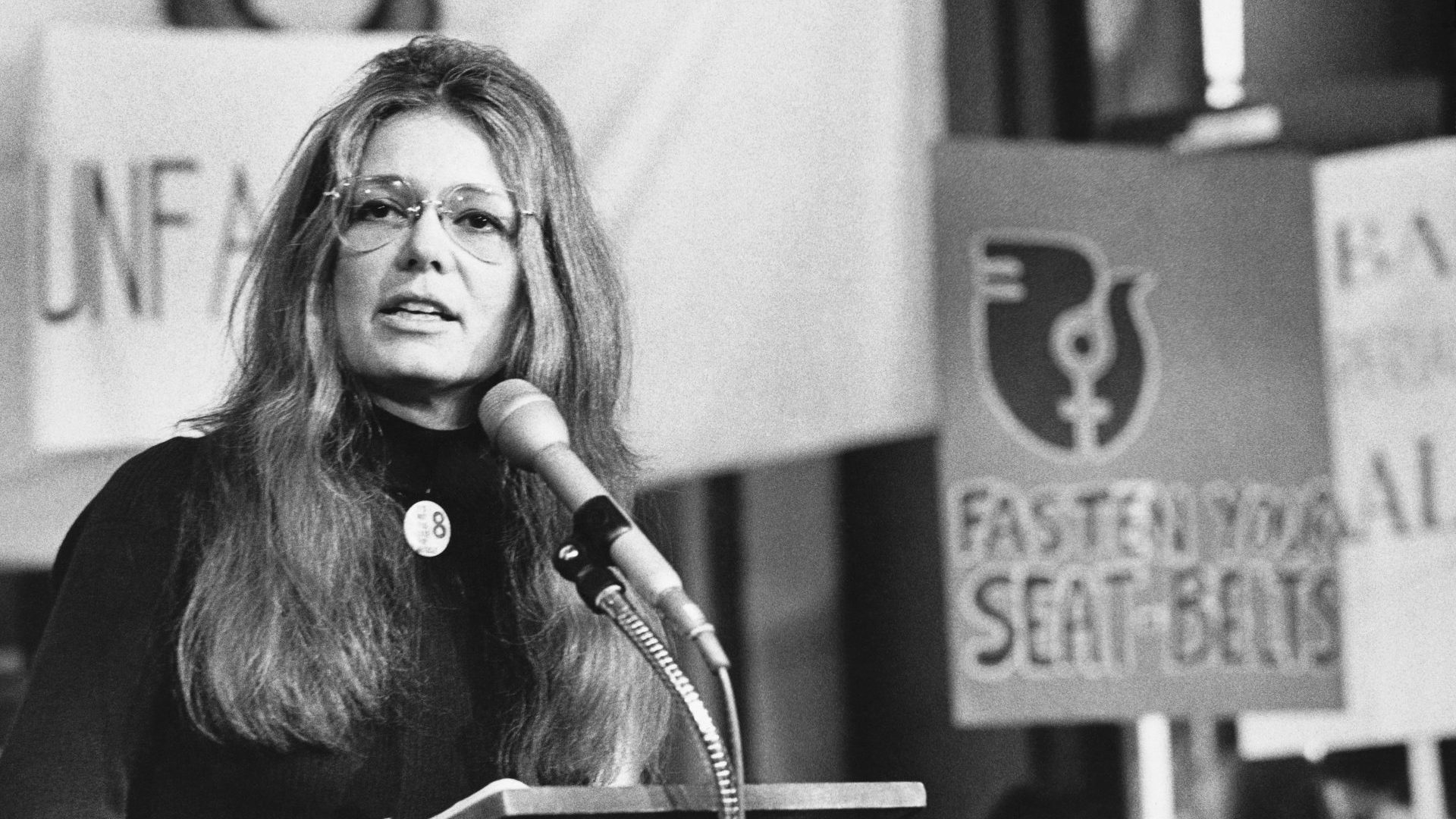
For a brief summer when I was 16, I tried to wear my wire-framed glasses over the front strands of my hair. It looked crap, but I was in love.
I had just watched Mrs America and found myself utterly enamoured with Margot Martindale’s Bella Abzug, Tracey Ullman’s Betty Friedan and, most of all, Rose Byrne’s Gloria Steinem.
Imagine my delight when I started reading the words and watching the interviews of the real women behind them. Their writing, their arguments, their political lives and, most importantly, their sheer refusal to shut up, have shaped my own feminist journey more than I can say.
Gloria Steinem died this week, aged 92, and almost immediately the obituaries appeared from publications across the world, everyone producing the familiar liturgy of a great life: journalist, activist, one of, if not the, defining figure of second-wave feminism.
We are now into the fourth wave of feminism, where the concept, and even the word feminism is less an ideology than something to be bandied around like a warhammer, smashed over any concept in order to justify or demonise it.
But Steinem’s feminism had profound real-world effects. It helped bring abortion, contraception, sexual harassment, domestic violence, unequal pay and the Equal Rights Amendment into the political mainstream. She also co-founded Ms. magazine, and the National Women’s Political Caucus.
Imagine my surprise, then, when my X algorithm – unlike the seemingly endless streams of rightly deserved memorials to the also recently departed Dolly Parton – was full of young leftists, many of them women, treating Steinem’s death with indifference, bordering on satisfaction.
Apparently she was guilty of not being intersectional enough, being insufficiently radical, and, most bizarrely, being a CIA asset who had been tasked with subverting feminism away from class analysis.
Suggested Reading

Goodbye Dolly Parton, my favourite feminist and ultimate ally
There is, to be fair, a historical basis for the “she was a fed” claim: in the late 1950s, Steinem was involved in anti-communist student organising connected to CIA funding. But hardly a sleeper agent for Big Government. I suspect the mainly leftist men haranguing people for paying tribute to Steinem over this are practising little more than thinly veiled misogyny.
But many women have been quick to point out that Steinem was not perfect. Nor, I rebut, was almost anyone who has ever actually attempted to change anything.
Like many progressive movements, this is a simple case of feminism tearing itself up from the inside. And it’s not like the feminists of the 70s didn’t do that either. But you cannot disavow everything Steinem and her contemporaries’ activism achieved for women’s rights simply because they were “liberal” feminists (a dirty word these days) – especially when we currently seem to live in a time when feminism of any meaningful sort is increasingly difficult to find.
Steinem’s passing feels like the end of one of the last remaining eras of the twentieth-century freedom fighter. Most of the titans of second-wave feminism are dead now. And they’re leaving us at precisely the moment when we need them most.
Two parts of Steinem’s work, in particular, feel remarkably prescient now. Firstly this quote: “A liberated woman is one who has sex before marriage and a job after.”
We now seem to be in an era where women are increasingly being told to strive for the opposite. Right-wing manosphere and incel content creators continue to push sickening rhetoric about women’s purity, obsessing over body counts and sexual history.
Meanwhile, tradwife content is being pushed onto young girls’ screens with the message: “Hey, why would you ever want to work a silly job when you can bake bread and raise nine children and be financially dependent on your husband? I do it all in pastels!”
The other part is her focus on sex work and pornography. In 1963, Steinem went undercover as a Playboy Bunny and wrote “A Bunny’s Tale”, exposing the reality behind the glamorous image of the Playboy Club. And then there is Linda Lovelace, who became one of the most famous porn stars in the world after starring in Deep Throat, but later said that she had been coerced and abused by her husband, detailed in an expose published by Steinem.
Her steadfastness in emphasising the gap between the fantasy of female sex work and the reality of the conditions in which many women actually work is a discussion I feel we are increasingly not allowed to have as feminists today.
The rightful insistence that we support sex workers has, in some circles, turned into the rather strange idea that all sex work is inherently empowering, non-exploitative and central to women’s liberation. Never mind that often this discourse centres on middle-class, first-world women who choose to make a few quid on OnlyFans, rather than the millions of sex workers in the Global South who are trafficked, coerced and mistreated on a daily basis.
I once got some furtive glances at a feminist book club meeting when trying to debate a passage in de Beauvoir’s The Second Sex about whether sexual liberation in sex work can still exist within a patriarchal society. I was also once told by an editor of a supposedly radical feminist magazine that I could not write about Andrea Dworkin because she was “too radical”.
And this, basically, is the point. The second-wave feminists of the twentieth century had their flaws, they excluded people, and fought among themselves. But they were having meaningful debates about what liberation actually meant, and then going out and trying to make it happen.
They did not always say or believe the same things as you do about pornography, transgenderism, economics or any number of other issues. But if you are a woman who writes, a woman who has sex for recreational purposes, or simply a woman who likes expressing her opinions in public, let’s keep a little bit of perspective.
Suggested Reading
The women in pink who stand with Lindsay Clancy
A story that has cropped up again and again in tributes to Steinem is that, in the introduction to her recent memoir, she thanks the doctor who illegally performed an abortion on her at age 22. He made her promise that she would “do what you want to do with your life”. And what she did with her life was to concretely, through her activism, make the lives of millions of women across the world better, in one way or another.
But their work, and our work, is far from over. Everything from reproductive rights, female genital mutilation, sexual violence, medical misogyny and femicide are fights that are very, very far from being won.
Instead of modern women burying our heads in the sand, fighting over microscopically insignificant discourses, maybe we ought to take a few leaves out of the likes of Gloria’s books – and perhaps, let’s start actually reading them.
So goodbye, Gloria. Thank you for fighting, for arguing, for being difficult. I’m sure we all have plenty left to fight about. But perhaps we could start by remembering that we are, at least in part, standing on your shoulders.
 Most popular


My truly deranged encounter with Trump apologist Kellyanne Conway

Suella Braverman’s book has sold only 106 copies. This is why


The moral depravity of Robert Jenrick

Hungary’s lesson to the world: Populism isn’t permanent