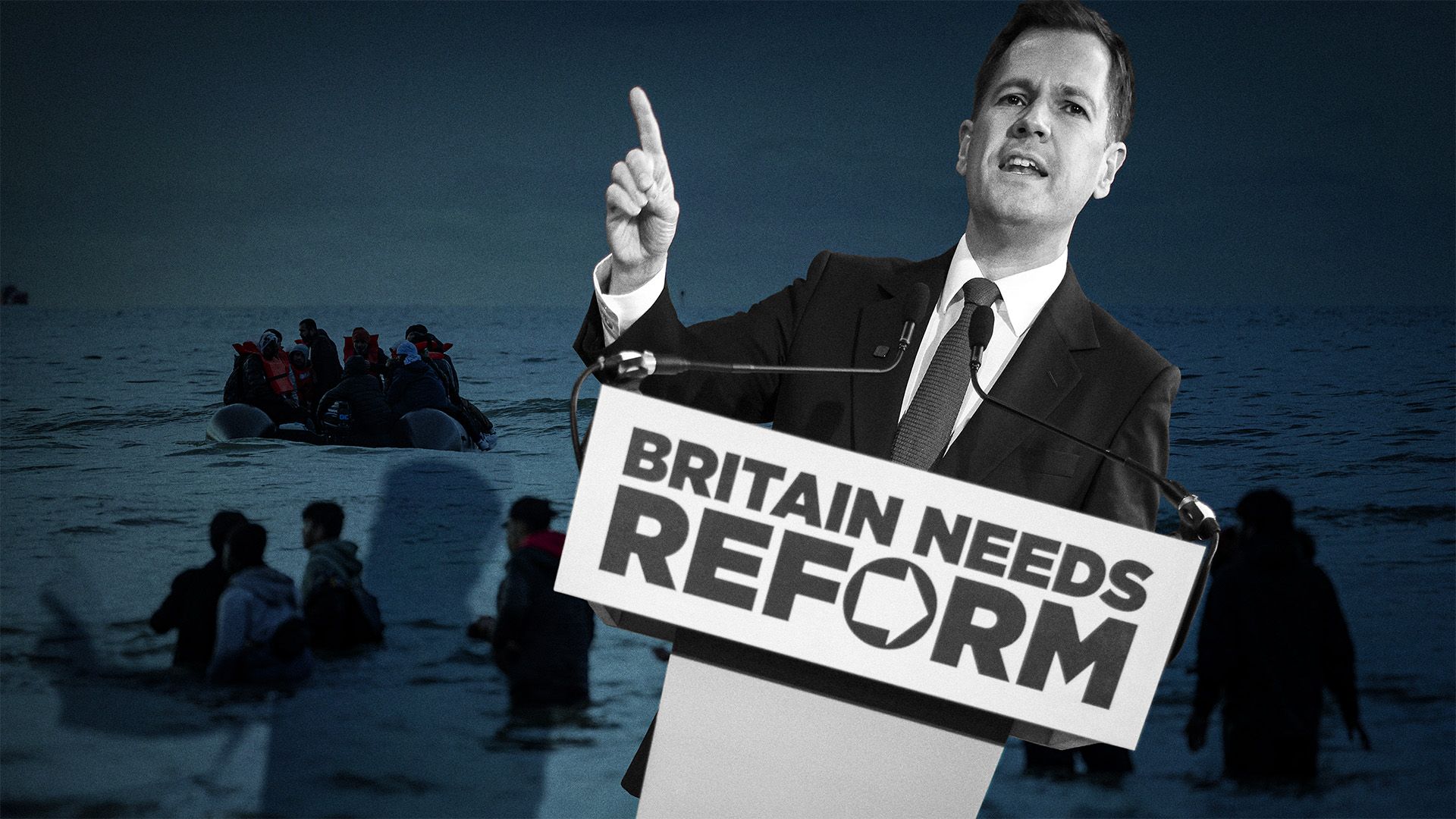
“Deploy the Royal Marines into the Channel. If they need to use lethal force then they’ll be able to do so, I think the problem would come to an end within a matter of days”.
Robert Jenrick’s comments on Talk TV sparked a chorus of disapproval. The Labour peer Alf Dubs, a child refugee himself, called it “horrifying”. Former defence secretary Ben Walles was among many who pointed out that the armed forces could not be directed to commit murder at sea, and should refuse an illegal order to commit war crimes.
When Nigel Farage responded, he rather implausibly claimed that Jenrick had done nothing beyond reiterating that the armed forces retain the right to self-defence if attacked.
But how had it come to this? It seemed one of the strongest signals yet of how online radicalisation is shifting the “Overton Window” in Britain. The immigration and asylum debate is being pushed ever further right, beyond the idea of simply shutting the borders and mass remigration towards the overt contemplation of war crimes. Or could it be a simpler case of political opportunism?
It looks like a combination of both. Politicians can change their minds, like the rest of us. But none has travelled so far and so fast on identity and immigration as Robert Jenrick. He began as the very model of the modernising Tory moderate, so pro-immigration in his first campaign as to suggest he self-identified as an immigrant himself.

“We are all – well many of us, are certainly immigrants to some extent,” said Jenrick. “My name’s an unusual one, but I think my ancestors just caught an earlier boat than other people’s. This country’s been built by great immigrants.”
He said this while campaigning in the 2014 Newark by-election and it may have been an opportunistic pitch for LibDem and Labour tactical votes to help David Cameron’s Conservatives see off Ukip.
Jenrick even teamed up with Labour, SNP and Tory thirtysomethings to appeal to the nation’s youth. “We don’t want to be Generation Brexit,” wrote the group, arguing that the choice went beyond economics to defending an open, liberal, progressive Britain of the future from the angry intolerance of Nigel Farage’s Britain.
Jenrick was appointed to the Home Office largely as a Sunak ally, to help keep an eye on Suella Braverman. He proudly hosted a Ukrainian under the Homes for Ukraine scheme. His advocacy of our duty to Afghan interpreters led to a bitter row with his Reform rival Zia Yusuf. But Jenrick was in transition, developing ever tougher views over time.
He had a Mickey and Minnie Mouse mural painted grey at a centre for unaccompanied child migrants – though he regretted that decision after the negative headlines. His Conservative leadership campaign sought to offer the right of the party everything it wanted – but was unsuccessful, perhaps primarily on questions of personality and how authentic the new Jenrick was.
His defection to Reform has seen Jenrick among the strongest advocates of emulating Restore’s voice, rather than challenging it. He also said this week that there are “millions and millions” of British passport holders he does not regard as truly British.
One sign of the shifting right is that Jacob Rees-Mogg has now emerged as a vocal defender of basic decency in conservative politics. Rees-Mogg sees Rupert Lowe’s Restore as outside the norms of conventional politics with an ethnonationalist agenda – and Reform is deeply split on how far to follow suit.

His astute observation was that it is not now far right entryists but Farage’s converts from the Conservatives – Braverman and Jenrick – who most open Reform up to charges of ethnonationalism. The former government ministers may feel they have more to prove to their new populist party colleagues.
Kemi Badenoch’s punchy defence of foundational anti-racism norms could mark a turning of the tide – but not on immigration. Shadow home secretary Chris Philp’s response to Reform’s pledge to abolish the asylum system was that Reform had copied his homework.
Labour’s Bridget Phillipson offered a faster, stronger challenge to Jenrick than the Labour government had done in the Starmer years, calling it “disgusting” and illegal, and part of an increasingly vicious ideological “bidding war”. Have the politics of remigration and racism finally reached their peak? Much will depend on whether the government can finally offer a different vision of its own.
 Most popular

My truly deranged encounter with Trump apologist Kellyanne Conway

Is this the real reason Trump keeps falling asleep in public?

Suella Braverman’s book has sold only 106 copies. This is why

Hungary’s lesson to the world: Populism isn’t permanent