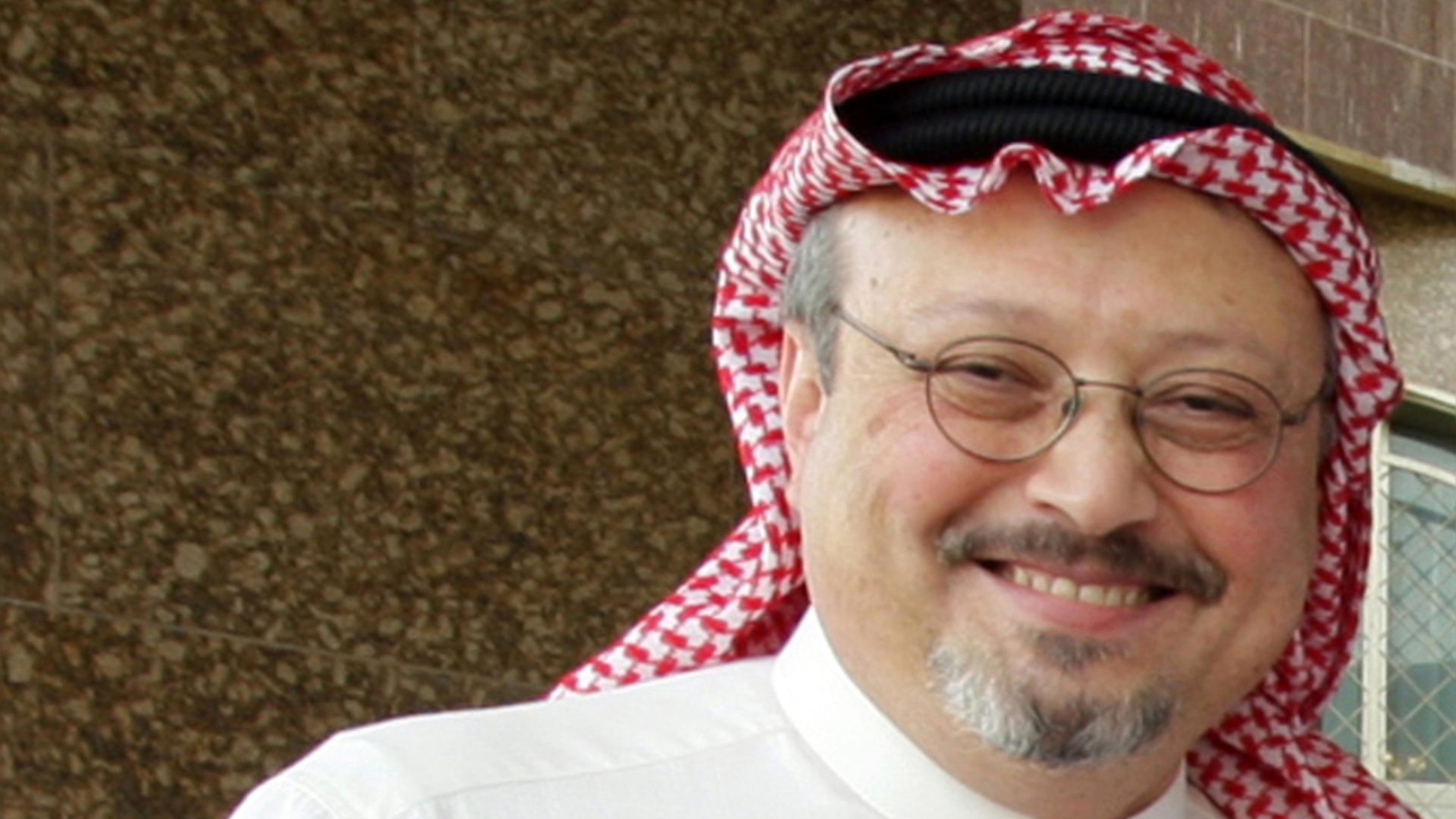
October 13, 1958 – October 2, 2018
Two girls are leafing through their father’s passport, sitting on the floor of his musty office, surrounded by old newspapers and magazines. Delighted by the geography of the stamps that cram its back pages, they ask where each is from, fascinated by countries they hope to visit one day.
Their dad, Jamal Khashoggi, tells them his stories, passing out gifts from his travels. He has instilled in them a love of books, of reading and of travel, both intellectual and physical.
“In all he read, he never discriminated, fully absorbing every opinion,” his daughters would say about him. “His love of books taught him to form his own thoughts. He taught us to do the same.”
Khashoggi was in his late 20s when his journalism career took off, his reports from the Soviet-Afghan war giving this young reporter a voice for the first time. As foreign correspondent for Asharq Al-Awsat, he travelled regularly to areas of conflict, fearlessly reporting from the front line.
Khashoggi became “a quintessential newsman who not only liked his story but also liked ferreting out what lay behind it.” He enjoyed getting close to his sources, to earn trust, to establish relationships.
Some of this “ferreting out” led him to Osama bin Laden in the late 1980s. The young Saudi fighter allowed Khashoggi to spend time with him, to document what was happening with the Soviet occupation of Afghanistan. This unprecedented access resulted in one of the first-ever written pieces about bin Laden, for a Saudi magazine in 1988.
Khashoggi, called a “huggable panda” with a twinkle in his eye by his colleagues, got on well with his occasional companion, finding bin Laden charismatic and “very humble, did not like to be the centre of attention. Did not like to be photographed.”
But as time went on and bin Laden’s views became more extreme, Khashoggi was concerned and faced up to him about the direction he was taking, as he began to “open up and develop my own flavour of free Islamist thought”.
Khashoggi had grown up in the holy city of Medina and had been religious as a student, but as a young man he found his values increasingly aligned with freer thinking, his writing nuanced, intelligent and honest. His ability to praise and then distance himself from bin Laden’s fanatical brand of Islam reflected his concern with the social over the religious. An avid movie-goer with a thirst for books, his reputation was as “a measured thinker who takes time to weigh each argument before expressing himself”.
When he was told by the Saudi Arabian state in 2017 that he was prohibited from writing and speaking publicly after being increasingly critical of the government, Khashoggi left his country of birth and settled in America. There he wrote for the prestigious Washington Post, giving a voice to his home country from far away.
He loved America, but it was never home. Saudi Arabia was still where his heart lay, and he said: “My friends and I living abroad feel helpless.” He refused to apply for asylum in the United States or to define himself as a dissident, never losing his belief that his country could change.
As one of the foremost Saudi Arabian voices of dissent in Washington, he became in demand to discuss the politics of a regime that did not want its politics discussed.
Suggested Reading
Bessie Smith: the woman who faced down the Ku Klux Klan
When he talked to his daughters about the complexities and tragedies of his own enforced exile, he told them: “some depart to remain”. In his 50s, his core beliefs never changed from those days as a young journalist when he would run into his newsroom waving his latest story in the air, to the delight of his colleagues, relishing being part of the hub of the written press.
The pieces he wrote for the Washington Post drew on the voice and experiences of his younger self, and he believed “the essence of journalism is in providing information so that people can reach their own conclusions. This is especially what Arab audiences need because they have restricted access to genuine facts.”
To ensure that Khashoggi’s life – and the manner of his death – will never be forgotten, his adopted home city named a street after him. An official unveiling on June 15, 2022 was timed precisely to start at 1.14pm, the time Khashoggi entered the Saudi consulate in Istanbul on October 2, 2018, and never came out again.
Anyone wanting to write to the Saudi embassy in Washington DC, or to visit it, now needs to use its full address: Jamal Khashoggi Way.