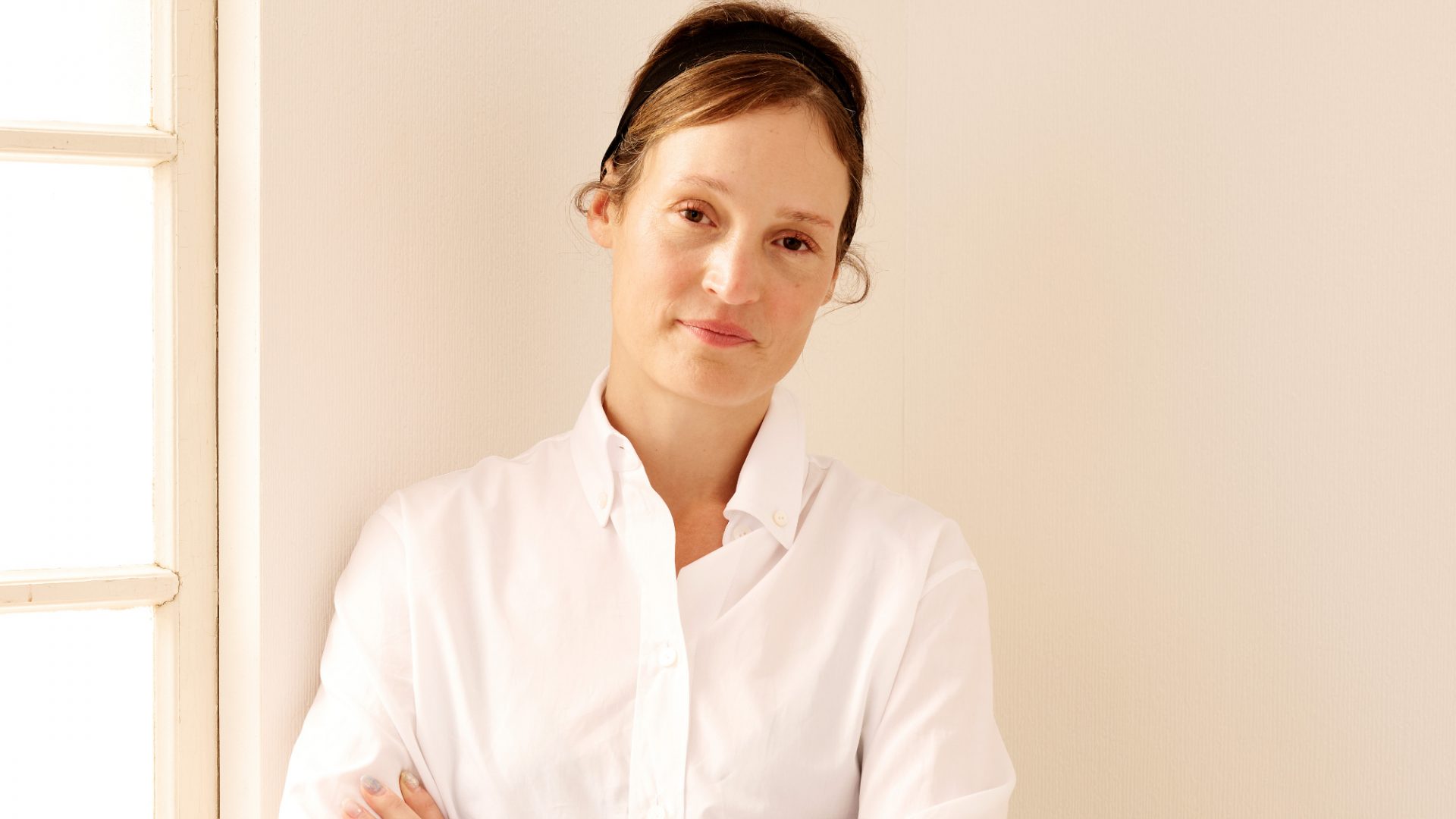
The first time I met Vicky Krieps, we were at a dinner in Locarno, and ended up talking about how recognising the possibility of failure can be liberating. When I talked to her again about her new film Love Me Tender – the story of Clémence, a mother who loses custody of her child when she comes out as a lesbian – I reminded her of that conversation and how it relates to the new film. How losing something can, paradoxically, free you.
“Exactly, there is probably nothing more scary or terrible than to step out into the world and say, ‘OK, this is who I am.’ Because you know that you’re leaving the structures society gives you to move in,” Krieps says.
“This is who you’re supposed to be, this is where you’re born, and you belong to this.
“And then, if you step out of this and you say, ‘No, I actually don’t like that, and maybe I don’t even like my family,’ you start becoming who you really are.”
This sounds very much like the young girl who once got up and walked out of her English class while they were reading George Orwell’s Nineteen Eighty-Four (to, she has said, the outrage of her teacher) because she wanted to check they weren’t living in that dystopia.
“It is always very, very scary, because you might fail,” she admits. “But the truth is: with failure you cannot lose. You cannot fail at becoming yourself, and the same is true in acting. You cannot fail in acting because the failure becomes the moment. It is very scary, but once you’re in it, that’s all there is.”
Krieps should be on the newly designed European banknotes. As Joseph Conrad writes of Kurtz in Heart of Darkness: all of Europe went in to making her.
Her mother is German and her father was the director of the Luxembourg ministry of culture. She speaks perfect German, Luxembourgish, French and English. In Paul Thomas Anderson’s Phantom Thread (2017), she won plaudits going face to face with Daniel Day-Lewis at his most imperious and besting him. This breakthrough, however, was not something that unduly impressed her.
When I ask her about playing a real person – Love Me Tender is based on a work of autofiction by Constance Debré – her response contains what sounds like a dig at her former co-star’s method: “I believe there’s only one great danger in acting: when we think we know how to copy someone, and when we think that copying someone is the big homework that we will be rewarded for: ‘Oh look at me, how well I copied someone who lives in 1850, and I speak exactly like that, or how I copied someone who has this kind of disability. Then we go: ‘Oh, great actor!’
“But actually, it’s just doing your homework. Great acting to me is something between the conscious and the unconscious; it’s something that can only happen if you’re not in control.” As Buzz Lightyear says in Toy Story: “It’s not flying; it’s falling with style.”
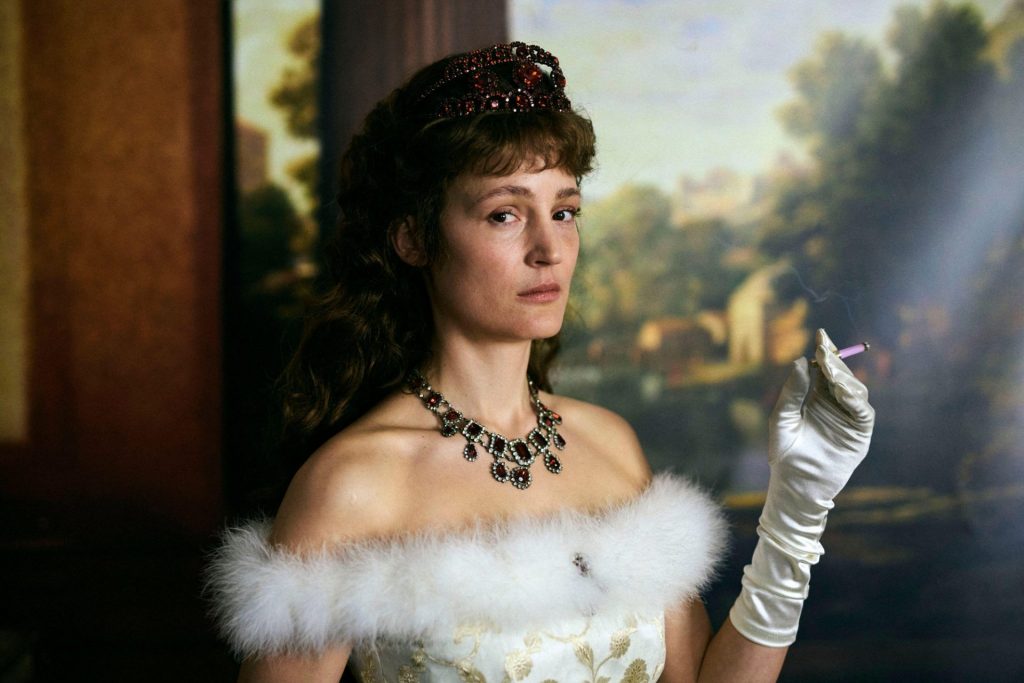
Her treatment during the promotion of Phantom Thread inspired Krieps to star in and executive produce Corsage (2022), a deliciously funny portrait of the Austrian empress Sissi, who strives to play the fame game, wedged into asphyxiating corsets, but according to her own rules.
“When I play real people, I try to not think of them, and I think of them at the same time,” Krieps says. “So, when I played Sissi or Ingeborg Bachmann, the writer, [in Ingeborg Bachmann – Journey into the Desert (2023)] I try to close my eyes and connect with whatever my intuition tells me.”
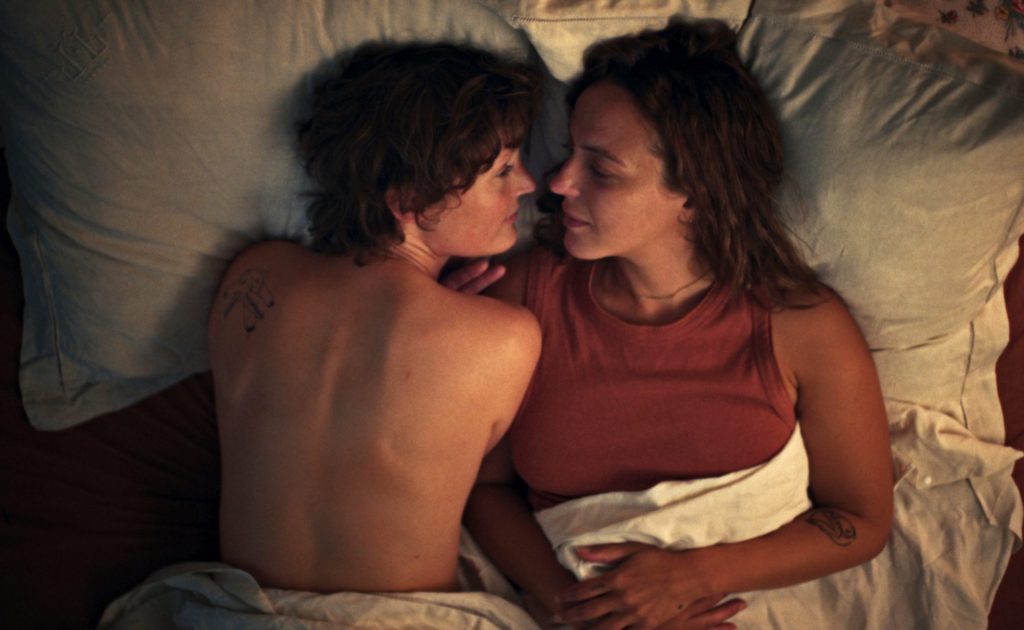
Clémence’s ordeal – her husband suddenly accuses her of corrupting their son when she comes out to him – is one Krieps can sympathise with. “I’m a mother myself. I have two kids, and I didn’t go through what Clémence went through, of course, but you know when you’re a woman and you choose artistic projects that will not bring you money, people around you will not understand.
“Someone asked me: ‘But why don’t you do a TV series in Berlin?’ – and the one she referred to is a really bad TV series. They’d never ask a surgeon ‘why don’t you open a doctor’s office next to your child’s school, so you can take them home after school?’ They wouldn’t even dream of asking that. I’ve been asked this question so many times.”
Playing a queer woman was not a first. She appeared in the adaptation of Deborah Levy’s novel Hot Milk. “I keep doing these movies. I cannot tell you why they come to me, but there’s something, I guess,” she says.
But although not an issue, it gave her pause. “I was, ‘OK… now I need this moment of scary letting go. This is unknown territory. I’m full of respect for women who love women, and who have their own way of expressing that sexuality. So, keeping that respect, yet letting go and just going for it, and just be like, OK, it is sexuality. It’s love. It’s sensuality. We all have it. We all have skin. We breathe. We feel, and then just follow that.”
Talking to the director, Anna Cazenave Cambet, she tells me Clémence’s coming-out story felt relatively unique in cinema: “There have been many, many stories of coming out, but already you see women over the age of 30 disappear from cinema. A queer woman wanting to live her life, be herself, at 40-plus, there were absolutely no references.
“Vicky could bring this real see-saw between her extreme strength and extreme vulnerability. There is also an aura of mystery. She doesn’t reveal herself in her roles, and I found that fascinating. I wanted to emphasise that with her through the fact she doesn’t speak her emotions. Her emotions are really translated through her body, and I wanted to have access to that sensitivity. I could trust her.”
In Love Me Tender, Clémence (Krieps) fights a two-year custody battle over the welfare of the estranged couple’s son, knowing with each month that passes she is losing part of his childhood. In parallel with this heartbreaking story is the character study of Clémence herself as she begins to realise herself more fully as a writer and a human being.
For Cambet, showing east Paris was an important element of the story: “The film is a sort of road trip through the city. Clémence moves an awful lot, and she becomes more and more dispossessed, literally, as she goes along.
“I myself have lived in Belleville, for 14 years, and it’s one of the most mixed areas of Paris. It’s more on the left politically. It’s more queer. It’s where most bastions of nocturnal queer life are.
“With regard to the story of Clémence, her story cages her in a way, and at the opposite end of the spectrum, the 20th arrondissement is actually set around a mound from which you get a sweeping view of the whole of Paris. It’s also less prone to Haussmann architecture, with more modern blocks of flats.
“The population is extremely diverse, it’s an area I absolutely love, and I really wanted to get away from the more classical view, American view of Paris.”
Krieps recently starred in Jim Jarmusch’s Father Mother Sister Brother (2025), in which Charlotte Rampling played her mother and Cate Blanchett her sister. In both films, motherhood is deconstructed and problematised.
“For some reason we put the love between a mother and a child in a different room,” Krieps says. “It’s like this doesn’t even require real love. This doesn’t require honest conversations. This only requires presence and cooking. That’s bullshit.
“I think we can very much love our children on eye level. We should invite our children to see who we are and then invite them to have an opinion on that. You can say: ‘It’s OK if you don’t like me, but this is who I am, right?’”
Suggested Reading

The unshakeable confidence of Julian Schnabel
Cambet agrees, telling me how she is often asked at festivals and on press junkets who is looking after her children: “No one ever asks my male counterparts about their childcare arrangements. They would never think to.”
“Motherhood is the key element patriarchy uses against women,” Krieps says. “Women are seen as beings that can give life, this one big magical thing, but they can also be all these other things. Giving birth is one part of them.
“I think men as much as women are the victims of patriarchy. I don’t even think patriarchy was in any way made for men. It was made for the machine, so the machine can run better and faster. It was the way they found to put women in a box.”
Vicky Krieps won’t be put in a box. She’s off to shoot a new version of Ocean’s Eleven, “my first coming back to Hollywood, I guess, other than the Ed Gein: Monster series, which also felt a little bit Hollywood, and then I’m doing a movie in the UK, but I have a very small part in it. And then back to small independent French movies!”
I permit myself a punch of the air, because Krieps is amazing in Love Me Tender. Among some pretty stiff competition – Renate Reinsve, Sandra Hüller – she is one of our outstanding European talents, and I can’t wait to see where she falls next.
Love Me Tender is in cinemas from August 7