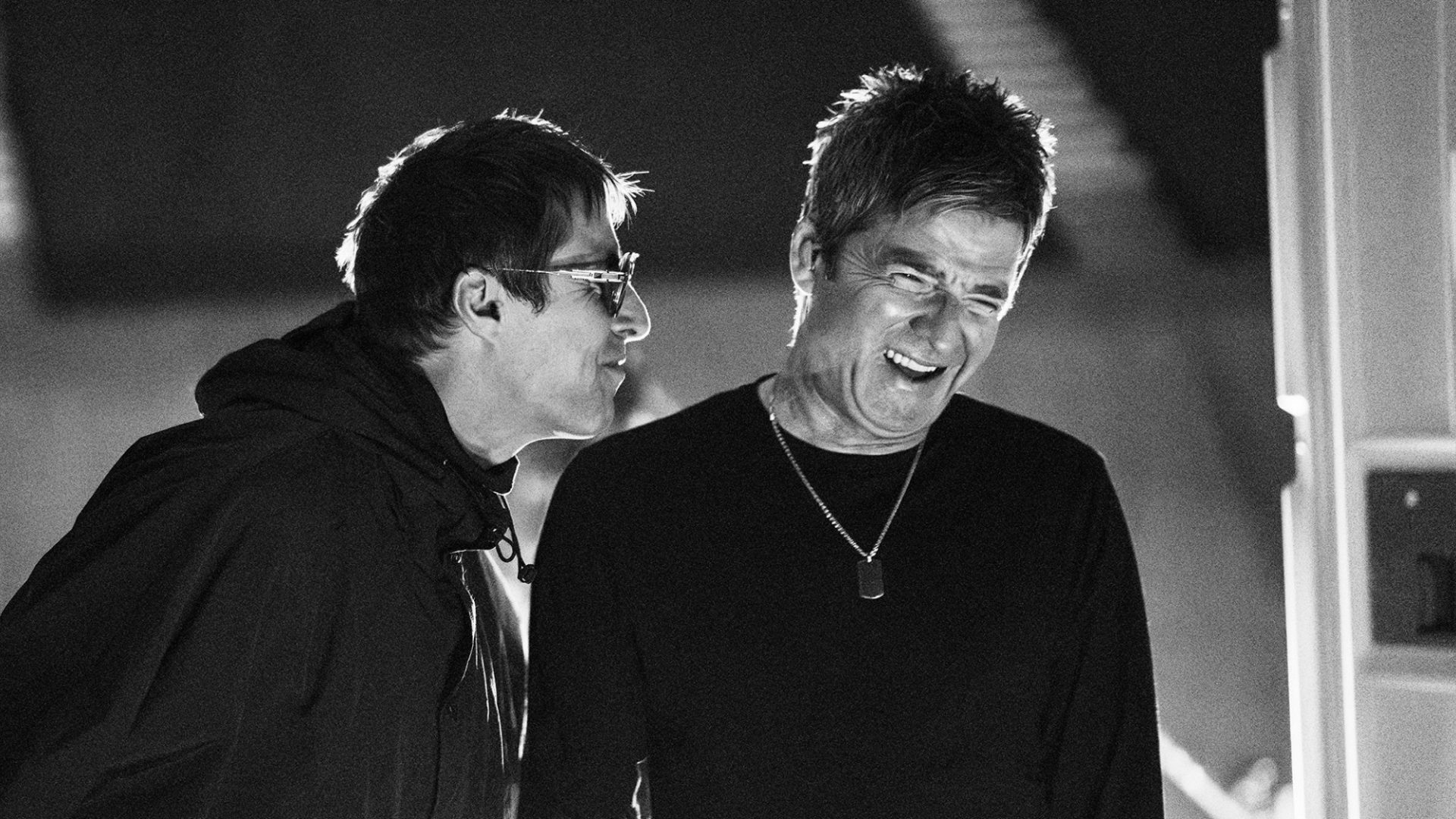
When Oasis reunited last year, for what would turn out to be perhaps the biggest reunion ever staged in music, no one was much surprised. This is what bands do, they get back together – especially those that swear they never will. It’s a formula, and one might suggest that Oasis were always very good at formula.
They did do something unexpected, however. They gave no interviews. None. The group whose fame was once as much reliant upon the combative press interviews they gave as the music they made now decided to maintain a dignified silence. It is surely a sign of the times when even Liam and Noel Gallagher no longer wish to submit their sibling rivalry to further mediation by the fourth estate. Instead, they choose to tell their stories via the medium of the sympathetic music documentary.
This autumn, Oasis will release their feature-length film, Don’t Look Back in Anger, in cinemas. Here is where we will finally get to see the latest iteration of Gallagher dynamics, played out in IMAX like The Odyssey.
According to press notes, the documentary was “created” by Steven Knight (the man behind Peaky Blinders) and so it is surely going to look epic. This is what music docs do so well: they flatter and enhance. It’s the modern way. Kylie Minogue has recently had the treatment, likewise Shania Twain (both for Netflix), as, imminently, will Katy Perry. Oasis aren’t even the only Britpop-era act to submit; in September, Pulp will release their concert/origin story film, What Do You Do for an Encore? Singer Jarvis Cocker is listed as executive producer.
What this all means is that musicians today now elect to tell their story in the same way Meghan Markle does: on a screen, in soft focus, and steering the narrative arc to show them at their very best. Which is all well and good, but what is lost amid all this ego massage? Which chapters in their life stories are not being told, or else glossed over? And how often is the most interesting material left on the cutting room floor?
“I think that the music press was a victim of its own success, to be honest,” says Toby Langley, co-founder of the music label Transgressive Records, and a documentary maker in his own right as Toby L. In 2022, he directed Knebworth 22 for Liam Gallagher, and two years later made the Blur film To the End.
In this era of often overly generous visual portraits, the latter film in particular stood out. It did not serve as a puff piece, but rather captured the four-piece in all their knotty, and occasionally abrasive, reality.
“It’s all about establishing trust,” says Toby L, “and not offering the final cut. Artists understand the need to be seen as real and relatable, and so for the documentary maker it’s important to show the full spectrum of their behaviour, their humanity. The artists I work with have always understood that intention.”
In this way, he suggests, they come to trust the film-maker perhaps more than they ever did the journalist.
“Back in the 1990s, the music press, as entertaining as it could be, was also unpleasant, sensationalist and negative – misogynistic, too. So is it any wonder,” he muses, “that artists today might be slightly resistant to give them the agency they once did?”
The only surprise here is that it took them this long to steer themselves towards a more sympathetic ear. Where, say, Amy Winehouse too often seemed like a pawn for the industry, her mental health overlooked in pursuit of maintaining fame and sustaining profit, Taylor Swift and her ilk operate more like savvy CEOs, exerting near-total control over their careers.
Case in point: when 24-year-old Billie Eilish allowed a documentary team to film her recent world tour, she employed no less a film-maker than James Cameron, and then announced that she herself would co-direct. Cameron agreed.
Suggested Reading
Dave Eggers makes the case for optimism in a post-Trump world
For the past three decades, the American documentary maker Thom Zimny has been capturing Bruce Springsteen at work. His film Letter to You (2020) was a visual accompaniment to the album of the same name, and managed to be both sympathetic to its subject and deliver something that no magazine article ever could: a penetrating look at how the singer and his band built their songs from the ground up.
“I think the power of music documentary is that it can reach further,” Zimny tells me. “It gives us the opportunity to explore the acts through archive footage and old recordings, and in the studio. This appeals to the uber fan, yes, but it introduces them to a new generation, too.”
Zimny has also made films on Elvis Presley and Willie Nelson. “When I’m working with someone,” he says, “I’m not looking to make a flattering portrait so much as I am to tell it as it is. Bruce knows that, and he realises the benefit of it, too.”
Authenticity, not gloss, is the key component of the artistically successful film, and to rescue it from mere hagiography. In the UK, some of the best examples have come from Mindhouse, the production team co-founded by Louis Theroux and his wife, Nancy Strang.
Mindhouse’s recent films on the pop acts of the 1990s – Girlbands Forever and Boybands Forever, which featured interviews with All Saints, Atomic Kitten, Take That and Westlife – revealed just how grim the reality of popstar life could be, and quite how much of themselves they had to give away in the process. These are cautionary tales.
“The aim,” Strang says, “is to tell the unvarnished truth, and we’ve always ensured total editorial independence.”
Where Theroux himself has repeatedly allowed his documentary subjects the rope to hang themselves should they prove willing (and many did), these particular films were far kinder towards subjects that actually deserve our sympathy. They did, however, make for comparably uncomfortable viewing.
“We would never want to strong-arm anyone into featuring in our films,” Strang says, “and it’s true that All Saints’ Melanie Blatt wasn’t initially keen to take part.” When it was conveyed to Blatt that she could use this as a way to reclaim her own story, she relented. “And people loved her for it.”
The rise of the music documentary is not a surprising pivot. We live in an increasingly visual world. Why read, when we can watch instead?
But while some are admirably candid, others more resemble vanity publishing. It is in these cases that something valuable has been lost. Because what’s more compelling than the whole story?
“Look, I started out in music journalism,” Toby L says, “and, personally, I don’t see documentaries as a replacement medium at all, just a different art form. Ideally, both should have their place within the cultural dialogue.
“I know of plenty of artists who consider a well-researched review, even if it’s not entirely positive, as something of value. Artists do still have humility, you know!” He smiles. “But the fact is that these documentaries provide not only a wonderful time capsule for the subjects, but can also be a major cultural event in themselves.”
And on cinema screens this autumn, none will be bigger than the Gallagher brothers’ Odyssey of returning to each other, and to the world.
The Oasis documentary, Don’t Look Back in Anger, is released on September 11