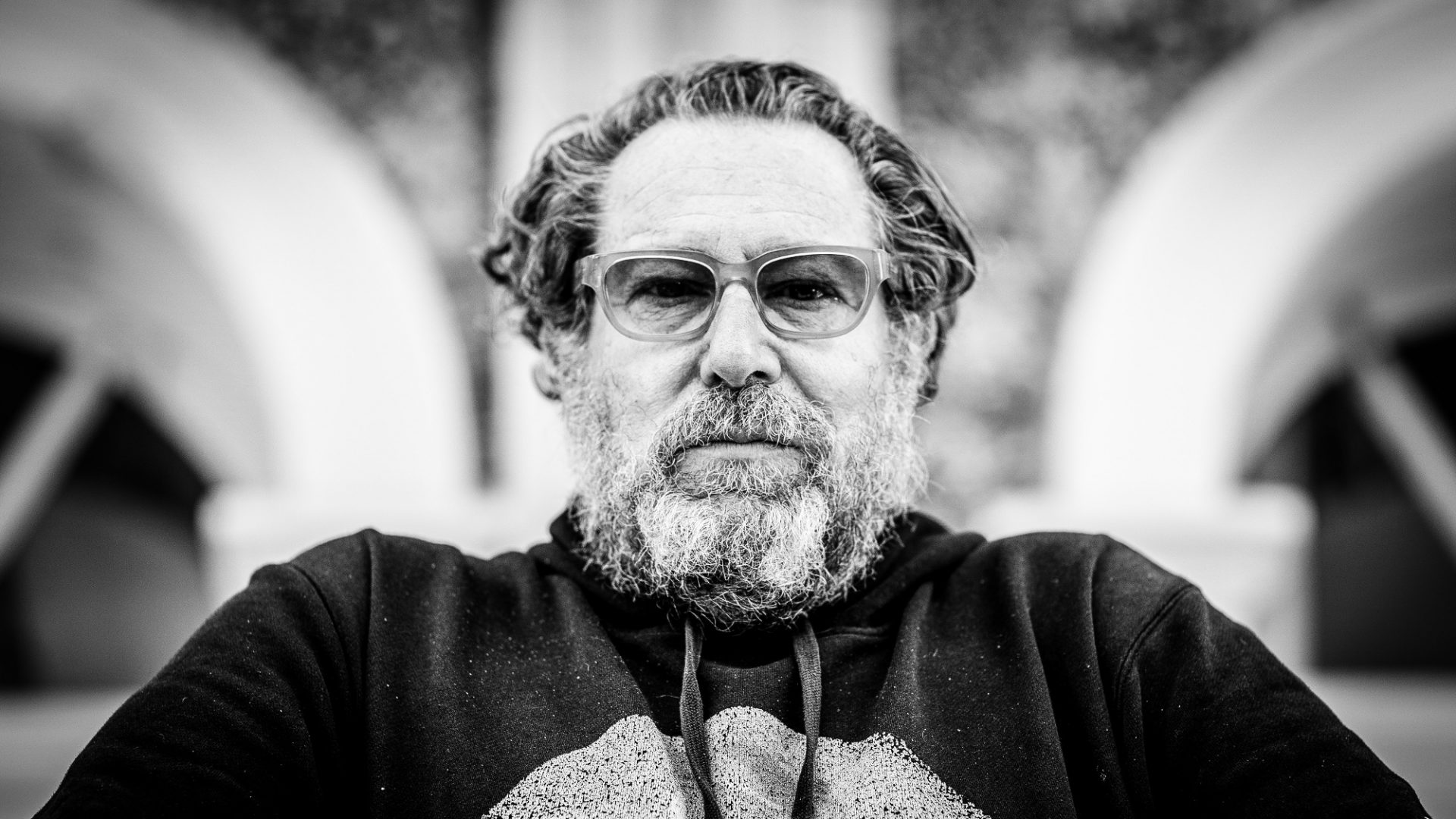
Meeting Julian Schnabel, painter and film director, the first thing that strikes me is that he’s wearing a onesie. Something between overalls and a romper suit. It shouldn’t be the first thing on my mind, but here we are.
We’re sitting on the Lido in Venice talking about the star-studded In the Hand of Dante, just released on Netflix and the subject of reviews that range from “a striking and ambitious cinematic fever dream” to “kind of a disaster” and “the most uninteresting film of the year”.
The film is a literary thriller – adapted from a novel by celebrated journalist and author Nick Tosches – and stars Oscar Isaac, Gal Gadot, Gerard Butler and Jason Momoa. It also boasts a host of cameos from the likes of Al Pacino and Martin Scorsese. It begins in the early 2000s, when Tosches (Isaac) gets caught up in retrieving a manuscript of Dante’s Divine Comedy for a mob boss (John Malkovich).
How did Schnabel get involved in the project, I ask.
“Johnny Depp and I are great friends. Johnny Depp was in [2000 Schnabel drama] Before Night Falls. He worked for free. He said, ‘put the money on the screen’. Johnny Depp is a standup guy.
“Johnny, he had this book, and he said, ‘well, what shall we do?’ And I said, ‘this is the most impossible book. This is what I want to do.”
But Depp fell out of the picture – “did the pirate stuff” – and Mathieu Amalric, who had starred in Schnabel’s The Diving Bell and the Butterfly (2007), was briefly cast instead.
“I love that film,” I said. “Thank you so much,” Schnabel smiles benignly. “I actually think that this movie is better than that movie, but it’s a lot to take, and you’ve got to watch it a few times. A friend told me it’s my most Schnabel movie.”
Schnabel is a connoisseur of his own work. “I love that movie,” he allows of Diving Bell. “Before Night Falls is pretty good also. Nobody wanted to make a movie about a Cuban homosexual they never heard of with a guy named Javier Bardem. So, I basically had to borrow the money from a friend of mine and finance it myself. That was quite a breakthrough at the time.”
It’s good to have friends. I had one who lent me a bike once.
Portraits of artists in Basquiat (1996) and At Eternity’s Gate (2018), writers in Before Night Falls and The Diving Bell and the Butterfly are natural subject matter for Schnabel, himself a celebrated artist before he turned his hand to film-making in the 1990s.
In this new film, Schnabel toys with comedy, romance and tragedy: “The thing is, it is a tragic comedy. People have been trying to do that forever. It’s serious and it’s funny, and it’s got all the stuff that life has. I mean, it’s got failure in it. Dante created a perfect work of art, but his life was a mess. It takes Nick 700 years to figure out.”
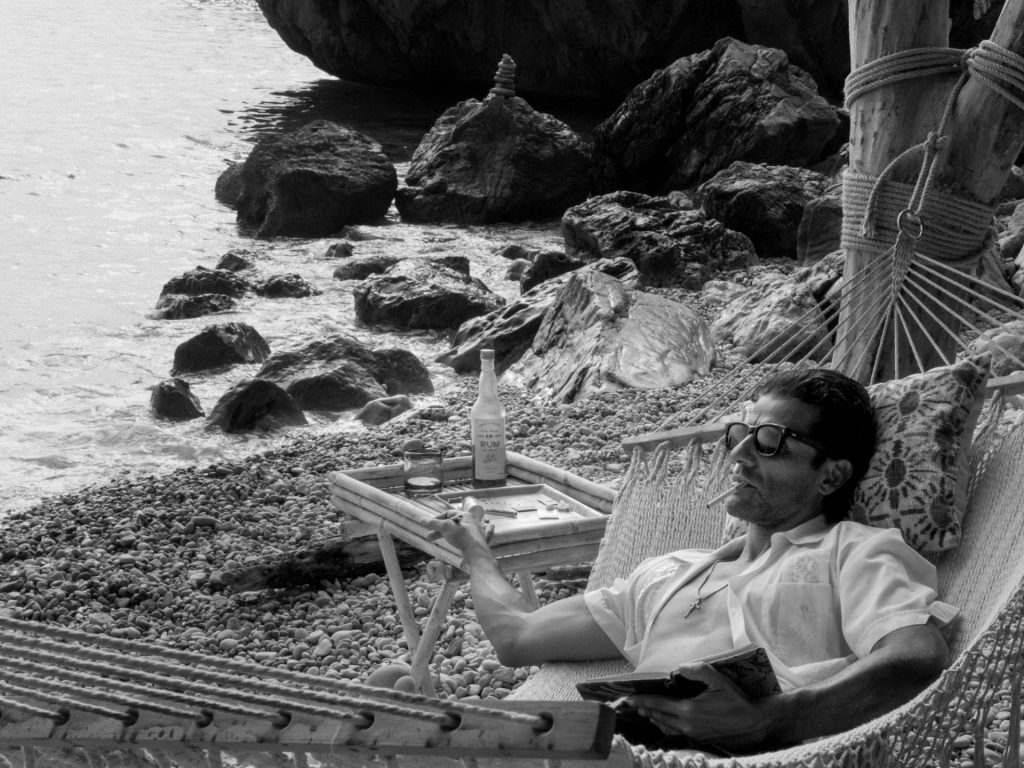
This is because the film has two parallel storylines. The 14th-century one involves Dante (also Isaac) and the other is post-9/11. I ask about Schnabel’s counterintuitive decision to film the more recent section in black and white and the earlier in colour.
“Why do the same thing that everybody else does?” he wonders, reasonably enough. “Also, I think that the gangsters in black and white look great. Like the Stanley Kubrick movie, The Killing. Also, they’re in purgatory. They’re grovelling around, trying to make money. And in the 14th century, when Giotto painted the Cappella degli Scrovegni, it’s in colour. Life was in colour in those days.”
The technique and philosophy date back to his time in the 1970s and ’80s when Schnabel produced his plate paintings, large-scale art that took on a sculpted aspect.
“I believe in the simultaneity of time, and I always have,” says Schnabel. “And so if you look at, say, the first plate painting, there’s a bunch of broken dishes on a piece of an armature. It looks like furniture, but then I’m not leaving it like that to say that’s my signature. I’m painting something on top of it. So, there’s something pictorial and there’s something physical.
“There’s a conflict between those things. If you don’t have conflict, you don’t have a story, whether it’s in a movie or if it’s in a painting, and that discrepancy is my area of interest. The juxtaposition of things, why is it in black and white and colour? Well, isn’t it nice when you don’t know what the hell is going to happen in a movie? I mean, I usually know what’s going to happen in most movies. You know what’s going to happen in the next scene!”
This film has some cast, I mean, Martin Scorsese, how did you talk him into that?
“I didn’t have to talk him into it. He and I are great friends. He loves my films. He said that I create cinematic language. I mean, who would think it, you know? I mean that he would feel that way. But I’ve always made things that are personal to me. And if I talk to art students, I say, make it personal.”
Coming to the interview, I was worried because I wasn’t that keen on the film, but fortunately it turns out that Schnabel likes it enough for the two of us. He heaps praise on his cast, and Gerard Butler’s dual performance as a hitman and the Pope is almost worth watching the film for.
Schnabel thinks it’s even better. “I think that’s probably the best performance in a supporting role that anybody is going to give this year, or any year. I mean, who is that guy? I mean, somebody thought it was Ray Winstone.”
Momoa plays a camp villain in a very large hat. “Jason Momoa is a great actor,” Schnabel says. “He can do stuff that Benicio Del Toro can do. He is like an archangel.
“Jason Momoa is an artist, and Jason Momoa actually knows about painting and is curious about painting. Now there’s a lot of actors that don’t know anything about art, that don’t go and look at paintings. He looks at them. He makes them. His parents were artists.
“I surfed with his uncle in Hanalei Bay in Hawaii, 2004 and the guy shows up, puts his arms around me, and I was like his father, and I love that he could be this guy in this movie.”
I don’t ask about Gal Gadot, because though I’m a critic, I’m not cruel and the less said the better. I feel a bit dishonest not letting on that I don’t like the film, but I don’t think it’d make a jot of difference, and Schnabel doesn’t seem particularly sensitive about other people’s feelings.
For instance, about the book on which the movie is based: “I felt like I could do something with Nick’s book… that was almost unreadable, that I could do that, and Nick was alive, and he read the script, and he loved it, so that was great for him to feel like it was passed to somebody who could carry the baton.”
We all dream of someone coming along and making something unwatchable out of our unreadable novel.
Suggested Reading


My top ten hates about online journalism, ranked
Although richly rewarded in both riches and friends and rich friends, Schnabel doesn’t care about financial success: “As a painter, I never made any money. I never, I never, I never made art to make money. Tom Waits [in the song Long Way Home] says money is something you throw off the back of a train. But the fact is that if you don’t do it for that reason, and do it to see it, not to sell it. Now here we are talking about it, and it’s important to mediate this into the world so people will see it.
“But why did I do it? I did it because I felt like I knew something about this topic, that other people or I could bring a perspective to this topic that other people couldn’t do. And so it’s worth it.”
“Why would I give a commencement speech in Houston, Texas to these graduating students?” he says, and I assume this is something that has happened. “I don’t want to go there and stand there necessarily and do that. But the fact is, if you could impart something to somebody to help free them in some way, to have a different perspective on what they’re about to do, it’s worth it.”
By the time we finish, I’m convinced that Schnabel himself is the work of art. There’s performance, there’s the material – the film – and then my mind drifts back to this onesie once more.
And it sits there. Like a symbol of something bigger. I wonder what it could be.
In the Hand of Dante is streaming on Netflix