In the backrooms of Hollywood, everyone is obsessed with Obsession and Backrooms. These two horror films, made with the combined budget of three dollars, have blown away franchise fodder such as Star Wars: The Mandalorian and Grogu and are inspiring a hundred internal memos about what the industry can learn from these upstarts.
Enamoured of the next shiny new thing, Hollywood execs will soon be scouring YouTube and TikTok for similar film-making talents to directors Kane Parsons (Backrooms) and Curry Barker (Obsession), who made their names on YouTube, making shorts and serials. The idea of Backrooms itself comes from a creepypasta meme – these are short horror stories of the urban legend type – that originally launched in a chatroom on the website 4Chan.
It exploited the indoor version of “uncanny valley”. Not animated characters that are so very nearly like us they are genuinely unsettling, but the liminal spaces of corridors, lobbies, waiting rooms, conference rooms, storerooms and stairwells, and their virtual counterparts in video games and films. The movies of David Lynch were Backrooms-style creepypasta avant la lettre.
There are some relatively obvious explanations for the success of these films. First, horror as a genre has a built-in fanbase, committed to the theatrical experience, who will come and watch films without stars – which lowers the budgets of said films.
Second, audiences are showing that they are exhausted with franchise fare. The Mandalorian… requires you to have followed two television series on a streaming platform prior to watching it. That cuts your casual audience down to a fraction of a fraction. No wonder it has scored the lowest box office of a Star Wars film yet.
Third, these creators only seem to have come from nowhere. Even though he’s the youngest director to ever make a film for the A24 studio, Parsons, who turns 21 later this month, has been producing content for years and has built up a fanbase already familiar with his Backrooms web series.
Suggested Reading

Nicole Kidman is great. But is she any good?
Likewise, Barker had previously made a short called The Chair and a comedy web series titled that’s a bad idea, which he developed into a found footage horror film called Milk & Serial. When he failed to find a distributor for it, he uploaded it for free on YouTube, which got him the deal to make Obsession.
With their motion pictures, Parsons and Barker bring along their web audiences, excited to see what their heroes can do with more resources at their disposal.
So those are three ideas that the executives will understand. It’s a “get with it, grandad” moment and quite a few YouTube directors might benefit as a consequence; directors who, like Parsons, had to have their parents sit in with them on meetings.
But there is another reason that might be overlooked in the rush to hire someone, anyone, to produce similar results. And that is that both of these films are good. And good films are a rare commodity at the moment.
The whole point of studios reviving and churning out existing intellectual property (IP) is that it’s familiar. We go to see an IP film because we like that IP already and it doesn’t necessarily have to be good, because we’re already in the cinema and have bought a ticket. Rinse and repeat.
The problem is if the audience begins to feel rinsed too often, they’ll stop going. Or, as with Marvel and Star Wars, the audience has stopped being the general audience and started being the fanbase, which, no matter how big it is, is still a fraction of the general audience.
But horror is a genre that has consistently produced good films that perform well financially. Like any other genre, there’s a lot of dross, and some critics and directors in the 2010s tried unsuccessfully to gentrify horror with the term “elevated horror”, which angered and appalled fans.
Films such as The Babadook, Under the Skin, The Witch and Hereditary were all talked about in this way, but what people really meant was good horror. They wanted to be able to say this film was good without having to say this horror film was good.
But horror has a long history of being good. Whether it’s novels such as Mary Shelley’s Frankenstein, Robert Louis Stevenson’s Dr Jekyll and Mr Hyde or Bram Stoker’s Dracula, or the short stories of Edgar Allan Poe, HP Lovecraft, or Shirley Jackson, or movies such as Nosferatu, Night of the Living Dead or Texas Chainsaw Massacre, horror leaks into our imagination like a dubious stain across the ceiling of a backroom in which we’re talking to an old man about whether he has a telephone with which we can ring a garage.
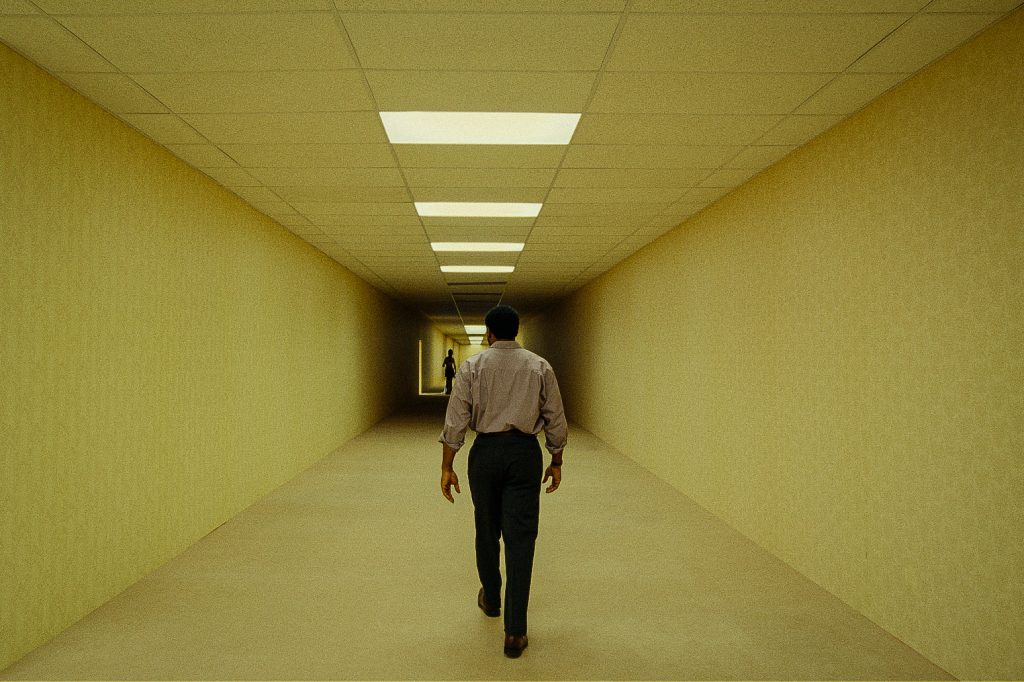
Why is Backrooms good? Clark (Chiwetel Ejiofor), who owns a furniture store, is an alcoholic recovering from a sloppy divorce with the help of Mary (Renate Reinsve), his therapist. His discovery of a suite of apparently endless backrooms in the store might at first seem like a fantasy – a Narnia-like space to explore – except for the fact it looks like it smells of carpet freshener and has the spatial logic of a drunk Ikea.
Story is not paramount in the film and, thankfully, very little will be resolved. Loose ends are exactly what we want in a story about liminal spaces.
Suggested Reading
How Na Hong-jin’s Hope brought glory to a second-best Cannes
Mark Duplass shows up briefly as a scientist resolutely determined to not give exposition. Instead, we are given vibes. Disturbing, weird vibes.
The look of the film reminded me of the Blade Runner soundtrack I bought in the 1980s. Before the film gained its cult success, Vangelis was disappointed with the music he’d produced and refused to release a soundtrack album, which led to the soundtrack being released with orchestral versions of Vangelis’s tunes performed by the New American Orchestra. Synthesizers programmed to sound like an orchestra – strings, timpani and all that – were now being replaced by an orchestra playing like synthesizers.
In Backrooms, virtual environments from video games are reproduced physically by the production designer, Danny Vermette. Chairs are piled, sofas sink into floors, walls meet at odd angles – Lovecraft would’ve had a stiffy watching this – and Escher-like spaces of uncomfortable weirdness abound. Smoothness becomes fluid; characteristics are glitchy.
Is there a deeper meaning? Is the film a vision of how imaginations are becoming turned against themselves by nefarious algorithms and eviscerated by AI slop? Or is the terror that this has no meaning?
Violence, when it happens, almost comes as a relief. We can, after all, follow a bloodstain. This is The Shining from the point of view of the hotel.
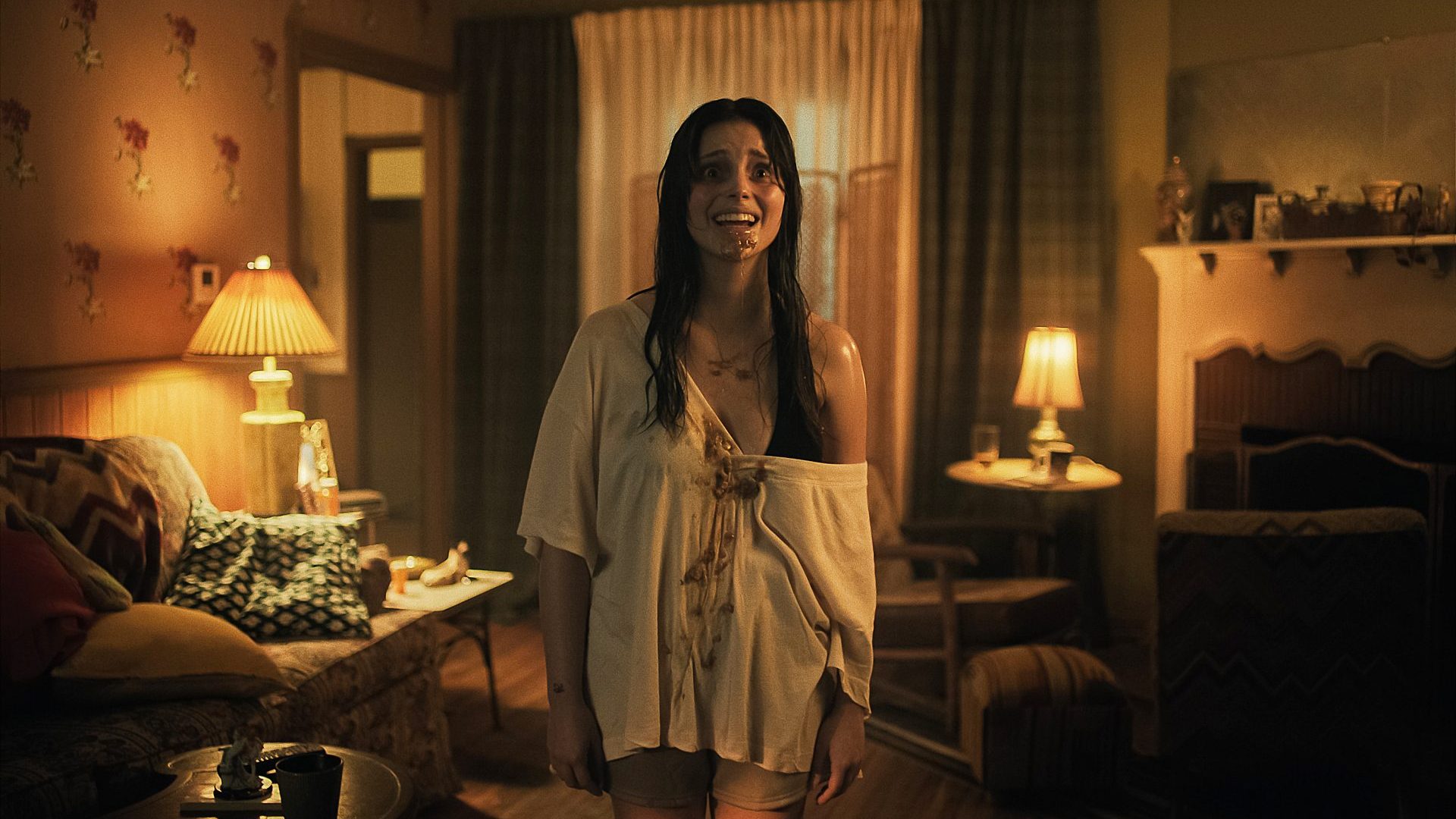
Obsession has a terrible title, which it shares with an eau de toilette. But the film is brutal in its simplicity and profound in its implications.
Bear (Michael Johnston) is an affable geek in love with way-out-of-his-league Nikki (Inde Navarrette). One night, frustrated and hopeless, Bear breaks a One Wish Willow stick he bought for Nikki as a gift and wishes that she loved him more than anyone has ever loved anyone ever.
The wish is granted. The rest of the film explores the consequences of the wish as Bear initiates a romance, nervously at first because he’s a good guy and isn’t it a bit creepy, before being soothed by a romantic montage of happy love.
As it goes on, Obsession becomes a clever and subversive deconstruction of modern notions of romantic love. The hottie and the nottie has been a template for romcoms, Woody Allen’s pre-ick career and Revenge of the Nerds-style campus comedies since Harold Lloyd glimpsed his sweetheart. It’s the asymmetrical warfare between men and women that has recently found a home in the rancid ideology of incels.

Nikki should be the fantasy, but male fantasy involves utterly disregarding her in terms of agency and consent. Are we actually watching rape?
The ugliness of male fantasies is one thing. But what about the weirdness of love itself?
We always use superlatives and exaggeration as part of the vocabulary of love: I’ll love you for ever; I love you more than anyone; we’re going to have sex all night long. All. Night. Long.
If that rhetoric were literally true, … as Marlon Brando said in Apocalypse Now: “The horror; the horror.” This is what is at the heart of all these wish nightmares. It’s not the mis-saying of the wish, or the ironic twist of the wish; it’s simply that, to missquote the Rolling Stones: “you don’t always want what you want”.
Freud said that a nightmare was a fantasy disguised, but what if our fantasies are nightmares, pure and simple? Remember when the National Lottery used to advertise with a hand pointing to a victim from the sky? That was terrifying. In Andrei Tarkovsky’s Stalker (1979), three men travel to a room in a zone where your deepest wish comes true, but the twist is: do you even know your deepest wish?
Look at me. Talking Tarkovsky about a horror film, which would be weird if Stalker weren’t itself a kind of horror film. And that’s the point: a good film is a good film is a good film. And people want to see good films: entertaining, thoughtful, original and crazy films. There’s no need for them to be necessarily horror films.
I wish there were studios dedicated to making top-class original crime thrillers (like Warner Bros used to) and comedies (which Paramount was once famous for): but while it’s horrors made by Blumhouse and A24 and others, I’ll take the win. And hopefully other studios will learn the lesson that originality trumps familiarity, and there’s no special effect like a good idea.
Obsession and Backrooms are in cinemas now. John Bleasdale is the author of the novel Connery (Plumeria)