It’s fitting in a way that the Palme d’Or at the 79th Cannes Film Festival was awarded to Romanian director Christian Mungiu’s Fjord. Like many films in this year’s competition, it’s not the director’s best.
First of all, it’s beautifully filmed by cinematographer Tudor Vladimir Panduru, contrasting the impressive Norwegian locations with the flat-lit institutional spaces the characters occupy. The performances are for the most part also impressive.
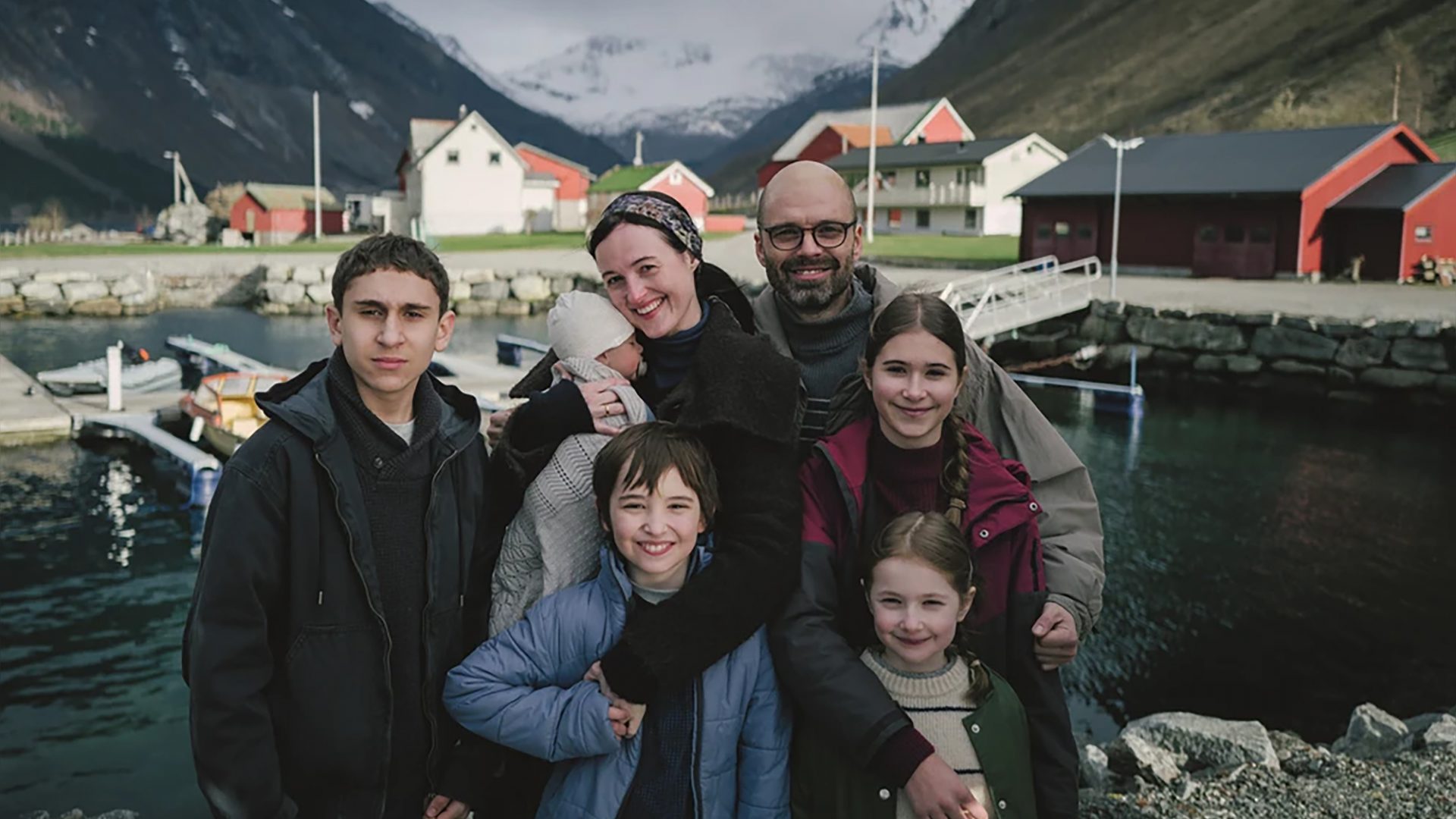
Sebastian Stan – himself Romanian-American – and Renate Reinsve play Mihai and Lisbet, a Romanian-Norwegian couple who have recently moved from Romania to a small village in Norway with their brood of children. Initially, the family is accepted with open arms and houses. The couple join the local church and the children begin to make friends at school, but when a teacher notices bruises and the children say that their parents use corporal punishment, the social services swoop in and, with a Norwegian flag flapping in the window, seize the children and place them in care, even the baby who is still being breastfed.
The family are portrayed as stoic, quietly spoken, well-educated, devoted to their religion and eminently reasonable. When Mihai loses his temper, it is brief and with dignity. Lisbet is obedient and understandably desperate to have her children returned.
In contrast, the Norwegians – with few exceptions – are seen as glib, inflexible, hypocritical, unreasonable and farcically self-satisfied. They stick to the protocol of protecting children and conflate child abuse with not sharing their values, or allowing their kids to watch YouTube. They are the Wokerati as a nation.
This manipulation makes the discussion Fjord presumably wants to spark moot. It is not nuanced; rather it feels like a provocation: catnip to the Tucker Carlsons of the world.
This kind of stuff is also irresistible to self-flagellating liberals who like nothing more than beating themselves up about how perhaps they ought not trust their own views or values. By contrast, do you notice how the right never seems to have a moment of self-doubt about their point of view? That’s what makes the Mitchell & Webb sketch about the Nazi asking “Are we the baddies?” so funny.
A supplementary but vital weakness in Fjord is the performances of the cast’s younger members. Acting for the most part in their second language of English, they are supposed to play a crucial role in showing hope in the future generation, but unfortunately fail utterly to convince.
So what film did I like?
Na Hong-jin’s Hope, a selection for the overall competition alongside Fjord, is over two and a half hours of some of the best action cinema since Mad Max: Fury Road. This time Hong-jin’s film is in competition where it thoroughly deserves to be. Snobs will contend that a creature feature with characters who spend much of its running time literally running is not worthy to be considered at the same level as boring social dramas that turn Daily Telegraph editorials into arthouse cinema… damn it, enough negativity!
Hwang Jung-min plays Bum-seok, a local police chief who finds himself fighting monsters that are attacking the small village located close to the DMZ. His lines seem to be almost all repetitions of “Ssi-bal,” like Hugh Grant fuckety-fucking through the first few minutes of Four Weddings and a Funeral. His cousin Sung-ki (Zo In-sung) is a local hunter who heads into the forest, and Squid Game sensation Jung Ho-yeon plays Sung-ae, a rookie cop who kicks some serious ass. It’s wild, kinetic, beautiful to look at and very funny. There’s also a bit of dodgy CGI that Hong-jin has promised to fix before the film’s release in two months.

Hope was one of the few films that left me feeling better after I left the Palais du Cinéma than when I went in. When this year’s Cannes line-up was announced, it felt low-key. What’s the French for “meh”? A lot of familiar names of directors whose films do well on the festival circuit but are utterly unknown to most of the public. As a freelance film critic, I felt like F Murray Abraham in Inside Llewyn Davis: “I don’t see much money.”
The big names brought second-best films; the new names didn’t break through. Three stars galore; maybe a four. Hope would be my only five, and even there I don’t trust myself.
This is a genuine problem, because we are living through turbulent times and if directors don’t respond adequately, spectators are hardly going to rush to the cinema. Iran, Gaza, the fall of the US as a democracy, the ongoing invasion of Ukraine, the looming catastrophe/panacea of AI and the onward goose-stepping of the far right… none of these subjects impinged on the art.
Celebrated Iranian director Asghar Farhadi preferred to make a film about women typing and smoking in French cafes instead of engaging with the state of his country. This obviously is his right, but his film was insipid and pointless.
There was an oblique approach to the resurgence of fascism in Europe and it’s instructive that the films are no longer dealing with the rise of fascism, but how to live under fascism, and all of them were period films. László Nemes’ Moulin and Antonin Baudry’s De Gaulle: L’âge de fer both deal with heroes of the resistance. But collaboration was getting an airing as well with Emmanuel Marre’s A Man of His Time.
The film won best screenplay and stars Swann Arlaud as the director’s great grandfather, Henri Marre, a Vichy collaborator who out of ideological belief and ambition works with the Nazis. With modern touches in glaring lighting and a pop-song driven soundtrack, this is a postmodern work of dark irony.
Bérenger Thouin’s The Golden Age seamlessly blends Pathé archive footage with fictional characters (no AI used, we must note) to tell the story of Jeanne, played with winning sympathy by Souheila Yacoub, in a decades-spanning tale of a butcher’s daughter who becomes the lady of the manor before coming a cropper when she is on the wrong side of the second world war. It’s an excellent evocation of the time, albeit tinged with complacency of its first-person protagonist.
Suggested Reading

Imagine this Lennon film doesn’t exist
The Spanish civil war is the backdrop of Javier Calvo and Javier Ambrossi’s La Bola Negra, a heightened piece of cinema that contains musical set pieces and flash-forwards to contemporary Madrid, as a young conscript in Franco’s army falls for a captured Republican who was once the lover of famed poet Federico García Lorca. The film – like every film in competition, except Paweł Pawlikowski’s Fatherland (82 minutes) – is 30-50 minutes too long. The films are windy with vastness.
A film which at least earned its length was Andrey Zvyagintsev’s Minotaur, a relatively banal crime drama that achieves profundity via its masterly craftsmanship (no one can frame a shot like Zvyagintsev) and the way it deploys the “special military operation” as a background story. It’s an irony worthy of Monsieur Verdoux and Fyodor Dostoyevsky, but the film still didn’t eclipse his 2014 masterpiece Leviathan, though it did earn the Grand Prix.
Cannes presents a snapshot of the industry and art of cinema. Following a vintage year – Sirat, The Secret Agent, Sentimental Value – there was always the chance of a dip, but a serious rethink might be needed. Closest rival Venice might well answer the questions Cannes has asked. We shall see.
John Bleasdale’s novel Connery is published by Plumeria