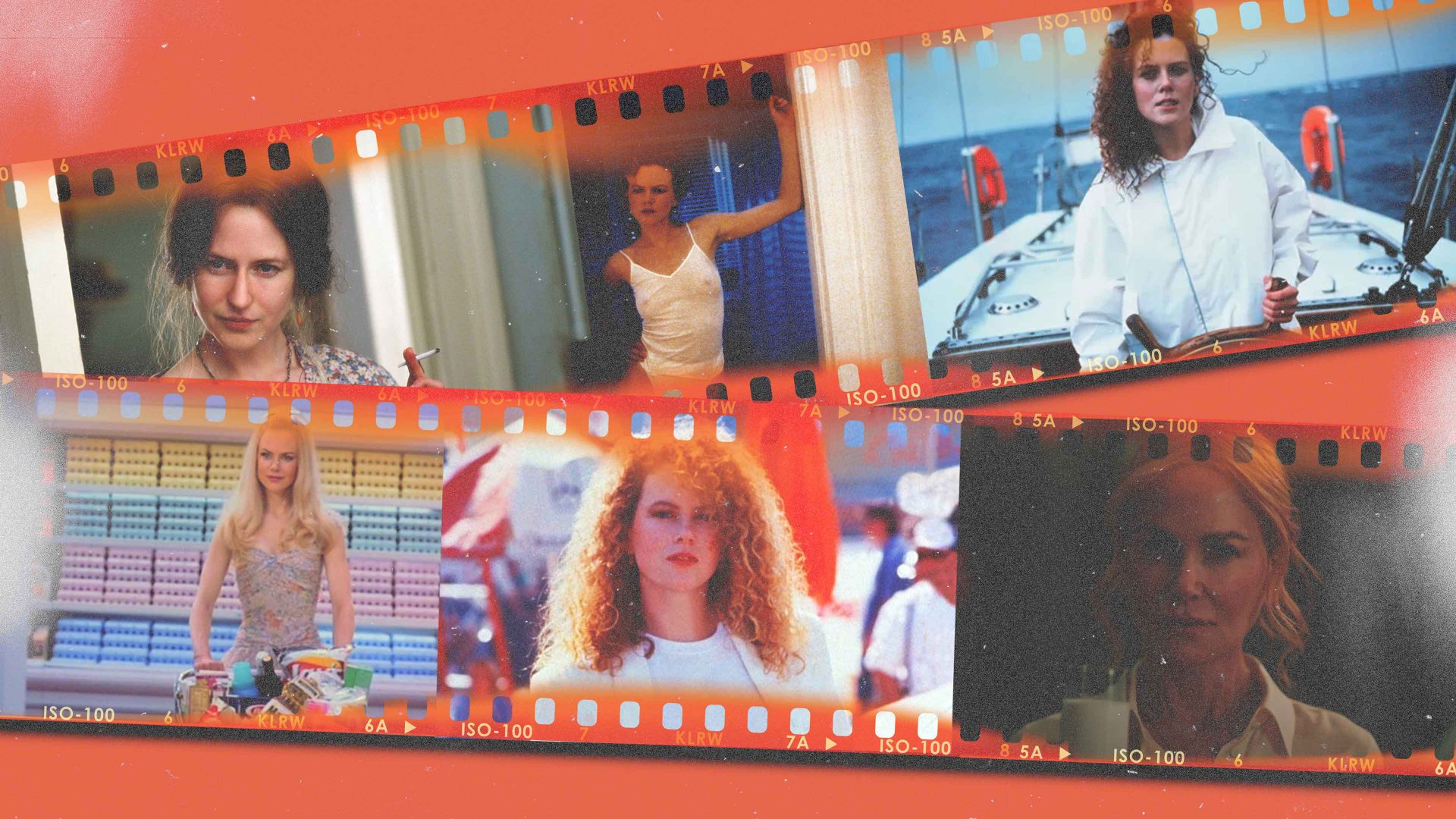
Nicole Kidman is an icon, a star, a force of nature. But although I’ll happily declare that she’s great, I often find myself wondering: is she any good? There are more swings and roundabouts on her resume than a housing estate playground in the 1960s.
Birth, you say, but Australia comes the reply. The glorious fun of Moulin Rouge, the deadly dross of Days of Thunder. The Hours won her an Oscar, but Bewitched won her a Razzie.
She is an actress who has never gone away, consistently staring at us from movie posters, fashion magazines and DVD boxes for the better part of four decades. We know her from the arms-aloft photo, supposedly taken as she left her lawyer’s office after her split with Tom Cruise. We know her for that movie star romance, played out under the intense blitzkrieg scrutiny of the paps, before she settled for years with a “really, him?” guy.
But despite what we think we know about her, there’s an unknowability with Kidman. There’s an enigma. She’s a big gay icon who supports same-sex marriage, but is a devout Catholic. She’s arthouse and romcom: a movie star and a TV star, moving seamlessly between the two.
Her power is such that she chooses her collaborators – concentrating now on female talent – and has the sway (and her own production company) to greenlight material she likes. Has this led to a marked increase in the quality of the stuff she is involved with? No, but so what? Men have created their fair amount of shit (gestures vaguely at the world).
Suggested Reading

Is Timothée Chalamet taking the piss?
Add to all of this, Kidman has recently announced that she is to moonlight as a “death doula.” Colour me curious. A quick consultation with Dr Google, and I learn that just as a doula traditionally aids – in a non-medical capacity – the labour and birth of a new life entering the world, so a death doula provides emotional, physical and psychological support to a life that is ending.
The decision was inspired by the death of her mother Janelle Ann in 2024 at the age of 84, she told an audience at the University of San Francisco earlier this year. As heartfelt and honest as her motives surely are, I can’t help but wonder if I was dying and I saw Nicole Kidman looming over me, all 5 ft 10.5 inches, it would persuade me more to hang on than to let go. I have so many questions. Why waste the opportunity by dying?
Like every famous Australian, Kidman was actually born somewhere else – Honolulu, where her Aussie parents were studying. Mel Gibson is a New Yorker by birth; Russell Crowe was born in New Zealand, though was left somewhat homeless when both countries denied their responsibility for him. The key members of AC/DC’s original lineup are all from Scotland, Hugo Weaving was born in Nigeria and I’m sure the croc in Crocodile Dundee was actually born in Barrow-in-Furness, but just claims to be from Australia because it’s good for his brand.
I discovered Kidman more or less at the same time as every other non-Australian, when she appeared in Dead Calm in 1989. Based on Charles Williams’ 1963 thriller, the novel was to have been adapted by no less a personage than Orson Welles as one of his many unfinished projects, retitled The Deep.
In the version directed by Phillip Boyce, Kidman plays Rae, a young woman who lost her child in a car accident and has gone to sea with her older sailor husband (Sam Neil) in order to heal from the trauma. Unfortunately, they come across a boat adrift, with Billy Zane’s psycho on board. It’s a superb minimalist thriller and Kidman’s aggressive, fierce performance caught the attention of casting agents everywhere.
The move to Hollywood was inevitable, and a year later she turned up in Tony Scott’s Top Gun-But Cars movie Days of Thunder. She plays a brainy young doctor who needs Cruise to explain to her how overtaking works, which he does with condom packets. It’s classy.
Cruise fell for her despite their differences. He a Scientologist; she a Catholic; she a knuckle-width from a six-footer; he, a Hobbit on a box. Together they would make Far and Away, the worst film of her career, as well as Eyes Wide Shut – perhaps her best: especially for the way it mirrored the break-up of their own relationship, with Cruise driven to fragility by Kidman’s careless, swaying self-regard.
In between those she made To Die For. She plays a local weather girl, Suzanne Stone, who becomes unamoured of her husband Matt Dillon and contrives to get local drop-outs Casey Affleck, Joaquin Phoenix and Alison Foland to kill him.
Suggested Reading
When will Quentin Tarantino shut the f*** up?
The film was written by Buck Henry (The Graduate) and directed by Gus Van Sant. The ensemble is stacked, with David Cronenberg as an Italian hitman. Kidman dominates proceedings though, with such a subtle/savage portrait of ambition and sociopathic narcissism that it’s difficult not to read something autobiographical in its authenticity.
Her first notable film had been Aussie teen movie BMX Bandits, which she appeared in at 16. By the time she was in her early 20s, she was acting with stars and becoming one. That doesn’t happen without drive.
But by a star, it was more the old-fashioned Bette Davis, Joan Crawford type of stardom she seemed to draw upon. Some of her best work was underappreciated, such as her role in Jane Campion’s Portrait of a Lady, and then she’d pay for it by appearing as a nuclear scientist opposite George Clooney in The Peacemaker, where she had to save the world while running in heels.
Kidman had a way of turning heads and creating obsessives. Stanley Kubrick was obviously prolonging the shoot of Eyes Wide Shut to become the longest in modern movie-making just so he could hang out with her more. And the minute she leaves, he dies. Was she already a Death Doula without knowing it?
When she appeared on stage in David Hare’s The Blue Room, one London critic called it “pure theatrical Viagra”. People/men go a bit strange when Kidman’s around. Esteemed film-writer David Thomson devoted a whole book to her in which you could imagine every i topped with a little heart.
When she finally kicked Cruise to the kerb, her walking-away euphoria was a fairly deadly summation of what the marriage must have been like. It was like she’d just taken the best dump of her life (Kidman now insists the photo was taken on a film set and had nothing to do with her divorce).
Hollywood kept putting her in iconic roles – Bewitched, The Stepford Wives, Grace of Monaco – when she herself was her own icon. It was like putting a tiara on a tiara.
And it was the iconoclasts with whom she most found herself in harmony. Jonathan Glazer’s Birth, considered a daft pervy film on its release, is now regarded by this writer as one of the best films of the first quarter of the millennium. Lars von Trier gave her Dogville so he could manipulate her to his own misanthropic ends, and she turned the film on its head.
There’s an amazing moment in the behind-the-scenes documentary when she rounds on Stellan Skarsgaard and Trier and gives them a dressing down for not respecting the scene they’re filming (it’s of a sexual assault.) They look like little boys, which is what, essentially, they are. Yorgos Lanthimos brought out the iciness, the survivor, in The Killing of a Sacred Deer.
And of course she was Virginia Woolf in The Hours. She got grief for the prosthetic hooter, but she was utterly superb as a woman who is talented, loved and successful and just can’t stay in the world any longer. This prioritising of a female space, female moments – those scenes with Miranda Richardson – were just a wonder to behold. To say she deserved the Oscar gives the Oscars too much credit. Do the Oscars deserve her? Do movies deserve her?
Suggested Reading
The Four Seasons is a very funny taste of the America we miss
For Halina Reijn’s Babygirl – underrated, it’s brilliant and funny – she won best actress at Venice. Now she’s all over the streaming services. Nine Perfect Strangers, The Perfect Couple, Scarpetta and Margo’s Got Money Troubles. She’s done fantasy with The Northman, and a superhero franchise with Aquaman. And she’s returning to horror – The Others was a superb chiller from the early oughts – with Osgood Perkins’s new film The Young People.
There was a time when it was accepted lore that any actress past 30 would stop hearing the phone ringing. That was never always the case – see Bette Davis and Joan Crawford, mentioned earlier. But Kidman is genuinely rewriting the rule book.
Going back to my opening question – yes, she’s great, but is she good? – I think this actually is part of her skill as an actor, part of the way she does what she does. By this I mean, we are used to actors revealing themselves, but Kidman tends to keep a panic room of space where we’re not allowed to go.
We can see the door. We know there’s something about her that we don’t know. And we’ll never know. Of course, there’s dross – Scarpetta is as unwatchable as TV can be these days – but she plays it as if it’s the BMX Bandits once more and she’s got to earn herself a right to the rest of her career.
John Bleasdale’s novel Connery is published by Plumeria
 Most popular
My truly deranged encounter with Trump apologist Kellyanne Conway

Suella Braverman’s book has sold only 106 copies. This is why

The moral depravity of Robert Jenrick
Hungary’s lesson to the world: Populism isn’t permanent