“Paint me like one of your French girls,” Kate Winslet’s Rose asks Leonardo DiCaprio’s artist vagabond Jack in James Cameron’s Titanic. Jack has been in Paris, soaking up the avant-garde. So it comes as a surprise that instead of rearranging Rose’s ears and nose à la Picasso, he gives her the semi-decent rendering of someone drawing portraits for tourists in Trafalgar Square.
Director James Cameron proudly let it be known that he’d done the drawing himself and it seems like many Americans he had translated the French to mean “in the nud”. Sir Christopher Frayling, in his new book The Hollywood History of Art, likens Jack’s picture to the cover of a heavy metal rock album from the 1970s.
I was thinking about Sir Christopher’s book as I watched The Christophers, Steven Soderbergh’s new film. As with his Ocean’s Eleven series, this is essentially a heist movie.
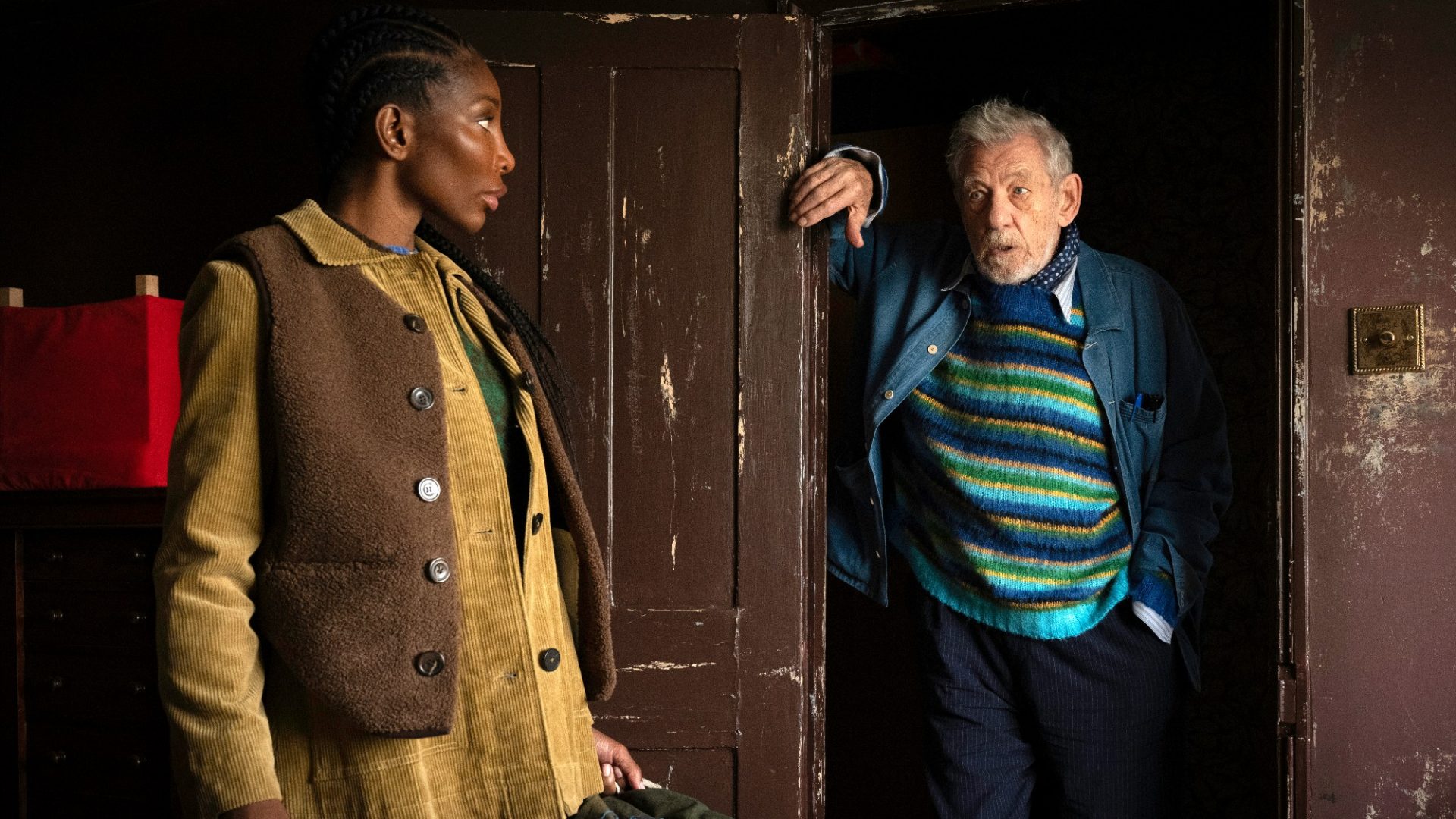
Lori (Michaela Coel) is hired by an old college friend (Jessica Gunning) and her brother (sigh, James Corden) to become the assistant of their famous father, a once iconic and now iconoclastic painter, Julian Sklar (Ian McKellen). Here she is supposed to be doing a simple inventory of his works, but in reality she will seek out the last series of unfinished works known as “the Christophers”, a series of portraits of Sklar’s one-time lover and muse.
Unknown to the artist, Lori will finish them in secret using his paints and brushes so that when Sklar dies, his children can sell them for an immense profit. A celebrity who once featured on a TV show called Art Fight, Sklar himself has now given up painting following a public fall from grace and now makes his money recording cameo videos for eager fans to keep him in the shabby splendour to which he has grown accustomed.
We see more than once a photograph of Sklar in the hall, taken in the 1960s one assumes, where he’s touching his moustache with his middle finger. I heard Alan Partridge saying “oooh, sex!” every time it came on screen.
It’s difficult to show genius on screen, especially artistic genius. In The Agony and the Ecstasy, we see Charlton Heston as Michelangelo finishing the ceiling of the Sistine Chapel, and in Lust for Life, we watch Kirk Douglas as Vincent van Gogh losing his marbles. Genius becomes a performance in which the art is a dramatic expression – Nick Nolte listening to rock music as he splashes paint in Martin Scorsese’s segment of New York Stories – and so its creation also becomes dramatic and inextricably linked to the biographical.
Artists become dramatic types: inarticulate outsiders, authentic, untaught, tortured, battling their own excesses and the restrictions of the establishment. Visit any art college and the number of smokers per capita rockets. Because that’s what artists do; they smoke. That’s what they are: individuals. Every single one of them. Except for Gilbert and George.
So Hollywood gives us its view of how artists looked and behaved, but also influences the next generation of artists to look and behave like Hollywood artists. This makes them more photogenic because they’re already mythologising themselves.
Luckily, Jackson Pollock’s action paintings are inherently cinematic: as we see Ed Harris reproduce them in his 2000 film Pollock. Frida Kahlo’s art was autobiographical, and therefore in the 2002 biopic Frida, Salma Hayek can hold hands with the art.
Jean-Michel Basquiat’s biopic Basquiat is a Brundlefly of colourful mush that reflects his status as a post-Warhol art celebrity. René Ricard, the art critic and poet who was instrumental in discovering Basquiat, also promoted the artist Julian Schnabel, who then wrote and directed the 1996 film in which art collector David Bowie plays Andy Warhol and art collector Dennis Hopper plays Bruno Bischofberger, a Swiss art collector.
The Christophers sidesteps all this oddness by having a fictional artist – a critically successful genius to boot – as its main character. This is a dangerous drug for a writer to take, even one whose previous credits include the Bill & Ted films and the Now You See Me franchise. You’re giving yourself a mouthpiece whose qualifications you’ve made up, though having Gandalf on your side helps.
The screenwriter, Ed Solomon, researched the likes of Lucian Freud and Francis Bacon, as well as consulting dealer George Barker of Gazelli Art House and pop artists Jann Haworth and Derek Boshier. His mother is also an artist, which gives him an insight into the world. And McKellen says his own character’s portrayal was inspired by his long friendship with David Hockney.
Suggested Reading

The night before Spielberg, Lucas and Coppola took over Hollywood
But there are some problems with Soderbergh’s film. First off, the invented TV show Art Fight, which has made Sklar a household name, a figure you love to hate – think Craig Revel Horwood from Strictly. But are there really any household names when it comes to the art world?
Damien Hirst wants to be, the little guy’s been busting a gut trying his whole life. Tracey Emin, perhaps, if you read the Guardian? But the only artist as famous as Gordon Ramsay in the UK is Banksy, and his fame resides entirely in his refusal to be a celebrity, or is he absence-as-celebrity? (Like Schnabel, he also directed a highly successful film: Exit Through the Gift Shop.)
We see Lori painting in the film; a nice touch because she’s an actor pretending to paint as a forger pretending to be another artist. Beautifully meta, and I imagine Steven Soderbergh eagerly rubbing the stubble on his postmodern chin. When we finally see Sklar painting, it’s an act of vandalism which then becomes a process of artistic creation. It’s just too strong for him. Artists can’t help art. It becomes another action scene.
The “Christophers” themselves – the paintings – were created as a collaboration between the film’s production designer, Antonia Lowe, and painter Barnaby Gorton, who also painted the portraits for the Harry Potter films. It’s a brave move of the film because ultimately it’s the evidence of what’s behind all the fuss everyone makes of Sklar.
Of course, they’re unfinished and not good according to Sklar, but the film thinks they are good. Are they actually good? A cynic would say he’s painted them like one of his French boys.
The Christophers is in UK cinemas from May 15
John Bleasdale’s novel Connery is published by Plumeria