When in 2022, Russia seized the mantle of global pariah by invading Ukraine, its absence from that year’s Venice Biennale – the international culture expo hosted by the city every two years – seemed an inevitable acknowledgement of world events.
On that occasion, the bleak green facade of the Russian pavilion had the lost, neglected look of a house long uninhabited. Cordoned off by an invisible but palpable boundary of shame, the weeds made the most of it, and the world’s biggest art event passed off without drama. Two years later, the Russians were absent and their pavilion was loaned out to Bolivia.
In 2026, for the Biennale’s 61st edition, things have gone differently. Controversially – some would say recklessly – Russia have been welcomed back by new organisers, giving Vladimir Putin’s country an opportunity to once again exercise its soft power on a world stage; even if only partially.
Whether to avoid protests, sanctions or both, the plan was for the Russian pavilion – run this time by the daughter of a former KGB agent – to open for parties and previews before the official opening of the so-called “Art Olympics”. Then it would close its doors before the public were admitted on May 9, with those interested in the spectacle still be able to peer inside and watch videos of the previews.
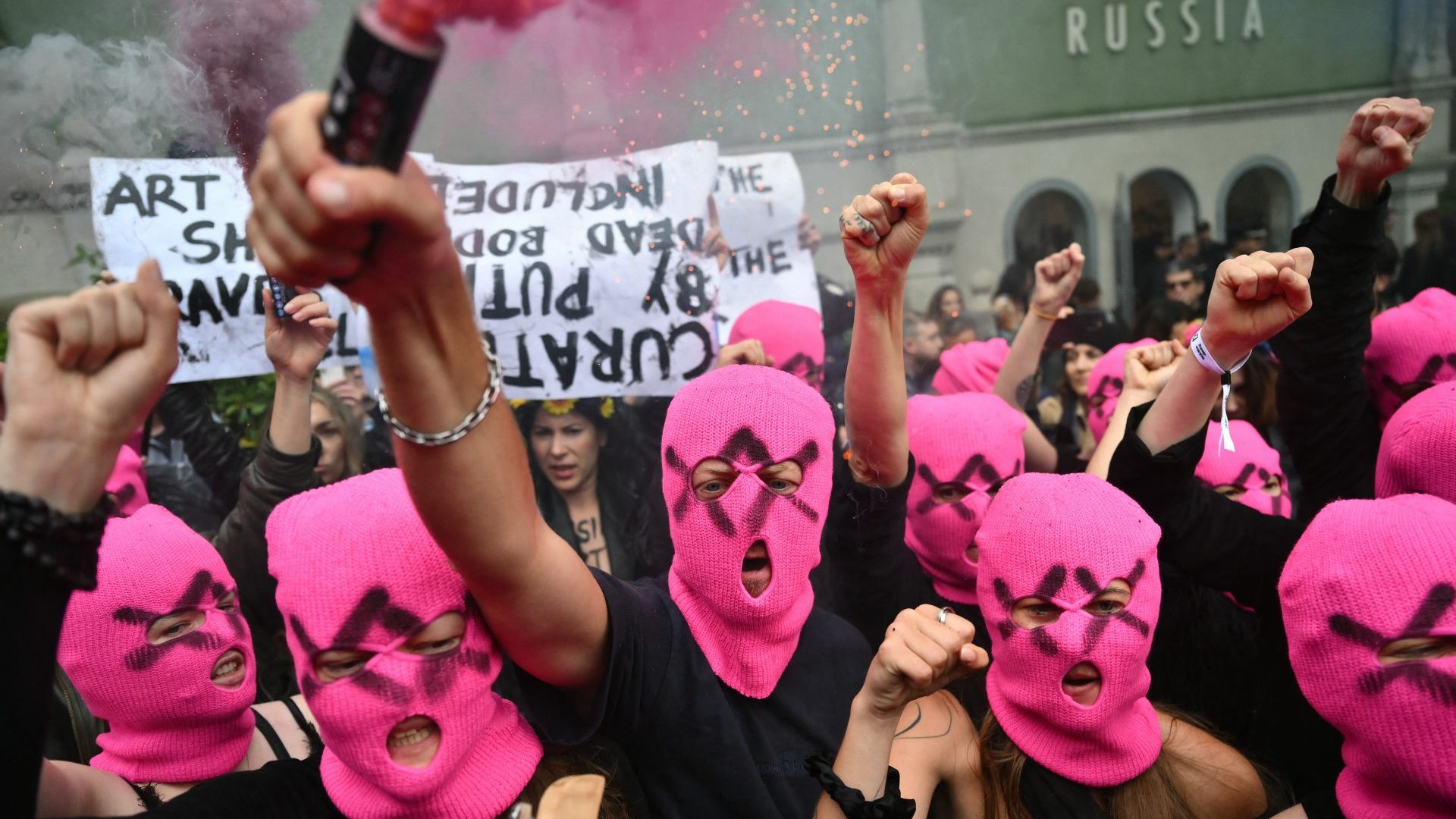
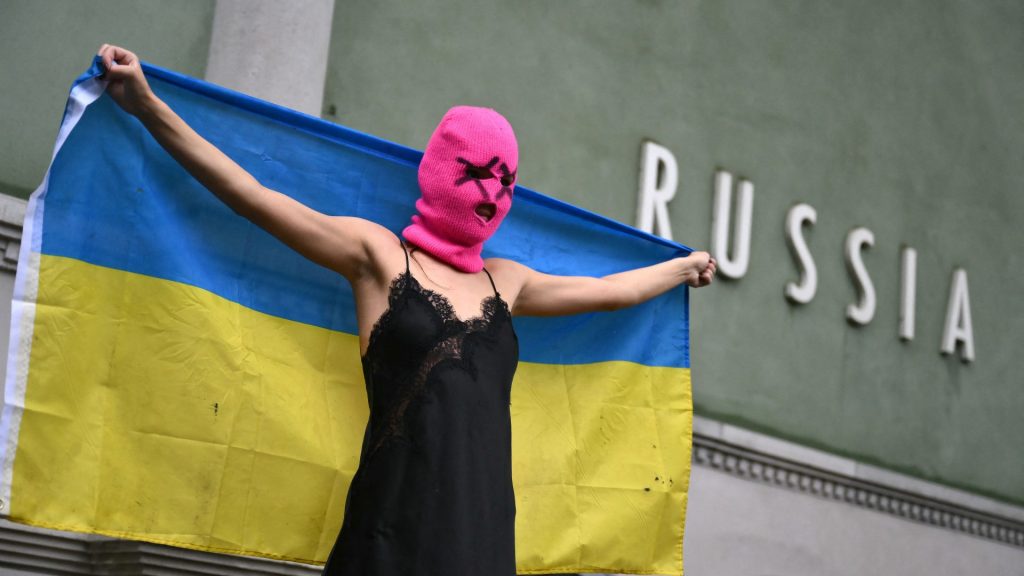
If this was supposed to quell unrest, it hasn’t worked. Just two days into the preview week, on Wednesday, May 6, protests erupted across the Biennale’s main sites, the Arsenale and Giardini della Biennale. Most dramatic of these was outside the Russian pavilion, where protesters in pink balaclavas let off pink flares, shouted slogans like “Russia kills! Biennale exhibits!” and played music, forcing it to close briefly.

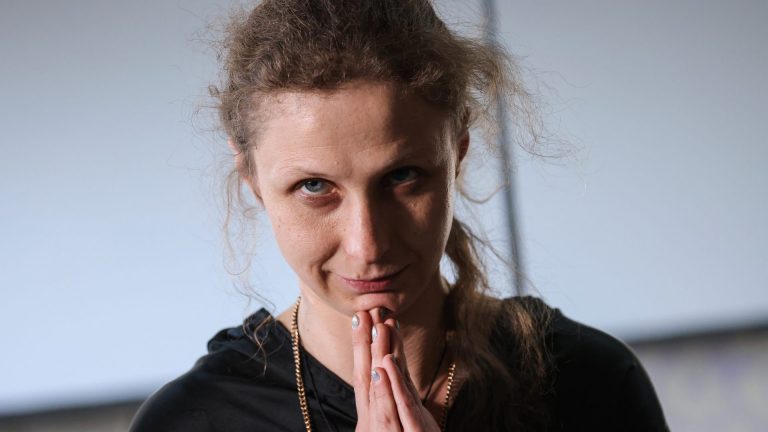
The protest was led by Russian art activists Pussy Riot and “sextremist” group FEMEN, founded in Ukraine in 2008 with the aim of “complete victory over patriarchy” and known for its events featuring topless women whose bodies are scrawled with slogans. Pussy Riot’s Nadya Tolokonnikova told the BBC that inside, the Russians and their guests were “drinking vodka and champagne in their pavilion, soaked in the blood of Ukrainian children.”
She added: “It’s not just tanks and drones, murder and rape in Ukraine. It’s also culture, art, language… it’s the way [Russia] tries to conquer the West and you guys just opened the doors to them.”
Those sentiments will meet with widespread approval, and Tolokonnikova certainly had a point about the booze. The Russian contribution, titled The Tree is Rooted in the Sky, centres on a handful of sweaty millennials dancing to headsplittingly loud techno music, inadequately supervised by someone masquerading as a DJ.
Other than that, the main point of interest seemed to be a stockpile of alcohol, large enough to be unseemly even at the Venice Biennale, which is around 90% Aperol spritz. Given that the doors were soon supposed to close, this suggested a huge amount of drinking to be done before May 9 or that the Russian team was involved in some grotesque piece of performance art.
The Pussy Riot protest concluded peacefully and before long, the only evidence of the scuffle was the presence of several disconsolate carabinieri, who had every reason to look fed up. But more dissent is bound to follow.
The presence of Russia, and indeed Israel, this year coincides with a change of personnel at the top in 2023, the organisers setting out the Biennale’s laissez-faire stance in a much-criticised statement on March 4 that read: “La Biennale di Venezia rejects any form of exclusion or censorship of culture and art.”
Not surprisingly, this approach went down badly with victims of Russian aggression, notably Ukraine. Its Security Guarantees exhibition in the Arsenale accompanies Zhanna Kadyrova’s The Origami Deer, 2019, a public sculpture that was evacuated from the city of Pokrovsk in 2024 and is currently positioned within sight of the Russian pavilion at the entrance to the Giardini.
For Ukraine, the Biennale is a vitally important opportunity not only to express outrage at the invasion, but to highlight what it sees as its betrayal by allies including the USA and the UK, who along with Russia were party to the Budapest Memorandum, which in 1994 gave security guarantees to Ukraine in return for the handover of its nuclear arsenal to the Russians.
“Unfortunately,” says co-curator Leonid Marushchak, a bear of a man with a beard that looks as if he has come straight from the winter-wracked front, “not much time has passed and one of the countries [Russia] that signed the Budapest Memorandum has invaded Ukraine. Now, just like in the ‘90s, Ukraine is being forced into new security guarantees to stop the war.”
As pieces of paper go, The Origami Deer is altogether more robust than the Budapest Memorandum, and since leaving Pokrovsk it toured Europe before coming to rest, temporarily, in Venice. Still on the back of its truck, the deer (actually made from concrete) appears at the Biennale suspended by lifting gear, to emphasise its transient status, displaced from home ground.
Its journey, which included stops in Brussels, Berlin and UNESCO headquarters in Paris, is documented in films, playing on a bank of screens in the Ukraine pavilion. The tour has been more than a symbolic gesture, says Marushchak, and with the unfolding conflict in the Middle East taking attention away from Europe, a visit from President Volodymyr Zelensky on Thursday, May 7, is a measure of its significance.
Suggested Reading

How Europe stops Gen Z going to war with Putin
“It’s very important to keep reminding the world that the war in Ukraine is still going on, a lot of people are dying and they’re destroying the cities”, says Marushchak. “But we understand that these topics are tiring for outsiders, so we have to look for new methods and platforms to remind people. That’s what our project is about.”
A walk staged by the Baltic pavilions on Wednesday expressed solidarity with Ukraine, by three countries – Lithuania, Latvia and Estonia – that were occupied by the Soviet Union until its collapse in the 1990s, and whose histories are loaded with Russian interference and oppression.
The walk included protest songs and chants at each of the Baltic pavilions, by participants carrying signs reading “Death in Venice – Russia Go Home!” and with badges and stickers putting numbers to the “artists invited to Biennale” and “artists killed by Russia” at 110 and 346, respectively.
The event highlighted both current and historic anger at Russia’s actions. Artist Merike Estna said that in her country’s past, “Estonia was unable to participate because of Russia – but why should we be forced to step back again because of that, after waiting until the dissolution of the Soviet Union to regain our independence and our voice? For us, for me, taking part now is about refusing to let aggression dictate our cultural presence or silence our voice.”
Suggested Reading

What Pussy Riot did next
The organisers may also be wondering if it might have been better to leave the Israelis to carry out some urgent repairs on their pavilion, rather than offer them an alternative space which on May 6 was the site of more angry but peaceful protests, convened by Art Not Genocide Alliance (ANGA) a coalition of artists, curators and art workers which has been calling for Israel’s exclusion since its participation was announced in October last year.
An estimated 200 people gathered in the narrow thoroughfare outside the pavilion, occupied by Romanian-born artist Belu-Simion Fainaru, which was forced to close, its doors and signage flyered with slogans reading “End cultural diplomacy now, No to the genocide pavilion”; “Starvation has been used as a savage weapon of war.”
This came just days after the resignation of the Biennale’s five-person jury, which had previously said that it would not consider awarding countries “whose leaders are currently charged with crimes against humanity by the International Criminal Court” – a not very subtle reference to Russia and Israel.
On April 30, the jury went further and resigned en masse, with no further explanation. It was then announced that the Golden and Silver Lion honours normally handed out at the Biennale would be suspended, with two Visitor Lions awarded via a public vote instead.
That has met with a mixed response. One concern for countries with a less established presence is that pavilions off the beaten track, like that of Bulgaria, may be at a disadvantage. Likewise, those that attract fewer visitors from their home countries.
Yet over the next few days and in the future, discussion of the 61st edition of the Venice Biennale is unlikely to centre around awards. And perhaps that is the point.