
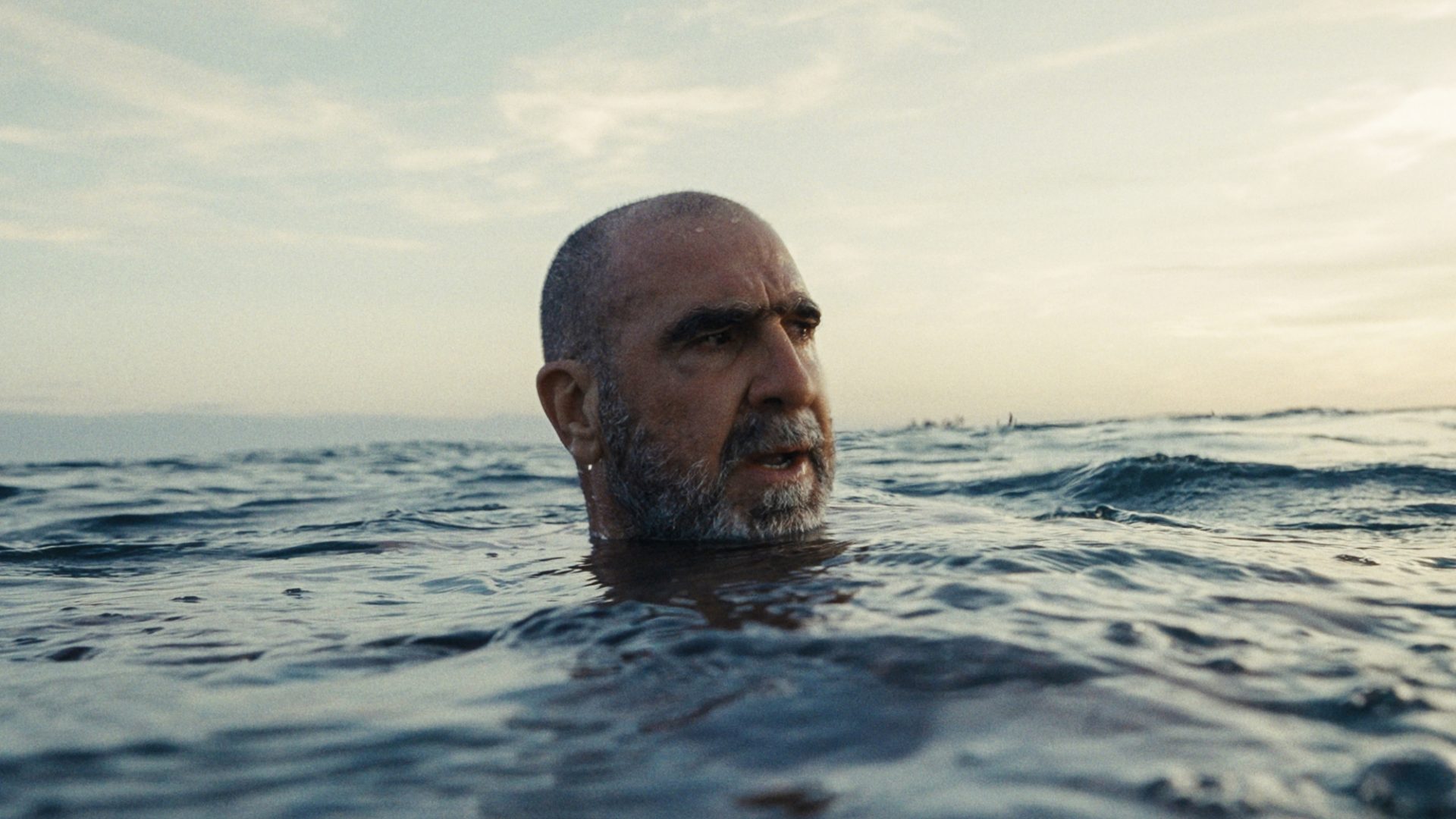
When I sit down to watch Cantona, the new documentary on one of the most iconic footballers of the 1990s, I am primed not to like it. You see, I’m a Liverpool fan and Cantona played for the wrong team.
And yet the greatest compliment I can give the film is that by the end, if not exactly rooting for Manchester United, I wasn’t vomiting in my mouth when Alex Ferguson appeared on the screen. Did I even feel a cheer emerging when King Eric netted a superlative goal?
Meeting one of the film’s directors, David Tryhorn, at the Karlovy International Film Festival in the Czech Republic, I admit to my moment of weakness. He assures me: “My co-director is a Spurs fan, and the editor’s a Man City fan, so between us, there were no United allegiances at all.
“We’ve made a few football films, so we know not to be biased. Though the editor complained sometimes about having to put in another Cantona goal.”
Tryhorn and Ben Nicholas first came together in 2021 to chronicle the rise of the greatest footballer to ever lace a pair of boots: Pelé. I ask how the two directors work together.
“Ben and I always operate as a unified duo,” Tryhorn tells me. “You see more double acts in docs as you have to question your decisions constantly, both in the initial creative and especially in the edit, where the storytelling can go in a thousand different directions.
“We share very similar sensibilities, so we never take a decision if we’re not both into a certain idea. Also having two of you means we can split some of the bigger jobs – one of us dedicates more of ourselves to music, the other to going through archive [footage].”
Eric Cantona first emerged as a promising young footballer in the French domestic league, before burning his bridges spectacularly with several sides and the national team and heading across La Manche. “He’s had more clubs than Nick Faldo,” one commentator quips when he finally lands on English shores, first at Leeds and then Manchester United, a period that forms the bulk of the documentary’s focus.
There was the awesome skill, the occasional moments of delicacy, the fashion statement – that collar – the enigma and then the occasional red mist and almost demonic violence. Were David and Ben ever afraid they might find themselves on the wrong end of a Cantona kung-fu special?
“Once we gained his trust, he was good as gold. He was lovely to work with: a very nice, mild-mannered, polite man,” Tryhorn says.
“What struck us when we were going through the archive is that he was saying the same things at 20 as he is now at 50. You always want your protagonist to change or go on a journey, don’t you? In any film. Is this a problem? Or is this actually something we need to embrace? We decided on the latter.”
Nice? Mild-mannered? Is this the same Cantona who stamped on the legs of his opponents and kicked supporters in the face? But this is the conundrum the film explores: how can such an individual – an anarchist as he characterises himself at one point – thrive in a team sport?
This puzzle affects the dynamic of the documentary, Tryhorn tells me. “We actually filmed and recorded a lot of interviews with other people, but then we realised that Cantona needs to dominate his own film. At one stage, we decided it should just be Eric and Alex Ferguson, and a couple of characters who come in at important moments. But it is essentially a two-hander.”
Come for the football, stay for the love story? “That’s exactly how we talked about it in the edit, and even when I was chatting to Eric in Cannes [where the film premiered], he was saying that he loved that angle. These are two people who both need each other: Alex needs Eric to win a title; Eric needs Alex to revitalise his career.
“Then they come apart at Selhurst, or Eric transgresses or pushes that love story. Alex forgives him. Eric repays him with his sort of masterpiece season.”
They came apart at Selhurst? I remember that incident. I remember it led the news.
Suggested Reading


The activists trying to save cinema, one screen at a time
It’s probably a Mandela effect, but I have a vivid memory of there being a newsflash. “We interrupt our programme as Eric Cantona just went Way of the Exploding Fist on a Crystal Palace fan’s face,” Peter Sissons says, glaring sternly into the camera.
Perhaps it lives in our memory so weirdly because it hasn’t been seen for a while: “The Premier League has never licensed the kick before for any production. They always use stills for the kick. For some reason, they think it’s bad for their brand image.”
There were headlines, questions in parliament, numerous opinion pieces. The Suárez bite, the Zidane headbutt, the Will Smith slap – can all be traced back to the Cantona kick. Then came the court cases and finally the press conference about seagulls following the trawler. The rhetorical cherry on the karate pie.
“I was a teenager in the ’90s and I always wondered whether it was a bit of a shtick. The whole French philosopher, artist, poet thing. It seemed almost too cliched to be true, but that was what fascinated us.
“Talking to him, you realise he grew up the son of a painter. He’s always been fascinated by art and poetry. He’s always been this deeper thinker.
“And the painting thing: he never sold a painting in his life, and he’s never given away a painting in his life. ‘My paintings are for me, my art’s for me,’ he says. It’s a personal thing.”
Unlike many footballers with their own documentaries – *cough* David Beckham *cough* – Cantona was not involved in the film beyond being its subject. “We were very nervous showing him the film because he’s an unpredictable character,” Tryhorn says, “but he was very proud of it.
“The great thing is Eric doesn’t really care about his image because he likes the fact that he’s this flawed human being. He celebrates the fact that he can be a liar or a hypocrite or any of these things, like we all can, which is quite rare in this current celebrity culture.”
And how can I live with myself now that I kind of like Alex Ferguson? “We show Ferguson in a very different light to the curmudgeonly Scottish disciplinarian that we all know. He’s actually a very soft, grandfatherly figure, which comes a little bit with age and hindsight.”
How can I live with myself now that I kind of like Alex Ferguson? Football, bloody hell.