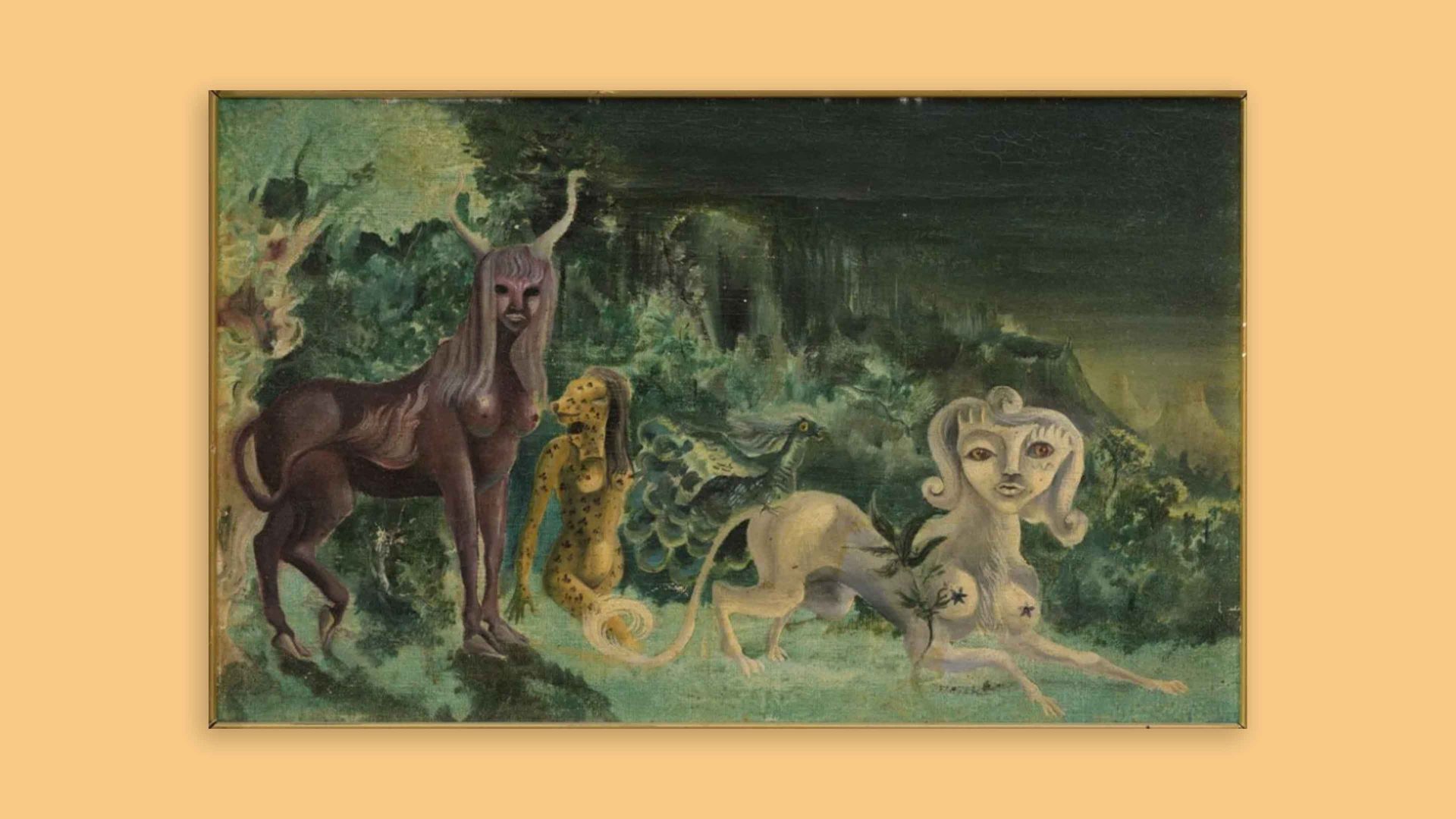
Hidden from the public eye for decades, it is a piece of surrealist genius with a playful nature that belies the grim circumstances of its creation.
Over 85 years after it was painted, Villa Pilar, by the British surrealist Leonora Carrington, has gone on show for the first time after a combination of detective work and gentle persuasion brought it to the public’s attention. It can be seen at the Freud Museum in London, a venue that feels appropriate.
Freud curator Vanessa Boni tracked down the rare work to Santander, in Spain’s Iberian Peninsula, where Carrington painted it while being treated in a psychiatric hospital. Spanish researchers at Faro Santander, a new art museum, contacted the owner, who was persuaded to allow Villa Pilar to go on show for the first time, as part of the first exhibition of Carrington’s art to be staged in the UK for 35 years.
“There is a group of animal-human hybrids set in a very green, lush area,” Boni told me. “I see these spaces as luminal spaces, a threshold between one reality and another.”
Carrington, who was born into a wealthy family in 1917, rebelled against the expectations of upper-class women. A studied at the Chelsea School of Art before she met German surrealist Max Ernst in London in 1937 and became a contemporary of Salvador Dalí, André Bretón and Marcel Duchamp.
When Ernst was arrested for being a “degenerate” by the Gestapo in Occupied France in 1940, she fled to Spain as her mental condition deteriorated. There she was gang-raped by soldiers in Madrid.
After suffering a psychotic breakdown, Carringrton was then admitted to a hospital in Santander, where she was subjected to treatment that, by today’s standards, has been described as “pseudo-Nazi” in its brutality.
Suggested Reading
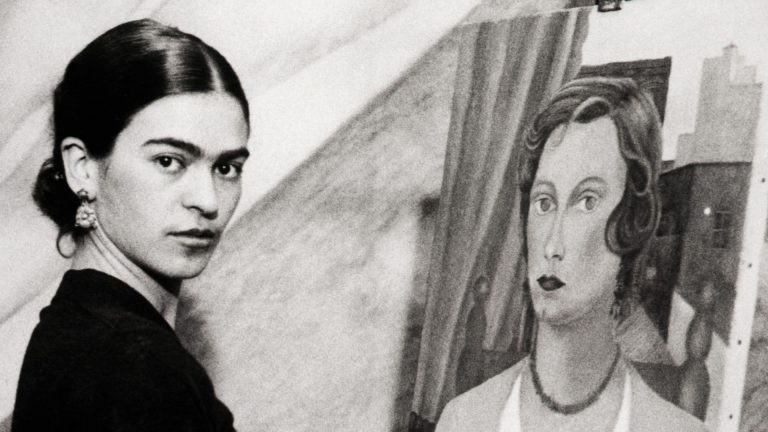
The night New York discovered Frida Kahlo
The 23-year-old was strapped naked to a bed and treated with Cardiazol shock therapy and Luminal, a barbiturate, which induced epileptic fits. Despite this, she later painted several works, among them Villa Pilar and Down Below, after being encouraged by her psychiatrist to continue with her art as part of her therapy.
Dr Luis Morales, who treated Carrington between August 1940 to January 1941, was later given the painting by Carrington, who wrote an inscription on the back. The work remained in his family unseen by the outside world – until now.
Boni researched the painter’s links to the Spanish city earlier this year as she was preparing the exhibition, Leonora Carrington – the Symptomatic Surreal. She contacted Faro Santander, due to open in the Spanish port in September, and they contacted Elena Morales, the late doctor’s daughter, to ask if she would allow the painting to go on display first in London, then in Santander.
Carrington’s masterpiece Les Distractions de Dagobert fetched $28.5 million at auction in 2024, but Villa Pilar is a much smaller work, measuring 25cm by 40cm.
Suggested Reading

Anish Kapoor’s dark matter
“What I understood was that there were two paintings which Leonora did while she was in Dr Morales’ care,” Boni told The New World. “Faro Santander played a crucial role in locating the painting. They contacted the family. The owner was interested in lending it to the museum because of the local connections. It felt like a special project.
“Down Below and Villa Pilar are significant in the context in which they were produced. It was the darkest and most difficult period of (Leonora’s) life. It happened to her at a very formative time in her life. She was a very young artist, she was only 23,” Boni says.
Boni says that Morales’ psychosis treatment was “by today’s standards really brutal, but at that time was considered quite normal. She talked about this experience as a kind of death by which she was reborn. That is the story that the exhibition tells. She left this sanatorium healthier than she had been.”
Leonora Carrington – the Symptomatic Surreal is at the Freud Museum, London until August 10, then at Faro Santander from September 8