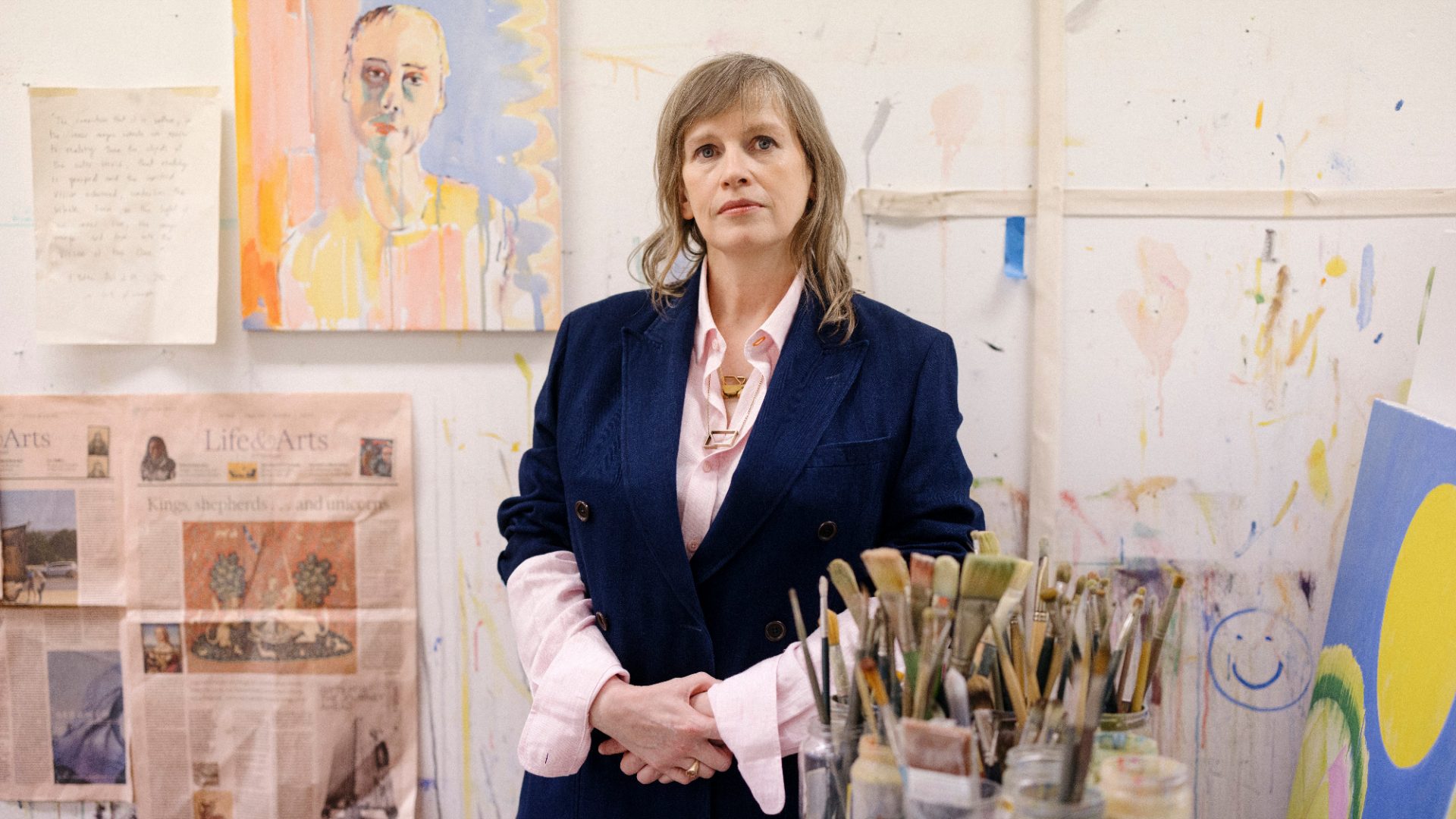
“How could you not love a man who wrote that?” says the artist Isabel Nolan, quoting the Renaissance printer and publisher Aldo Manuzio who, in November 1495, pledged to fill the world with reading materials.
Sometimes known as Aldus Manutius, he wrote: “It is our lot to live in turbid, tragic and tumultuous times, times when men more commonly turn to arms than books, and yet I shall have no rest until I have created a plentiful supply of good books.”
If Manuzio’s touching faith in the power of the written word jars with our own more cynical times, his description of a world in dangerous flux, shaped by an unblinking recourse to violence, brings us abruptly into the present day. It’s a time leap made all the more potent set against the crouching bulk of the Venice Arsenale, an ancient symbol of the city’s enduring naval might, and currently host to the 61st Venice Biennale, where Nolan represents Ireland with an installation of sculpture, drawing and tapestry.
The exhibition is titled Dreamshook, the artist’s own word to describe “when the wanderings of a sleeping or drifting brain stay with you for some time, for those days when you are haunted by sticky thoughts.”
Manuzio’s book-filled utopia belongs in this realm between reality and make-believe, wakefulness and sleep, but paradoxically it also brings to mind the complex and many-roomed cultural edifice raised by western civilisation to order and explain the world.
Growing up in a middle-class family in Dublin, where she still lives, Nolan confesses a certain ambivalence to the cultural touchstones of her upbringing: “I grew up within that canon, loving those books by the dead white men, and the dead white women. I’ve been formed by that, and also by a really standard Catholic upbringing.”
Catholicism, so richly served by the art of the Renaissance, is a thread that runs through the visual lexicon of Nolan’s show, which flows from piece to piece with the disjointed inner logic of a dream. The humanist impulse that fuelled the Renaissance is here too, embodied by Manuzio’s quest to print and distribute classical texts that had been lost to Latin Christendom for 1,000 years or more. “Aldus intends to build a library whose only boundary is the world itself” wrote Erasmus, a quote included in Nolan’s drawing Dreamstrife.
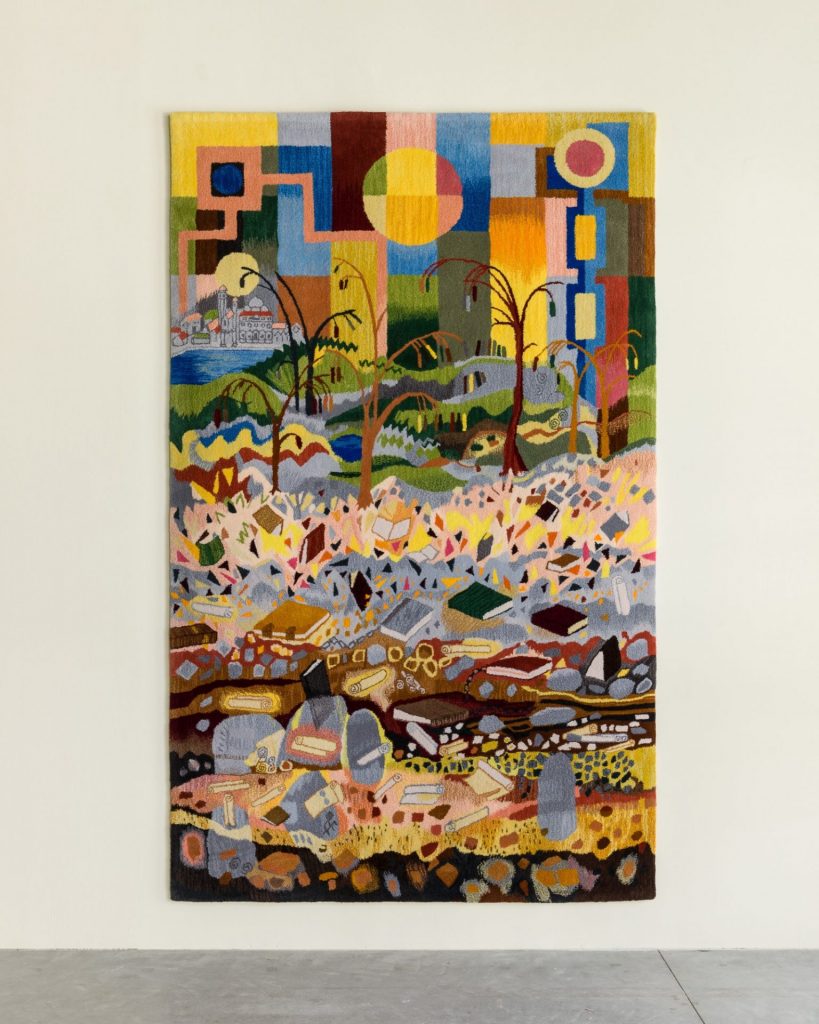
In the exhibition’s richly coloured central tapestry, Manuzio’s mission comes to him in a dream, which Nolan expresses in imagery familiar from medieval and Renaissance depictions of divine visitations, and especially Fra Angelico’s Annunciations.
“Depicting Aldo’s story in the form of a dream feels very consonant with the period in which he lived,” says Nolan. “Very often you see in artworks from that time some kind of great historical moment or turning point in someone’s life rendered as the story of a dream.”
The theme is expanded in the accompanying book – more an extension of the show than a guide to it – in which curator Niamh Darling brings together other momentous dreams, from Nebuchadnezzar’s forewarning of the collapse of his empire to the vision that brought about Emperor Constantine’s conversion to Christianity.
The movement and communication of ideas is expressed in more or less metaphysical ways, most touchingly in the recurring motif of winged books that appears throughout the show and which reflect Manuzio’s whimsical turn of mind, which attributed to books both a body and a soul, because of their simultaneously material and immaterial nature. Movement in time and space is embodied in the interaction between the works, with details from Nolan’s tapestries reiterated through the gallery space in three-dimensional elements, including the wonderfully stylish book-shaped Bench (For Aldo), and a sculpture titled Dreamshook that echoes the form and pattern of Aldo’s bed.
This sculpture is composed of elements from the central tapestry titled Aldo Dreams of a Plentiful Supply of Good Books, arranged in the centre of the gallery as exploded iterations of the bed and the floor pattern. Though “brought to life” in 3D form, the bed and floor are no more functional than their representations in the tapestry.
Although Nolan emphasises that she is “not trying to do some kind of postmodern pastiche” of Renaissance art, these projections of fictive, functionless objects indeed have a distinctly postmodern irony to them, especially Oh!, the flamboyantly swept-back curtain of Aldo’s bed that, delineated in lines of mild steel, conceals nothing.
These visual tensions in the work reflect the feelings of ambivalence that Nolan attaches to many things that she cares about, from great literature to the Gothic cathedrals: “Think about the history that produced them – the money, the men, the whiteness and the Christianity. That architecture weaponises beauty unlike any other architecture I’ve ever encountered. I find that fascinating.”
Her admiration for Manuzio and his Aldine Press, which introduced the precursor to italic type and the paperback book, and standardised punctuation marks including the comma and semi-colon, is tempered by the recognition that knowledge cannot combat all the ills of the world. Indeed, as the title of a tapestry announces: The Dreams of Reason Produce Monsters (the Seraphim of the Canon).
Suggested Reading
How David Hockney became an accidental life coach
Manuzio’s optimistic faith in books and reason is, says Nolan, “something I would love to feel. But it’s a dream that is really being shaken or destroyed. Now the idea that reasoned debate and a liberal education can make a better world just feels like a fucked idea.”
What’s more, she says, “The idea that a beautiful book can change the world feels much less likely, even though we know they still do. But there are also lots of terrible books that change the world.”
Still, like Manuzio, she’s an optimist, her work an ongoing effort to understand and love the world. In this sense, the Renaissance provides a model of sorts: “That period of time is really interesting now because it’s the time that has very directly patterned the kind of society that is familiar to us now… The story of humanism emerging in this time of terrible turmoil and strife feels like this really optimistic moment.”
Dreamshook is at the Pavilion of Ireland until November 22, 2026.
The first comprehensive solo exhibition of Isabel Nolan’s work in the UK to date opens at Southwark Park Galleries, London on 15 August