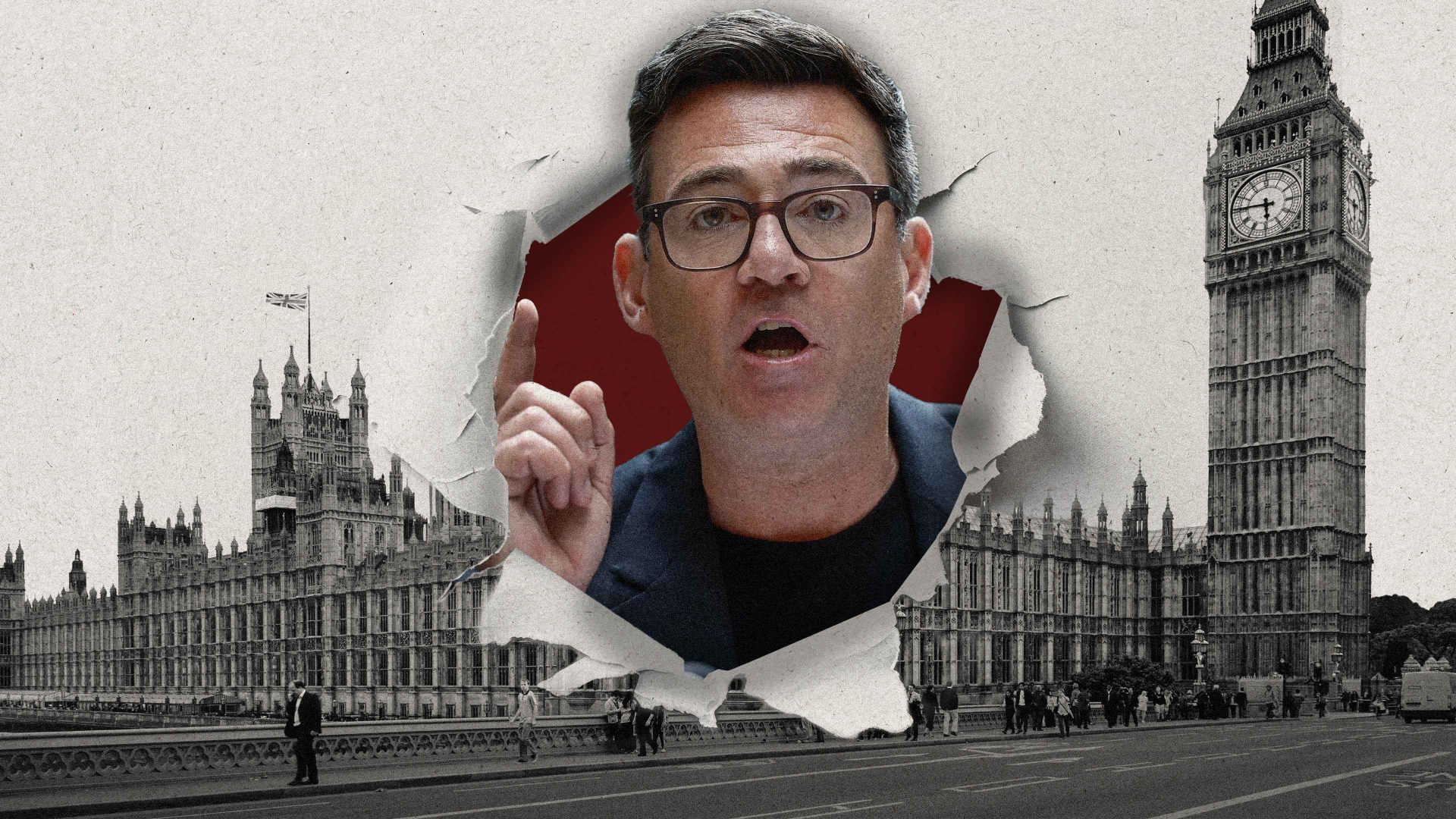
Talking with some figures in Labour this week is a little like talking to someone who’s been trapped underground for weeks, or even months. After so long in darkness, those confined had forgotten what it was like to see sunlight, to be able to move readily, how easy it seems to eat and drink. Until you readjust, the normal seems extraordinary.
That’s what Andy Burnham seems to have achieved with his first week or so as prime minister. Almost everything he’s done is something Keir Starmer could have done, or even tried himself. It’s just that now, it’s actually been done, and seemed to work.
Burnham’s big day one policy announcement – and the most significant of the retail offerings announced in week one – was a pledge to abolish rough sleeping. On one level, it’s a bold and ambitious pledge, but on another it is eminently achievable: New Labour cut rough sleeping by more than two-thirds, and it was cut by 80% or more during Covid.
Rough sleeping is also one of the most visible signs of state failure, or of social decline – and makes some people feel unsafe. So, tackling it is likely clever politics, too. And the rollout was cleverly handled: Burnham spent the morning before he became prime minister volunteering in a charity working with people experiencing street homelessness.
Suggested Reading

Need to raise taxes? Tell them a new story, Andy
A cynic can suggest it’s a photo op, but even to the extent that they are right…so what? Burnham made a statement just by being there, he looked and sounded authentically interested in the issue, and it worked.
Burnham similarly managed to produce multiple TikTok videos, several of them collaborations with influencers, which landed well. More than one person remarked with surprise that Labour still seemed to have people with communications and social media skills, after all – having assumed they must have all left under Starmer. Yes, the previous No 10 operation tried to do social media videos with Starmer, but the less said about most of those the better.
Similarly, Burnham’s retail politics offers have largely gone down well: £45 a year off electricity bills thanks to a VAT cut, a £2 fare cap on buses, and business rates relief for pubs aren’t going to fix the nation’s problems, but they help, and they’re a good statement of intent. They also work as a reminder that when you’re in government, you can just do things – something Labour had tried with Rachel Reeves’ summer giveaways, but deployed much more effectively here.
What is striking about Burnham’s first week is that he’s approaching the job like a man who’s been in opposition. He is talking about decades of failures from successive governments. While he is promising to deliver Labour’s 2024 manifesto – from which he draws his mandate – he is not trying to defend the record of the government to date.
More than that, he has fired or demoted many of its most visible faces. Rachel Reeves, David Lammy, Darren Jones, Steve Reed, Peter Kyle and Liz Kendall have all been returned to the backbenches. As mayor of Greater Manchester until just a few weeks ago, Andy Burnham wasn’t part of the last government, hasn’t kept its key figures, and isn’t defending its record.
This, again, is likely a clever trick, even if it will lead to resentment from some of his newly sacked backbenchers. There is widespread anger across Europe at incumbents at the moment, and the government was massively unpopular. Why associate yourself with that when you don’t have to?
Burnham has, very swiftly, proven he has the skillset of a great leader of the opposition: he can come up with attention-grabbing retail policies that sound good but don’t cost very much. His management of both traditional media PR opportunities and social media is better than his predecessor. He looks and sounds the part. More than that, he has made his leadership seem like a clean break from the past, and that was far from a given.
Of course, Andy Burnham has not been made leader of the opposition: he’s the prime minister, and that job is a radically different one. He is the person who has to actually run the government, and the person who will be held responsible for all sorts of things affecting the UK that are well beyond his power. There is only so much the PM can do to manage inflation, or to grow the economy, or any number of other things, but he will get the blame if they go wrong regardless.
Suggested Reading

The trouble with Andy Burnham’s place-first politics
Burnham has speedrun politics in a way that’s completely unprecedented. On one level, he is a political veteran with more than 30 years of experience as a special advisor, MP, minister and mayor. But on another, he was elected as an MP on 18 June, became party leader 29 days later, and became prime minister just three days after that. He has been away from Westminster for a decade, doesn’t even know the majority of his own MPs, and now is running the show.
His strong first week has shown he can do the presentational part of the job, but unless he opts for a very early election – something Burnham himself has now ruled out on camera – he will be judged by how he governs, and how he delivers. That’s the test he faces over the summer months, as he prepares for his first budget.
In truth, the first week reveals little on the governing front. No 10 faced a few headaches over how it would pay for its various policies, exacerbated by Darren Jones pointing out that their costings for the VAT cut on energy didn’t work. When Downing St claimed it would be part-funded by scrapping Digital ID, and Jones pointed out Digital ID was never costed in the first place.
While the policies are relatively cheap, this largely doesn’t matter – but for the big things Burnham wants to deliver on social care and devolution, it will be a much bigger deal. Similarly, while a business rates cut for pubs and hospitality got some good headlines, it made the usually staid policy wonks at the Institute for Fiscal Studies very irritated indeed.
“Whatever the government wants to achieve with the business rates system, this complex, ever-changing mish-mash of policies cannot be a sensible way to go about it,” senior IFS economist Stuart Adam said in his verdict.
“We seem to be moving ever closer to a system in which the government gives every business a score out of ten each year according to how much it likes the business that year, and sets its tax rate that year accordingly.”
There is an old maxim that politicians campaign in poetry, but govern in prose. Andy Burnham’s decision to stick with poetry for his first week in the job was almost certainly the right one, but crunchy details of governing are inevitably coming.
Suggested Reading

Everyone else has failed on climate – will Burnham do any better?
The good news is that Team Burnham seems aware of this. Having got in some quick early hits, they have promised that plans on devolution and social care – big, serious issues that will need solid policy and billions of spending – are coming shortly.
Early media leaks suggest Burnham proposes allowing regions governed by metro mayors to keep a portion of their income tax receipts – a policy that should, in theory, boost growth by incentivising local regions to allow development and encourage investment. No 10 is also preparing its social care policy – a brave move given that when Theresa May’s plans on the issue were dubbed the “dementia tax”, it helped to sink her 2017 election campaign.
Keir Starmer did not leave Andy Burnham a good inheritance. Starmer’s most fervent defenders try to argue that while he was unpopular, he laid lots of groundwork that would deliver good results in years to come – which, if it were true, would leave Burnham perfectly placed to take the credit for Starmer’s work.
The reality isn’t so rosy. Starmer’s manifesto tied Labour’s hands on tax and spend, and as a result the plans for public spending in 2028 and 2029 – the two years likeliest for the next election, if Burnham doesn’t go early – are extremely tight, forcing a government to deliver cuts in an election year.
The knock-on effects of Trump’s war on Iran mean the government needs to offer help during a cost of living crisis – with winter coming up fast – even as its own tax receipts take a hit. Everything about Burnham says he wants to be a good-times political leader who opens the spending taps. The government’s finances suggest he’ll have to work very hard to actually get that done.
Burnham’s whirlwind return to politics has had something of a dreamlike quality: he has sailed back into parliament, and straight into No 10. His first week in the job has done nothing to end that – he’s shown off his best qualities, got his cabinet in place, and even opened up No 10 North. Now, the challenge is trying to cling on to that dream through the cold daylight of governing.