
Unable to dodge, timewaste and deny any longer, on July 14 Donald Trump was forced to pay $5.6m to E Jean Carroll, to settle her successful 2023 trial against him for sexual abuse and defamation. A jury found Trump unanimously liable for sexually assaulting the former writer in the fitting room of a New York department store in the 1990s. He then defamed her in 2019, after she went public with her claims.
And yet the final success of E Jean Carroll’s proceedings against Trump, in some ways, seem to have had no effect. The fact of a man being found to have committed a horrendous assault has been absorbed without incident, giving the impression that, in some profound sense, this verdict – that Trump is liable for the sexual assault of a woman – doesn’t seem to matter. How can that possibly be?
When I was 14, a crude remark began circulating among a few of my male friends: “Never trust anything that bleeds for five days and doesn’t die”. Menstrual jokes from teenage boys were hardly new, but this one felt different.
I do not believe the boys meant what they were saying, and if they did, we weren’t able to appreciate fully what their words implied. Eventually, an adult intervened: “Where did you learn that?” they asked.
Where did he first hear that? What had led him and the others to believe that was an amusing, clever or even acceptable thing to say to a girl? If you asked the question today, the answer would more than likely be online. Or, more specifically, the manosphere.
Today, the manosphere is everywhere, but it’s a very different one from what first emerged in 2005, kicked off by Neil Strauss’s book, The Game. As James Bloodworth, journalist and author of the phenomenal Lost Boys: Undercover in the Manosphere, explains, Strauss launched “a kind of pick-up artist scene” into the mainstream.
“You saw all of these kinds of copycat entrepreneurs who would set these programs and promise to teach men how to get any woman they want with a few conversation starters and some tips,” Bloodworth tells me. While writing Lost Boys, he visited £7,500 boot camps in Las Vegas, where this was “exactly the pitch”.
By 2010, unsurprisingly, it was clear that Strauss’s teaching didn’t work. At first, the customers began to blame the pick-up artists for giving flawed advice, but then, more sinisterly, they began blaming the women. The subculture became a lot more misogynistic and aggressive towards feminism. “Then,” says Bloodworth, “in 2015, Trump arrives.”
“I saw it latch on to MAGA politics and imbibe some of the ideas from that,” says Bloodworth. “So, it becomes a much more ostensibly right wing and overtly anti-feminist movement. You also see ideas like anti-Semitism creeping into some corners of the manosphere as well. It’s now much more political. Then people like Andrew Tate emerge, and it’s about impressing other men, rather than attracting women.” This week, Tate and his brother Tristan have been arrested in the US after British authorities issued 38 new charges against them.
Today, the manosphere is a term that feels commonplace in our conversations and expands far beyond Tate. It boasts figures including Sneako, a believer in the “red pill” misogynistic ideology who has a video titled “All women are gold diggers”, and Hamza Ahmed, a British YouTuber who runs an online community called Adonis. This promises to help those wanting to become a “top 1% man” and charges £770 for the privilege of an annual subscription.
Influencers like these have got their claws deep into the algorithm of millions of young boys, reaping profits as they go. As Bloodworth puts it, the manosphere has become a “sales funnel”.
“It’s essentially masculinity entrepreneurs. It’s not disinterested advice that they’re giving; they’re trying to profit from young men. They make men feel insecure, and then they purport to have the solution. They present themselves as saviours and guides who can fix the problems that they’ve told them they have,” Bloodworth tells me.
According to a 2025 survey conducted by Common Sense Media of over 1,000 boys in the US between the ages of 11 and 17, 73% of them said they regularly encountered masculinity-related content, while one in four were exposed to a high level. Of that group, 14% said they experienced low self-esteem, and 39% reported that they felt “useless”.
This, Bloodworth explains, is key. “It’s people trying to dip their hand in your pocket by making you feel insecure,” he says, explaining that the conspiracy theories peddled on TikTok, Instagram and YouTube are their means to achieve this.
Suggested Reading

The Beatles vs Andrew Tate
For example, there is the so-called 80/20 rule: the idea that women are only interested in 20% of men, leaving the remaining 80% surplus to women’s desires. In this skewed reality, Bloodworth says, men can convince themselves they’ve been left behind. “They say this is because the sexual revolution has taken the pressure off women to get married and so, women are now all pursuing this small quota of ‘alpha males’.”
Josh Sargent knows this all too well. He is now a campaigner on the dangers of the manosphere. But when he was just 12 and during the summer when Tate was the fourth-most-Googled man in the world, he fell into the manosphere. “It was when the phenomenon of Tate was really hitting its peak. It was quite a crazy time.”
Sargent was exposed to what he now calls an “algorithmic bombardment of this hyper-curated content.” Images of muscular, wealthy men “parading around Dubai in sports cars”, running businesses while surrounded by models, filled Sargent’s social feeds and those of millions of young men just like him.
Today, some of Sargent’s friends are still glued to Tate’s content. “I still don’t think we’ve done enough as a society to let young men feel comfortable enough in thinking that they can fully open up and talk about their mental health and their emotions. So, it is difficult to judge, right?” he adds. Now, Sargent speaks openly about his experience and campaigns around masculinity and online spaces.
Bloodworth, on the other hand, says some of the men he knows were only able to step away after their female friends explained how it was affecting them. “It really cut through,” he says, adding that he’s “not saying it’s women’s responsibility to do that at all.” And Bloodworth is right – the manosphere is not our problem to fix.
Suggested Reading
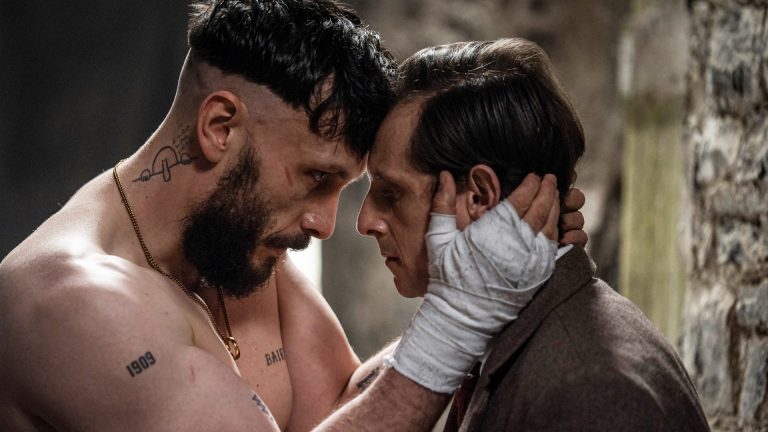
Richard Gadd’s Half Man is brutal, thrilling and unforgettable
From Louis Theroux’s Inside the Manosphere to Jack Thorne’s Adolescence, this idea of toxic masculinity has our documentarians and writers gripped. More recently, Richard Gadd’s series Half Man toys with this from an alternative angle, asking the question of what it means to be a man, let alone a “good” one.
But instead of going further down the rabbit hole, how can we get out of it? The answer may lie with populism.
“Donald Trump and Nigel Farage are pointing to issues like wealth inequality, difficulties in housing and the job market,” Sargent says. “They’re identifying and addressing those issues. The right issues with the wrong solutions, with excessive focus on illegal immigration or just borderline racism.” He argues that the manosphere has become a subsection of populism, focusing on “easy answers to complex issues”. In other words, forcing a narrative where there is an “us” and a “them”.
In 2024, Farage said in online interviews that Tate was an “important voice” for the “emasculated” and was giving boys “perhaps a bit of confidence at school”. His affinity for Tate caused rifts within Reform over the limiting effect that support for the manosphere would have on their appeal.
“With Andrew Tate,” says Bloodworth, “I think there is more understanding now that it’s just a grift. You see this with people like [Tommy] Robinson as well on the far right, where he disappears to Tenerife for, say, six months at a time and then reappears with a crowdfunder and a hard-luck story when he’s run out of money. He claims to have been persecuted or cancelled and then sets up a crowdfunding campaign when he needs more money for his lifestyle.”
For Bloodworth, the similarities between the manosphere and populism are clear. “The way the manosphere has this kind of conspiratorial framework, where the influencers will say to distrust the mainstream. Whether it’s dating advice or institutions, they then present themselves as the people with the answers,” he says.
Like Farge with the European Union and Trump with mainstream media, influencers teach their male followers that the world is against them and institutions revel in their failure – or even stupidity. As with populism, once there is someone to blame, it has taken hold, but without one, its grip could loosen.
“When you have the uncertainty of an education system that is not properly preparing its young people for the world of work and to go into an uncertain economy, and when, in parallel, you have an online world that sells certainty; ‘if you follow my 12-day plan, then you will be a millionaire’. Logically, what is a young man going to listen to?” Sargent says.
My mind is taken back to a scene in Gadd’s Half Man. The show’s two protagonists, Niall and Ruben, are embroiled in a fight after being reunited following a traumatic separation. Seething, Ruben turns to Niall and spits at him: “I’m the main character in this relationship; you should get that by now.”
Much like the manosphere, the ties need to be severed. The longer we argue over who holds the scissors, the worse it’ll become.
Eleanor Longman-Rood is digital editor of The New World