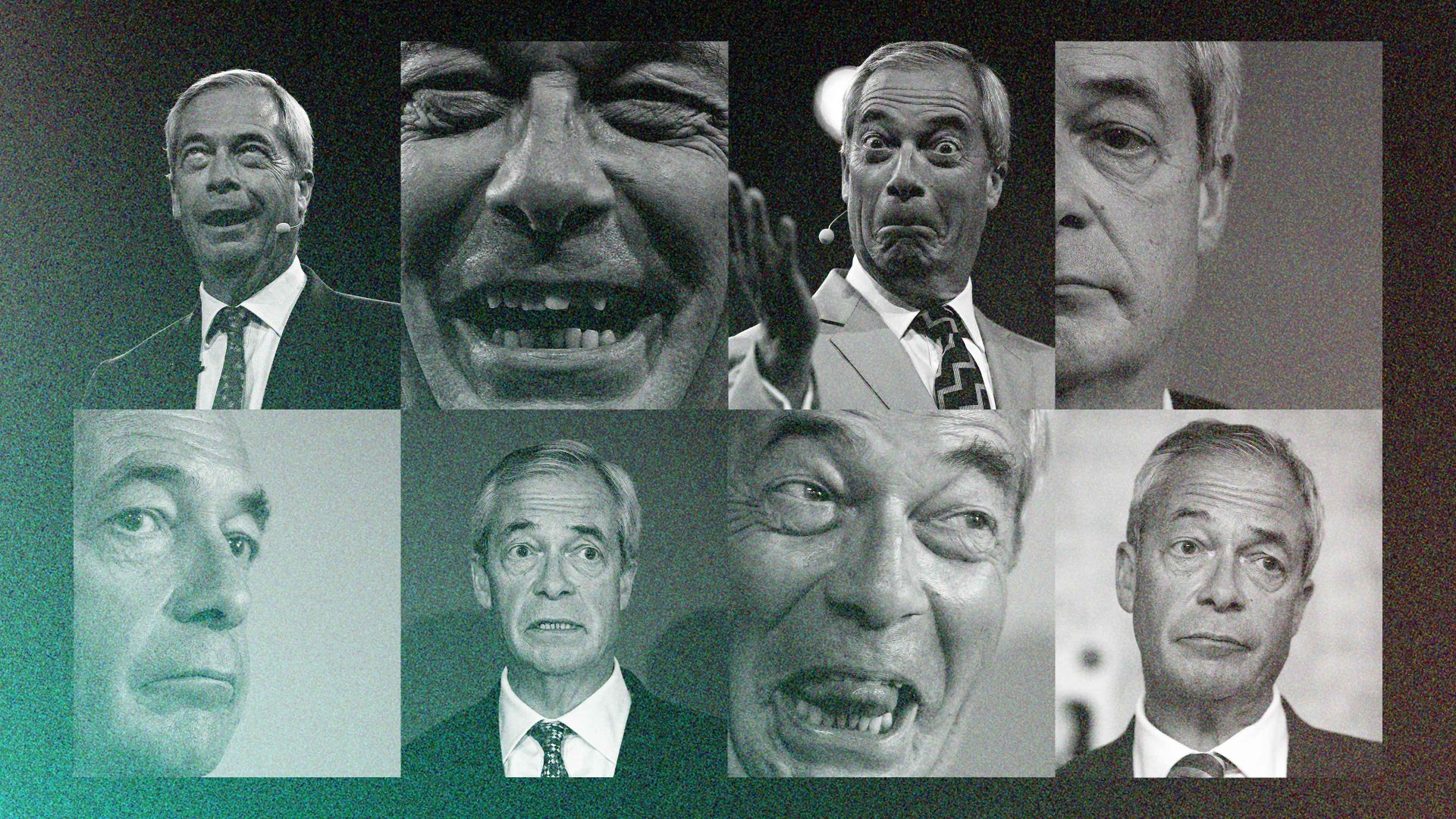
There is a contradiction right at the heart of Nigel Farage: he is at once both brilliant and terrible at politics.
His political acumen is undeniable even to his most ardent critics. In a country dominated by two political parties for more than a century, he has not once, not twice, but three times managed to launch a new political party and get it to the top of the opinion polls. He wanted Brexit for an awfully long time, and he helped to deliver it. He is reshaping modern British politics in his image.
But his shortcomings are almost as vivid. The political movements he founds disintegrate as rapidly as they rose, taken down by scandals, grift, infighting and the sheer weirdness of some of the supporters he attracts. He falls out with those around him in spades, turning allies into bitter adversaries. It took him eight tries just to get into parliament, which he then almost never bothers to attend.
And as has become inescapable in recent days, he seems unable to turn down a quick buck, even if it might cost him a bigger prize later. Party insiders have begun to mutter about what the rest of us have been muttering about for some time – surely all Farage’s shilling for gold and crypto firms, his GB News shows and his frequent, lucrative trips to the US, mean other things take a back seat? Like actually building a party that might win power?
For most of the last two years, though, we have only seen the dangerous, brilliant version of Farage. Reform sailed to 30% in the polls, while every other party struggled to break 20%. Projections suggested that if such a result held at a general election, he might become prime minister by a landslide.
Suggested Reading

Sorry, but you can’t write Farage off yet
Labour and the Conservative Party alike became obsessed with trying to play Reform at its own game, finding a way to be cruel enough to asylum seekers and economic migrants building a life in Britain to appease Reform voters. Farage dominated the news agenda, cashing in on his success even as he continued to rise.
But the momentum has stalled. Reform is still, just, topping the polls, but its lead has diminished almost to nothing. It hasn’t won any of the major by-elections of the last 12 months. The high-profile defections have dried up, and those who made the leap are privately voicing their anxieties – and even regrets – about their decision.
And Farage himself is showing his flaws, too. He has been unable to shake off the scandal around his decision to accept a £5 million “gift” from cryptocurrency billionaire Christopher Harborne – and Farage’s ever-shifting narrative has only kept the story in the papers. Farage has been absent, irritable, and at odds with Reform’s other visible figures.
Some Reform figures are resigned to the parliamentary standards commissioner censuring him over the Harborne donation, leading to a by-election in his Clacton seat. They hope the process might force a Farage reboot – an indignant, combative leader fighting for his seat against what he will style as an elite coup. Others fear he might be fatally damaged by a challenge from Rupert Lowe’s Reform – or even that he might walk away altogether.
Things got even worse for an already beleaguered leader when the Sunday Times reignited a long-running saga around his financial relationship with the 32-year-old crypto trader and convicted criminal George Cottrell, who apparently refers to Farage as “Daddy”.
The newspaper revealed Cottrell had paid for security for Farage – something the Reform leader previously claimed was covered by Christopher Harborne’s £5 million “gift” – alongside hiring staff members, and paying transport and other costs. Cottrell has reportedly even granted Farage use of a five-storey London townhouse since his election.
Almost none of this has been declared to the Commons standards watchdog by Farage, miring him in still another fresh scandal. He claims to be the victim of an “establishment hit job”, and says that since he was not involved in frontline politics at the time of the undeclared donations, they did not need to be declared when he became an MP. But this ignores the fact that he then was very much involved, as the owner-operator of Reform.
Even if he somehow survives these crises, the departure of Keir Starmer as prime minister means he faces a much slicker political opponent. Even within Reform, people are starting to whisper: is Nigel Farage already past his peak?
Suggested Reading

Let’s make Farage wear Brexit like a badge of shame
Times had certainly been good for Reform over the last year or two. The party has been able to comfortably outspend Labour and the Conservatives, it has set the media agenda, and it has surpassed UKIP or the Brexit Party at their peaks. Reform has had a steady flurry of defections, controls councils across England, and is the main opposition party in Wales.
The highs had certainly been high, but reality always catches up. Reform’s lack of basic vetting for its candidates led to scandal after scandal during the local elections, and a flurry of resignations in the weeks after it.
Farage’s personal finances have come under scrutiny. And as the prospects of Reform as a serious rival to the Conservatives have become more serious, right wing papers have joined in, too.
Farage is getting a taste of what it’s like to be a mainstream politician in the media’s sights. What looked like an unassailable vantage point just months ago is eroding from all sides, and much of the damage is of Farage’s own making.
Even before the flurry of fresh scandal, this had prompted both soul-searching and backbiting among Reform’s inner core, especially those who defected from the Conservative Party – some of whom have been venting to their former colleagues. Notably Zia Yusuf, Reform’s home affairs spokesman and one-time policy head, has clashed repeatedly with his successor Danny Kruger.
Several Reform insiders are also said to be having second thoughts about having accepted Suella Braverman – home secretary during the so-called “Boriswave” – into the party. “Everyone has realised how tarnished Suella is and how dumb,” said one longstanding Conservative. “People are beginning to work out that they got our dregs.”
On yet another jaunt to America recently – Farage was in Washington DC for the US 250 celebrations – he might have been tempted to look at Donald Trump and assume he can just shrug off all of these scandals. But Farage is not Trump, and the British electorate has almost nothing in common with America’s.
Trump won the popular vote in 2024: almost half the electorate cast their votes for him in that election, and even today, at the nadir of his popularity, his approval rating is at 37%. About one in three voters are MAGA ride-or-dies, a huge and fanatically devoted base who have forgiven Trump for almost every political sin under the sun.
None of that is true for Farage. Reform is polling just above 25%, and not all of those voters are dedicated to the party – in focus groups, many Reform voters will say they are cautiously planning to vote Reform because they are desperate for change, but they’re nervous about it. The party’s vote is much smaller, and its fanatical core is smaller still.
British voters care much more about what they see as petty corruption, too. People still remember the infamous “duck house” – a luxury pool accessory charged to the public purse during the MPs’ expenses scandal – nearly 20 years later.
Suggested Reading


The American right’s war on Britain
Five million pounds is a drop in the ocean in US politics. In Britain, it’s huge, and might be enough to sink Farage’s career.
At the moment, he is the third most unpopular politician in Britain. Unfortunately for him, the first and second place spots are occupied by Rachel Reeves and Keir Starmer respectively, and both of them are expected to be out of frontline politics within weeks.
Farage will continue to be dogged by official parliamentary investigations into his £5 million, alongside press attention about his many properties, his £22,500-an-hour sponsorship deal with a bullion firm, the Cottrell cash and whatever comes up next.
That leaves Farage becalmed. If he can’t somehow recover Reform’s polling lead, he knows the party will surely evaporate again. If it isn’t first, tactical voting against him will mean he wins a few dozen seats at most. His enthusiasm for proportional representation is waning as he sees many systems would enable tactical voting against him.
Farage can’t moderate his party’s position, because he faces a threat from Lowe – an internal rival turned bitter enemy thanks to Farage’s decision to expel him – on the right. Any hopes of getting Elon Musk on side, with the potentially unlimited funds and online exposure that could bring, have vanished to nothing. At the same time, he can’t easily go more extreme without losing ground to a more energetic Labour Party under Andy Burnham.
Meanwhile, Reform’s MPs are also having to work out how to deal with their leader’s perennial scandals, and are making distinctly different choices. Danny Kruger is sticking to the party line, insisting that it is deeply unfair for the media to ask frontline politicians about multi-million-pound gifts.
“The hounding of Nigel Farage and his family over their personal finances and living arrangements is a transparent attempt by established power – in the government and the media – to disable Reform because of the threat the party poses to their privileges,” Kruger posted to X, apparently unaware of the relentless scrutiny Keir Starmer received over a free gift of a few suits, or Angela Rayner got over the sale of her former home.
Robert Jenrick, though – perhaps with an eye on a possible post-Farage future for Reform – took a different tack. While he insisted “there is no donor influencing Reform’s agenda”, Jenrick said it was “legitimate” for the media to be asking about Farage’s gift, a marked contrast to his party leader’s own retort that it was “none of your business”.
Infighting and backbiting are bad enough, but it is also dawning on those within Reform that Nigel Farage is simply not acting like a man who expects to be prime minister within a few years. Where they might expect him to throw himself into his job, professionalise the party, handle its vetting issues, and come up with a populist policy platform, he is disappearing for weeks at a time.
Instead of cleaning his own house and consigning any scandals to the past, so they can’t resurface during an election campaign, Farage instead seems to be focused on grabbing as much cash as he possibly can – earning far more money from outside gigs, even as he’s supposedly a frontbench politician.
They might not care about the conflicts of interest or shadiness of it, but even Farage’s loyalists can see his eyes aren’t on the prize. If Nigel Farage doesn’t believe he’s going to form the next government, why should anyone else?
Farage has been written off prematurely before, and he has bounced back every time. For all the talk of a Kemi-naissance for the Conservative Party, its vote share isn’t recovering. Labour looks set to get a “Burnham boost” in the polls that could put it back on top – but governing is hard, and that may not last. It’s not Game Over yet for Farage, or Reform.
The gloss on the party, though, is fading rapidly, and the magical aura around Farage is all but gone. Reform’s path to No 10 is looking trickier by the day – and some in the party are even asking whether Nigel Farage is the right man to walk it.
James Ball is political editor of The New World