Conservative Party members might just be built differently than the rest of us. As they gathered for their annual conference in Birmingham last week, the mood wherever you went was jubilant.
The hotel bar at the Hyatt Regency was packed with loud revellers – so loud that at one stage hotel security threatened to call the police. Attendees widely agreed that the Birmingham Tapestry – an 88-foot-long AI-generated digital replica of the Bayeux tapestry, modelled on modern British political events – was hilarious. Kemi Badenoch’s closing speech received a rapturous reception.
Anyone in attendance who hadn’t checked the polls lately would feel all but certain that the Tories were on a glide path back to power. The actual pollsters – including Professor John Curtice and More in Common’s Luke Tryl, a former Conservative special advisor – kept trying to tell them differently, but the message did not seem to get through.
The Conservatives had, by some measures, their worst election in modern political history in 2024, and their performance ever since has been even worse. They lost hundreds of seats in 2026’s council elections, and are barely polling 20% nationally. The one silver lining they have is that their leader is relatively popular, but even there she now lags well behind Andy Burnham.
Polling by Survation tested which party was winning across 16 different issues in July – the end of Keir Starmer’s premiership – versus October. In July, Labour led on seven, Reform on five, the Conservatives on three (the economy, defence, and culture), and the Greens on one. By October, Labour led on 15 of the 16 issues – with the only exception being immigration, on which Reform led by 7.1 points (versus 12.2 three months earlier).
That means the Conservatives are polling at 20%, are comfortably in third even after a summer of relentless Reform scandals, and aren’t leading even on their strongest traditional issues. Usually, the party is known for its ruthless ambition – never hesitating to ditch a leader it thinks might be holding it back. Why, then, do the Tories seem so happy? And why is Badenoch’s grasp on the party so secure?
The second question is easier to answer than the first. Badenoch is relatively popular, and tests well in focus groups, too – voters appear to find her refreshing, to the extent that even people who say they still would not even consider voting Conservative tell pollsters they like her. The numbers, at least, suggest she is a strategic asset.

More than that, the obvious candidate who might challenge her for the leadership, Robert Jenrick, has left the party entirely. Badenoch wasted little time mocking her one-time adversary, deriding him in multiple public comments and portraying him as a tiny, ratlike figure on her tapestry.
In 2024, Badenoch was one of four leadership candidates. In 2025, her leadership looked shaky as Reform topped the polls and Jenrick looked likely to launch an internal challenge. In 2026, with both of these foes diminished, Badenoch seemed ready to define her own brand of Conservatism – and she wasn’t going to be stopped by any kind of false modesty.
“The party will be doing what I want to do, because it’s my Conservative Party now,” she told the Financial Times in one interview. “We are under new management,” she said to GB News. “There’s a new captain, there’s a new coach, there’s a new owner, effectively, which is all me.”
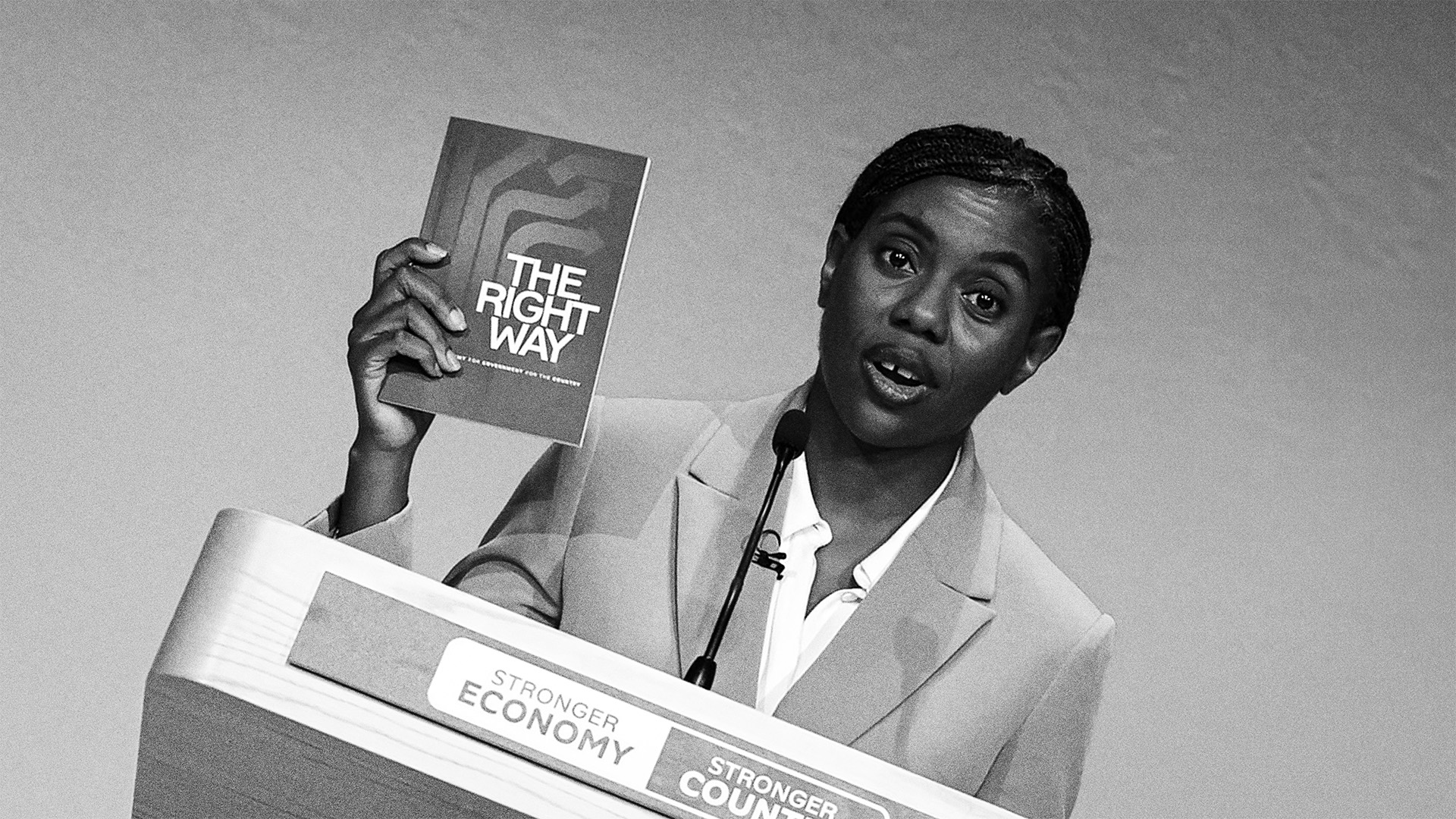
Badenoch did not quite go as far as to say “Le Parti Conservative, c’est moi,” but her message was hard to miss. She used the conference to launch a 100-page booklet, titled The Right Way, styled after The Right Approach, a booklet published by Margaret Thatcher during her time in opposition.
This newfound confidence was accompanied by a noticeable change in direction. For most of the last year, the Tories seemed determined to engage Reform in trench warfare, competing over who could look toughest on migration, and who could promise the harshest treatment of those who had come to the UK looking for a better life.
It is still the official policy of the once pro-business Conservative Party to deport 750,000 people within the first five years of a new government, a programme which would require an apparatus on the scale of that built by Donald Trump, and which would have been decried by the party as extreme even a few short years ago.
But that wasn’t where the party wanted to focus its attention this time. Instead, it was focused on the kind of high earners that used to be its core voters. The welfare bill would need to be cut by at least £23 billion, the Tories said, but there would be no shortage of money for giveaways for richer families.
They would end the cut-off for free childcare for people earning £100,000 or more. They would repeal the so-called “mansion tax” introduced by Labour – an annual charge on properties worth over £2 million. And, crucially, they would raise the threshold for inheritance tax to £1 million for a couple, and exclude their primary residence entirely.
This announcement was the centrepiece of Badenoch’s conference speech, and delighted those in the hall, after it was framed as letting people keep what they had worked their whole lives to earn.
Suggested Reading

Kemi Badenoch finally admits: I don’t know what I’m talking about
The leader was less clear about why a family who had bought a three-bed terrace in Hackney for £90,000 in 1990 had “earned” a house now worth £1.2 million, when a family who bought a similar house in Jarrow for the same price had now only “earned” £300,000. Just minutes after promising to simplify the tax code, Badenoch introduced a vast new complication – just try getting a boomer to downsize from their unmanageable family home once their inheritance tax plan relies on keeping it.
Badenoch’s team estimated the inheritance tax cuts would cost up to £5 billion a year, while independent experts at Tax Policy Associates thought it might cost double that. Either way, the Conservatives are certainly cutting clear dividing lines with Labour – as Andy Burnham asks people to dip into their pockets to pay a little extra for a National Care Service, Badenoch wants to slash welfare to cut taxes for the rich.
On one level, this was old-fashioned Thatcherite Conservatism in action – a small state, with low taxes, driven by the belief that economic growth could make everyone better off. But once you got past the slogans, it was missing one crucial ingredient: any kind of coherence.
Badenoch’s grabby tax-cutting pledges are squarely aimed at winning back the kind of well-off working age voters the party has lost to the Liberal Democrats. But with the party still requiring all candidates to sign a pledge to leave the European Convention on Human Rights, and to stick to a hard Brexit, such voters are unlikely to return.
Similarly, it makes no sense to bet the farm on growth while committing to policies certain to stall it. Withdrawing from the ECHR alone would trigger a crisis with the EU over Ireland that could easily escalate to a trade war. At the same time, the Conservatives have pledged to withdraw benefits from EU citizens with settled status – guaranteeing an even larger scale fight.
Doing all of that against the backdrop of zero net migration and mass deportations is a recipe for economic stagnation, if not an outright recession. Faced with the choice of battling for the votes of elderly racists or traditionally Conservative families, Badenoch has chosen to try to please both with directly contradictory plans.
Suggested Reading

Kemi Badenoch’s missing decade
No one in Birmingham seemed to notice much, but voters likely will – and if they somehow miss it, the plan would fall apart spectacularly in government. Much of the rest of the Badenoch programme was similarly hamstrung.
Badenoch’s policy on the triple lock is that she still supports it, but would not necessarily reintroduce it if Labour scraps it before she gets into government. That’s a confusing position, but makes sense if she doesn’t want to tie herself down with awkward spending commitments – except she has simultaneously promised that half of any savings she identifies will go to “pay down the deficit”, and her policies will be fully costed.
That means she has to find double the cost of any policy she announces in “savings” every time she wants a headline. Sometimes she’ll tie herself down, and sometimes she’ll refuse. Her shadow cabinet seems to think the message the public wants is more austerity, a smaller state, and lower taxes.
Shadow leader of the Commons Jesse Norman told one fringe that the public knew “at some deep level… there’s been this gravy train”, thanks to bailouts for the financial crisis, pandemic and energy bills. “Actually, at some point there is a reckoning” coming, he said, suggesting the Conservatives would be the best people to deal with that.
So, the future relies on growth, provided it can be delivered without any policies to encourage it. Better times are coming, unless they aren’t. Welfare must be cut, so the state can pay for the childcare of the top 1% of earners – and cut the tax on the inheritances they get, too. This is the programme the Conservative Party hopes will return it to government.
In the foreword to The Right Way, Kemi Badenoch had big things to say on the path to government. “Policy is critical but it comes last, not first: principle comes first, then a way of governing, then diagnosis, and then policy,” she wrote. “Otherwise, a party simply accumulates random promises with no argument linking them together.”
 Most popular

Burnham is already winning the new Brexit wars


Reform and the Greens are fading – the real fight is Tory v Labour
I was at Eton with Charles Spencer – this is how it explains his battle with the royals


The uncomfortable truth about Ariana Grande