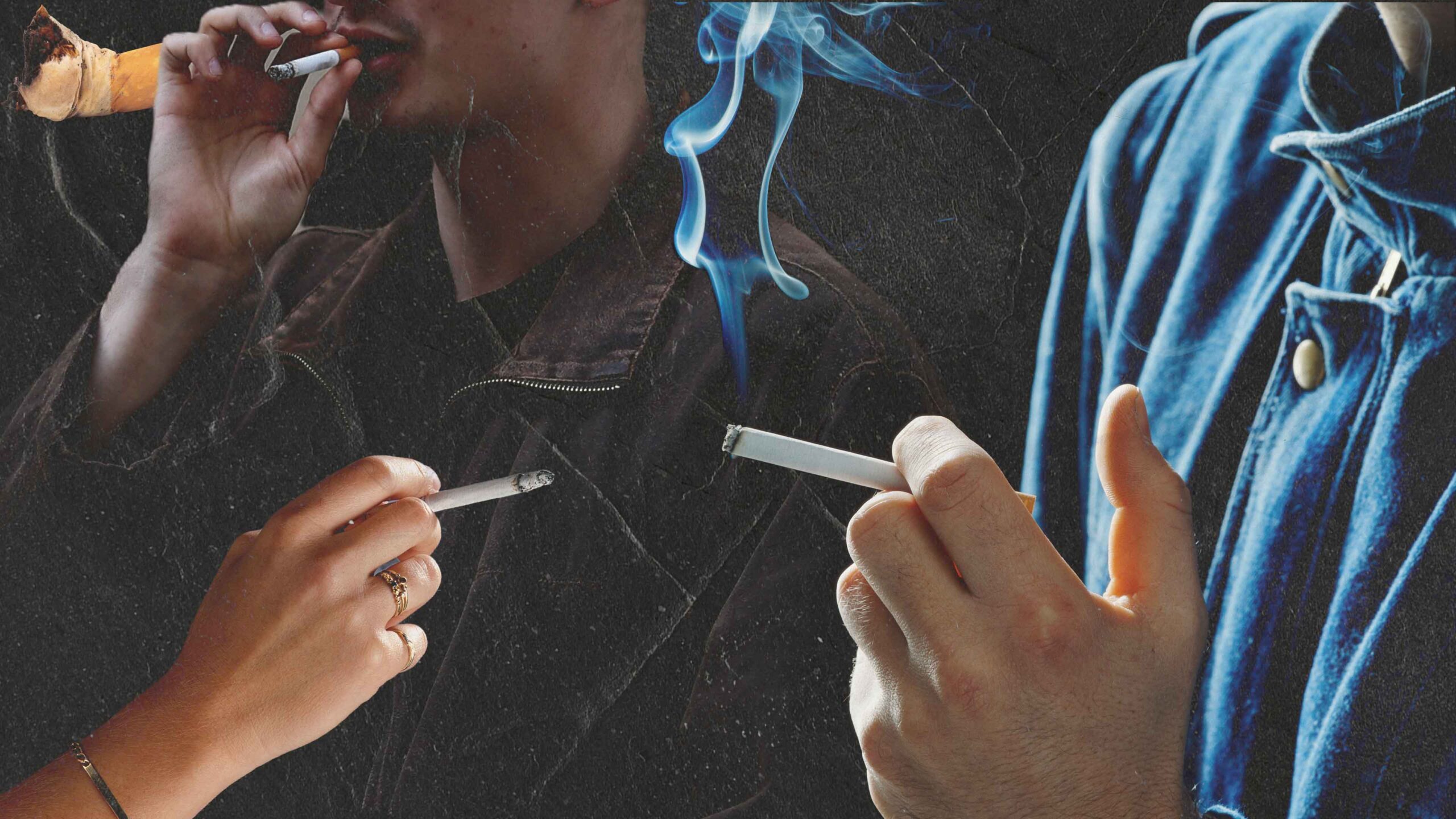
After taking up cigarettes while studying for her A levels, upon arriving at Bristol University at age 18, Ellie found her tribe.
“I’d say that 98% of the people I surround myself with smoke,” she tells me. “To us, it’s not a big deal. I can think of about two of my friends that don’t smoke. And even they might join us outside for a cigarette if we’re at the pub.”
Ellie’s testimony accords with the evidence of my own eyes and nose. Only weeks before Britain’s generational smoking ban comes into force – meaning anyone born on or after January 1, 2009 will never legally be able to buy tobacco products – young people seem to have taken up smoking in numbers not seen for many years. So common is the practice round my way, in Central London, that I can only conclude that every passerby under the age of 25 has a habit equivalent to the regulars at Rick’s Café, in Casablanca.
I am, though, mindful of caveats. A scalding summer and a pleasant September mean that the cubs sucking back smoke at tables outside the Camden Head, on the corner of Pratt Street, NW1, might well be unrepresentative of the cohort seated inside. Up at Camden Lock, meanwhile, the teenagers staining their lungs in and around the market do so in proximity of a middle-aged punk with a tattooed face who draws a wage posing for photographs with tourists for a quid a throw. Mine is not a neighbourhood known for its sensible behaviour.
Speaking to Ellie, however, makes me wonder if the trend extends beyond the confines of a rock and roll enclave of a capital city. “I’m in touch with my ex-boyfriend’s little sister, who’s 13, and although she doesn’t smoke, her friends do,” she says. “And my best friend’s little sister, who’s just turned 14, she smokes, as do all her friends. I was, like, ‘Oh my God, that’s crazy!’ No one I know was like that at that age.”
Similarly, Caroline Cerny, from the anti-smoking charity ASH, tells me, “Anecdotally, I would agree with you. I’ve got teenage children and they say that they think more young people are smoking. Particularly older teenagers.”
Naturally, the key word is “anecdotally”. Notwithstanding statistical eddies and flows – an uptick in the wake of the pandemic, for example – the hard data suggests that young people are in fact tumbling out of love with tobacco.
Office for National Statistics data released in October showed that only 9.8% of Britons now smoke cigarettes, a figure that drops to 7.2% among those aged 18 to 24. That is down from 25.7% in 2011, although the figures for young people vaping continue to rise – they are now roughly equivalent to those for cigarettes.
Does the increasing rarity of seeing people smoking in public make young smokers stand out? Or could it be that those who consider themselves only casual smokers are less willing to admit to the habit when asked by pollsters?
In Bristol, Ellie (not her real name) and her circle smoke only intermittently, while at the pub, or in listless moments out and about. Lighters in hand, during slow evenings at home, she and all her housemates have been known to pop out to the garden for what she laughingly refers to as “some fresh air”.
Suggested Reading

Suella Braverman’s book has sold only 106 copies. This is why
But this is how they get you. Less than a decade after igniting my first Marlboro Light, my own now-extinguished habit reached the point where I would step outside for a smoke if I woke up in the middle of the night. In the thick of winter, at 4am, shift workers and clubbers could find me on the front steps in a Motorhead shirt and a pair of boxer shorts. In the blissful period between flirtation and addiction, this was not how I pictured things playing out.
Despite mounting evidence that I am no longer A Young Person, few things have made me feel quite as aged as writing this piece. Mindful of the blanket ban on formal advertising of cigarettes, not to mention the universality of smoke-free public spaces, at its outset, I simply couldn’t account for what I was seeing on the streets of my adopted home city.
Consider, too, the far from trifling question of cost. To my genuine amazement, in London, the average price for a pack of squares is £17.50.
Turns out, though, that Big Baccy has been keeping up with the times. Rather than plastering the names of their brands on the sides of Formula One cars, today, serious money is being shovelled in the direction of online influencers.
Putting it mildly, the matter seems murky. A report by the US charity Tobacco Free Kids alleged that these “surround sound” viral campaigns violated the advertising rules of the social media platforms on which they appear. Unsurprisingly, the infractions went unpunished.
To my considerable delight, a number of these shilling microcelebrities seem about as au fait with smoking as I am with juggling chainsaws. As the laughter subsided, though, the deviousness of the messaging was less amusing.
“Ever since I was a little girl, I knew that I wanted to smoke cigarettes,” coos one presentable young woman who has probably never seen GoodFellas in a clip on TikTok. “Not in a trashy, bad-for-your-health type of way, but more like a classy, chic type of a way.” Well, that is a relief.
To this, we can add the guiding hands of the genuinely famous. In recent times, celebs like Timothee Chalamet, Florence Pugh, Dua Lipa, Jenna Ortega, Anya Taylor-Joy, Lily-Rose Depp, Lady Gaga, and Lana Del Ray have been photographed or filmed affixing smouldering objects to their pretty young faces. Fashion brands such as Aaron Esh and Edward Crutchley have also used cigarettes to promote seasonal collections at fashion shows and other media events.
In a fug of complacency, meanwhile, opposing voices have fallen silent. As Caroline Cery, from ASH, tells me, “There’s a concern that the really hard-hitting [anti-smoking] campaigns of my youth… don’t exist anymore. We’ve lost sight of just how harmful smoking is.
“It’s a habit that will kill two-thirds of long-term smokers. That kind of message seems to have been lost. It’s no longer present in our minds, just how harmful the habit is.”
Suggested Reading


Is this the moment MeToo died?
Considering whether any of this quite accounts for the ongoing prevalence of tobacco is a pursuit that would go well with a gasper. Sixty-three years after the pivotal US Surgeon’s General’s Report first formalised the link between coffin nails and lung cancer, like Japanese knotweed, the dark glamour of cigarettes marches on. In an unbeatable phrase, conversing with his friend Martin Amis, Christopher Hitchens once described their shared habit as “the miracle of smoking”. Both men died of oesophageal cancer.
As young people all around me continue to puff away, it occurred to me that perhaps the entirety of the human condition can be explained by our fondness for nicotine. In a haze of smoke, as a species, we have difficulty seeing pictures either big or small.
Forty years after almost half of the adult populations of the United States and the USSR mitigated the chill of the cold war by nuking their own lungs, today, a fresh generation faces a climate emergency with the aid of a product that brings ruin to earth and flesh alike. Whether planetary or personal, these are problems for our future selves.
At the end of an enjoyable interview, I ask Ellie if she has an exit strategy for giving up smoking. “I know it sounds bad,” she says, “but at the moment I really don’t plan on stopping.”
 Most popular

I went looking for Trump’s America – this is what I found

18 things that will absolutely, definitely happen if Trump gets whopped in the midterms

Emily Maitlis’s diary: Why are we turning away the people who could make Britain richer?

‘The deep state stole my mini-budget’: An exclusive extract from Liz Truss’s new book