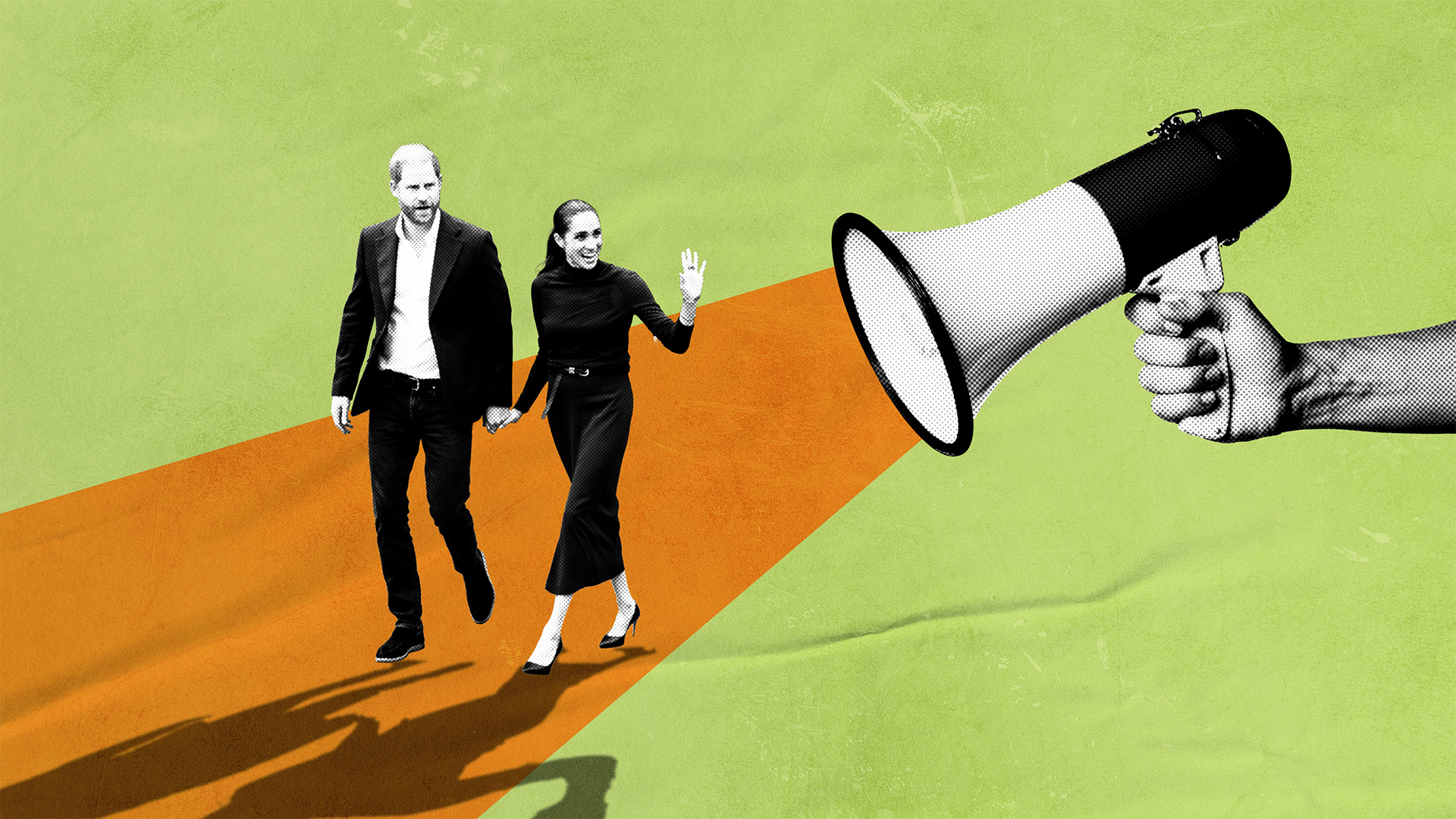
There was a general agreement in the British press that one line from Prince Harry’s 40-minute interview with GQ was the story. In a segment about family disagreements, Harry said, “Some people don’t want it to work out. I want it to work out.” Cue a rash of stories about a perceived swipe at his brother William, followed by a statement from Harry’s spokesperson clarifying that “the comment was made in a general context and was not directed at his family in any way”.
Three quotes from near the end of Harry’s conversation with Zach Baron are curiously absent from the newspapers’ acerbic write-ups. The first is about why the prince doesn’t just keep a low profile: “Someone like me, if you’re sitting back, staying quiet, keeping low, the stories don’t stop. The stories are continuous… Why not try to be in control of your own story?”
The second is a strong defence of his right to speak for himself: “Everybody else is allowed to tell their version of my story, but god forbid I should be allowed to tell my side of it.”
And the third is his commentary on journalism: “Growing up, I was surrounded by some of the worst forms of journalism… I’ll be damned if [people] who pretend to be journalists are going to drag this whole profession down the drain. I take real issue with that because journalism – proper journalism – is so important.”
Why are those quotes missing from the reports? Because they directly challenge the hacks writing them.
Suggested Reading
The Daily Mail’s dangerous obsession with Meghan
Take Hilary Rose in The Times, that paper’s de facto Harry and Meghan snark correspondent. She begins her piece on the interview like this: “For some of us, loose talk about podcasts by the Montecito Two is triggering. This time, though, it’s Harry talking, not her, to a man called Zach Baron, for reasons that even Zach Baron doesn’t understand.” She goes on to imply that Harry just rocked up and started oversharing to a man who just happened to have mics set up.
It’s a strikingly dishonest opening, even by Rose’s standards, since Baron knew exactly what the interview would be about. Harry has collaborated on a Masterclass course about grief with the neuroscientist Dr. Mary Frances O’Connor and was there to promote it.
Rose, who has expended thousands upon thousands of words about Harry and Meghan, pantomimes disgust about doing it again. She and The Times know exactly what they’re up to, particularly when they include a picture of Harry falling out of a nightclub in 2007. If the Royal Family’s motto was once “never explain, never complain”, the British press’s motto remains, “never forgive, never forget”.
When Rose mocks the idea that Harry partied hard as a teenager because of his grief over his mother’s death; when she smirks at his suggestion that he is trying to parent his children in a different way to how he was raised, it’s not just a dig at him. It’s an attack on others who can empathise exactly with those feelings even when they’re articulated by someone who was born a prince – something Harry points out several times in the interview – and has lived an extraordinarily strange life.
In The Sun, the paper’s royal editor, Matt Wilkinson, accuses Harry of “[causing] an international incident every time he opens his mouth” before writing a cloying tribute to the “loyal royals” who attended the state visit of the Sultan of Oman. He suggests the GQ interview – filmed a month previously – was released deliberately to land “in the middle of an important royal diplomatic mission”. Is the Royal Family really so fragile that it can’t cope with a mild conversation with Harry appearing on the same day that it was sucking up to a sultan? And does anyone think Haitham bin Tariq, Oman’s hereditary dictator, would notice or care?
For The Daily Mail, still livid that Harry had the audacity to even challenge its owner Associated Newspapers in the courts, the GQ interview was another welcome opportunity to put the boot in. Its royal editor, Rebecca English, told readers the conversation had been a “one-man pity party” in comparison with the “pomp and pageantry” of the state visit. There’s something particularly sad about the sort of person who is impressed by a golden carriage or someone in a big sparkly hat.
English’s sources sneered that Harry must “think everyone has collective amnesia after the past few years” and that he should “just bloody shut up about it”. Of course, that’s not at all what she or her bosses want to happen.
Harry is right; the stories would not stop no matter what he did. Silence would, in itself, be something to comment upon and to fill with the kind of speculation and scurrilous insinuations that keep the clicks coming.
 Most popular

Suella Braverman’s book has sold only 106 copies. This is why
The Brexit majority has gone for ever – rejoin now has a majority of 9 million

The mask has slipped – now we can see the real, shameful face of Reform

The riots in France are being stoked by Russia and Iran