
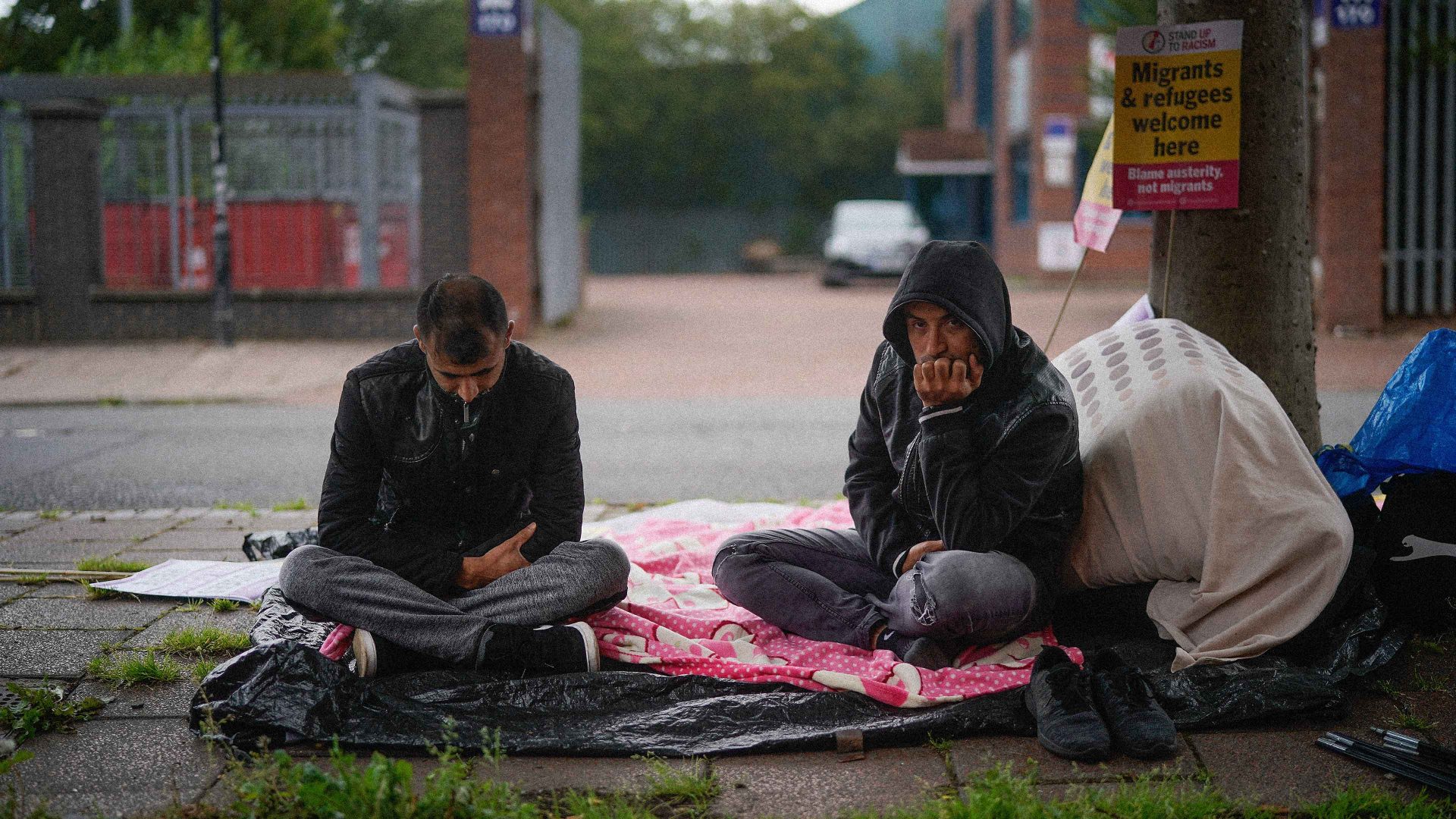
Whenever he moves to a new home, Abdo writes a letter of introduction to his neighbours. Delivered by hand to the houses on his street, the recipients are told not only that he’s employed as a support worker for adults with learning disabilities, but that he’s also a Sudanese refugee.
In his missives, Abdo (not his real name) might also add that, like thousands of other refugees, he has thus far been unable to find a job commensurate with his skills and expertise. In the days before drawing a wage as one of 161,000 non-EU workers in the care sector, he was an operations and maintenance manager on the railways of Sudan.
“I have a good experience with traction and rolling stock systems,” he tells me, “which includes the fault findings for braking systems and the door systems as well as the other parts underneath like the wheels and these things… If I got a job [in the UK], I could be doing these things. I’m looking to be an expert in this field.”
Having equivalised his credentials in a course at the National Training Academy for Rail, in Northampton, Abdo is qualified to work on the UK’s rail network. The National Skills Academy for Rail, meanwhile, estimates that a third of the industry’s workforce (up to 70,000 employees) will leave or retire in the next four years. While our Sudanese friend sits in the sidings, all but literally, an acute skills shortage is hurtling down the tracks.
The term for refugees who hold jobs that are separate from the field and grade of their qualifications is “underemployment”. There are large numbers of people who graft away in unglamorous sectors of the market, many of them foreign workers, who stack shelves and pick fruit. But they are earning their living in positions that bear no relation to their working lives in the countries they left behind.
With this, everyone loses. Without wishing to denigrate meaningful employment – in care homes, warehouses, or as cleaners – permanently situating foreigners in positions for which they are over-certified amounts to a huge waste of ability.
Entry-level jobs can be a useful means of opening the door to more suitable employment. But Breaking Barriers, a British charity that helps refugees find work says salaries and job security pose significant challenges to their clients. Despite 71% of people on their books holding degree-level qualifications or higher, most positions pay just above the minimum wage. Many workers are on zero-hours contracts; relatively few hold full-time positions.
“When refugees can’t reach their potential, it’s not only individuals who lose out,” Louise Thomson, its director of services, tells me. “Employers, local economies, and communities miss out on valuable skills and talent, too.”
For all the Reform and Tory talk of Britain being a soft touch, asylum seekers (people yet to attain refugee status) face a devil of a time entering the job market at any level. While the Home Office considers their request for sanctuary, new arrivals are barred from seeking paid employment for 12 months.
Only after this period has elapsed can permission be sought to apply for positions on a government-approved Immigration Salary List, which offers work for bricklayers, nursing assistants, care workers, and more. Wages are capped at 80% of the market rate.
In a system not known for its efficiency, asylum seekers often find themselves in a state of institutionalised limbo. Sixty per cent of Breaking Barriers’ client base spend more than a year awaiting a decision on whether they will be legally recognised as refugees. Incredibly, for almost one in 25 of these people, the wait exceeds a decade.
With claimants required to subsist on £7 a day for food, sanitation, and clothing, this purgatorial existence draws some to gig work in the black economy. In 2024, a joint all-party Parliamentary group on poverty and migration described the restrictions on asylum seekers finding legitimate jobs as “destitution by design”. Lifting the sanction, it found, would allow those seeking sanctuary “the chance to support themselves and escape poverty and destitution”.
“Unemployment has a massive impact on people as individuals,” Louise Thomson tells me. “‘What is my purpose and what is my meaning?’” For refugees specifically, who have left a country and in a lot of cases have been very suddenly uprooted, there’s a huge identity crisis of leaving your home against your will.”
She continues. “There’s a huge sense of loss in terms of your family and your networks, and your home, and everything else.” In the job market, the change of circumstances can be especially startling.
“For a lot of people there’s also a huge professional loss,” Thomson says. “People might have been running their own businesses, or been really high up in a university, or been a judge.”
Case in point: when visiting her local Job Centre, Areeg, a Sudanese refugee based in Manchester, was told to apply for work in kitchens, or as a cleaner. “I tell them, ‘I have masters’ degree, how can I work as cleaner?’” she says. “This is a waste of skills. I have skills that can be made use of. I think the country needs these skills.”
Indeed it does. As a qualified civil engineer, Areeg seeks to enter a profession that the industry newsletter Civil Edge says “is grappling with a severe talent shortage, driven by emerging projects such as the Lower Thames Crossing, the Great Grid Upgrade, and the Stonehenge Tunnel, in addition to ongoing developments like HS2 and Hinkley Point C”. The demand for skilled labour, it reports, “is expected to peak in 2026, risking project delays and heightened competition for skilled workers”.
For her part, after applying for an estimated 200 positions – for which she’s had just two interviews – Areeg’s seemingly indomitable will to succeed has so far been bested by one of the market’s most insoluble catch-22s. Without experience in the British workplace, she can’t get a job; without a job, she’s unable to gain experience. Equipped with domestic certifications, even her efforts to work for free have come to naught.
To this we can add the kind of harrowing circumstances familiar to many refugees. In fleeing Sudan at the start of the war in 2023, Areeg lost her house, her business, her cars, some gold, and all her money. Notwithstanding her remarkably breezy account of this trauma, her story serves as a stark reminder that while asylum seekers often arrive on our shores with nothing, at the point of departure, the everything they leave behind can amount to a very great deal.
“I [came here with] nothing,” she tells me. “I start from zero, or below zero.”
“What’s really difficult is that [we are] focussed only on one struggle, which is employment,” says Louise Thomson of her work at Breaking Barriers. “Whereas each individual [client] is thinking of their job, their housing; they’re wondering if they’re safe, if their partner is able to access the therapy they need. There are so many things.”
This list also includes an increasingly menacing chorus that leaves new arrivals in no doubt that they are not welcome here. In this telling, degrees of individual knowledge and experience are of no value. Instead, the presence of this cohort in our midst is seen only as a cause for alarm.
In what has become the very definition of a hot-button topic, while awaiting refugee status, asylum seekers are housed by (and at the expense of) the state. Notwithstanding the 22,996 new arrivals placed into nationwide detention centres (in the year ending December 2025) – an 11% increase on the previous year – in London and the southeast, most of these people are in hotels that have become flashpoints for local anger and nativist protest.
Last summer, a month before the conviction of the Ethiopian asylum seeker Hadush Kebatu on two charges of sexual assault and one charge of attempted sexual assault, I travelled to Epping, in East London, to watch a fitful group of protestors standing in the August rain outside the hotel at which the abuser had been housed. While agreeing that Kebatu’s actions were wholly abhorrent, I noted that none of the demonstrators seemed at all concerned that the women inside the hotel had been living in even closer proximity to a predator.
In the teeth of wider falsehoods of asylum seekers living high on the hog at the taxpayers’ expense, Juhina, a doctor from Syria, described to me her own experience as a guest of the state.
In the hotel in which she was housed, she says, “There is nowhere to cook, so for one year you are sitting without any cooking, without anything, just eating fast food or sandwiches. It wasn’t a good experience.
“Sometimes they just open your door and put someone in your room. A stranger. Say, ‘She stay with you’… I spent one year in this situation. It wasn’t easy. It was the worst experience of my life.
“I don’t want you to give me food,” she adds. “I don’t want you to give me accommodation. I want to work.”
After being granted refugee status in July 2023, Juhina says that she was given just seven days to leave her asylum hotel. Faced with the very real danger of sleeping on the street, she was able to rent a studio flat in Whitechapel, London, where she lived with her husband, who was granted leave to remain in the autumn of 2023. Then, at a cost of more than £1,300, she also attained the PLAB 1 & 2 qualifications that allow her to practice as a doctor in the UK.
In what is fast becoming a familiar refrain, however, thus far, her certifications have failed to provide a direct pathway to a living wage. Instead of being a doctor, Juhina now works in a non-clinical capacity at a private GP surgery.
“There is a shortage of doctors in the UK, but the NHS does not welcome us,” she says. “When I came to this country, my dream was very big. I want to help people. I want to do research. I want to study. But after one year, my dream became less. Now, I just want a job.”
Suggested Reading

Immigration is falling sharply – why haven’t politicians noticed?
Despite being scattered across the country, the four refugees interviewed for this article were united in confusion that a country as structurally imbalanced as Britain should choose not to make use of their hard-won talents.
Betraying just a hint of indignity, Fawad (not his real name) tells me that he was once a high-ranking credit risk manager at Afghanistan International Bank. Now settled in the Midlands, he’s gone from rubbing shoulders with government ministers in Kabul to downgrading his CV for banking jobs that have thus far proved elusive. While the Financial Services Skills Commission warns of a shortage of risk assessors, Fawad, who speaks five languages, works as an interpreter.
“Most of the time I’m sitting… in front of my phone [and] I’m translating while [people are] going to GPs or to the council,” he says.
All around him, meanwhile, are reminders of precariousness and vulnerability. When his father died of stomach cancer, Fawad’s status as an asylum seeker meant he was unable to leave the country. Despite living alone in Afghanistan, a place notoriously inhospitable to women, his ageing mother’s subsequent application to join her son in England has been refused (the decision is currently under appeal).
“All these political parties have this one tool, which is immigration,” he says. “There are lots of other [issues on which to] campaign for the elections, but they know how their citizens will react and so they’re focussing on only one thing: immigration.” Asked if he feels targeted by the darkening rhetoric, Fawad answers, “That’s the problem”.
For those in or near the corridors of power, though, the matter has been settled: a reduction in numbers is essential. Against a backdrop of newspapers that fixate only on the most negative aspects of the immigrant story – as if important issues such as crime, costs to the public purse, and housing were the only games in town – television channels that propagate the Great Replacement Theory, and Nigel Farage labelling the new prime minister “Open Borders Andy”, evidently, there is little room for nuance.
Amid this cacophony of nonsense, Britain is in danger of losing more than its moral bearings. Notwithstanding a sense of unease about measuring the worth of individuals in purely economic or infrastructural terms, clearly, there are benefits to be had in tapping the skills and proficiency of scores of thousands of people. With an ageing population and a declining birth rate, in the UK, important tasks wait to be done.
But as the country drives itself insane talking about refugees, with disarming clarity, the quartet of willing workers interviewed for this piece see asylum as being a two-way street. Of a nation that has granted them sanctuary, they ask nothing more than the chance to show what they can do for us.
“Immigrants can add value to the country,” says Areeg in Manchester. “Not all of them need to take benefits. They need to work. They need to contribute. But they need a chance to do this.”
Postscript: Since being interviewed for this piece, Abdo has found a job as a railway engineer.
 Most popular

My truly deranged encounter with Trump apologist Kellyanne Conway

Suella Braverman’s book has sold only 106 copies. This is why
The moral depravity of Robert Jenrick

Hungary’s lesson to the world: Populism isn’t permanent