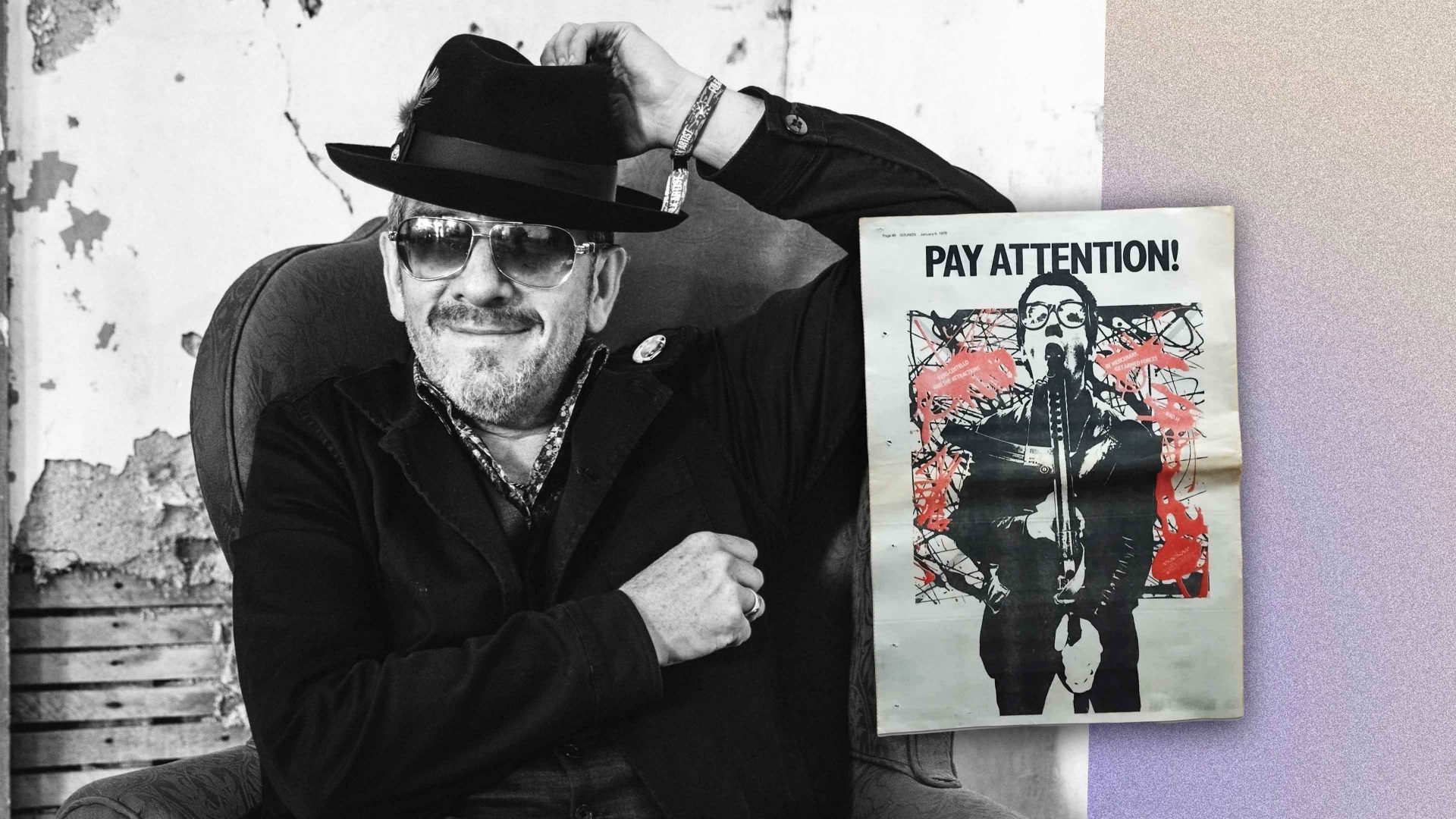
In the first week of 1979, Elvis Costello issued a piece of pop art of such urgency that I’m reminded of it almost every time I listen to his music. Designed by the late Barney Bubbles to promote the album Armed Forces, the image features the singer holding a machine gun to his mouth. Above him are the words, “Pay attention!”
The advice is still good. When it comes to social commentary, in three or four-minute vignettes, no songwriter is more adept at skewering the darker aspects of the English character. Placing his shoulder to what he “self-consciously describe[s] as… political songs,” as he put it in an interview with the BBC arts programme Arena in 1989, Costello catches the scent not only of what is happening now but what might be coming next.
In the company of his band The Imposters, this week, the now 71-year-old embarks on an 11-date UK tour of theatres, halls, and festivals. With its emphasis on material from the earlier stages of a riveting career – namely, an 11-album run from debut LP My Aim Is True, from 1977, to the bracing Blood & Chocolate nine years later – the Radio Soul gigs will see ardent supporters up and across their country gathering to hear songs that (as Costello put it in Little Palaces) are like “doors [that] swing back and forwards from the past into the present”.
I’m hoping for Sunday’s Best, a deep cut from Armed Forces that has been plaguing my mind since the start of the month. To a beat and an arrangement that sounds like music from the kind of circus from which children go missing in surprising numbers, Costello sings of prudish yet prurient people whose hearts have been hardened by life in a grey country. Roll up, roll up, to “read about the private lives, the songs of praise, the readers’ wives” in a place “where every day is just like the rest”.
Clipped to the point of exaggeration, the vocal delivery is sharp. Only once does Costello allow his voice to give vent to the force of his words. As he sings the lines “listen to the decent people, though you treat them just like sheep, put them all in boots and khaki, blame it all upon the darkies,” the final syllable elongates to the point at which it seems to explode with the exertion of it all.
And now look where we are. I write these words at a time when an entire media and political ecosystem accepted an invitation from Nigel Farage to dance to an old-time rag. Never mind that the response to his knowing provocations about blood and race contained many voices united in condemnation, all that matters is that (once again) he’s calling the tune.
In addition to a speech that set the news agenda for days on end, in a post on X that must have caused bedlam over Battersea way, the Reform party leader posited that “Britain’s historic way of life is being thrown away”. In The Daily Telegraph, he wrote that “over the past 20 years, Britain has experienced immigration on an unprecedented scale… in too many places, communities live parallel lives”. Blame it on the darkies, indeed.
For his part, Costello has made it his business to sift through the mire of English low-mindedness. Somehow, the terrain described by Christopher Hitchens, in a review of the book Stick It Up Your Punter: The Uncut Story Of The Sun Newspaper, as “the snigger of a Myra Hindley, the cloacal chorus from the Millwall terrace, the focus on excrement through the letterbox, the ghastly innuendo about race and sex” has been mined for art.
Suggested Reading
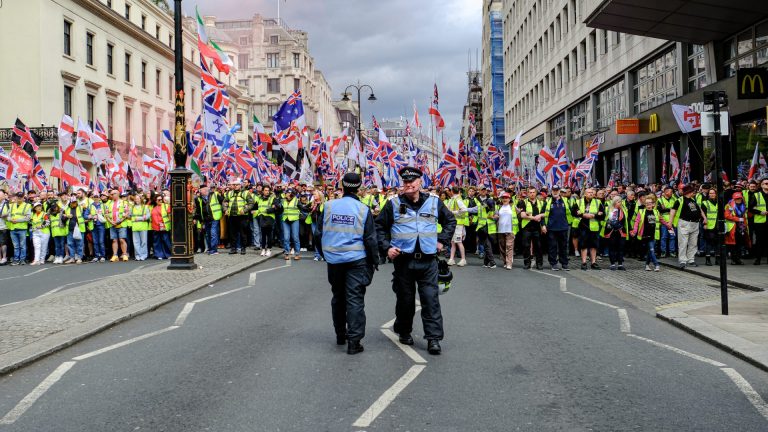

‘I photographed the Tommy Robinson march – here’s what I saw’
As if by instinct, he was at it from the off. In a lyric that spans continents and tenses, the genesis of his debut single, Less Than Zero, from 1977, was the attempted re-emergence into polite society by the founder of the Union of British Fascists, Oswald Mosley.
“There he was on TV, saying, ‘No, I’m not antisemitic, of course I’m not – doesn’t matter even if I was,’” the singer told Rolling Stone in an interview from 1982. “His attitude was that time could make it all right. It was a very English way of accepting things that used to really irritate me, really annoy me. The complacency, the moral complacency there – that they would just accept this vicious old man [rather than] string him up on the spot.”
Again, look where we’ve landed. Mosley’s rancid successors are on television every day. Some of them are in the House of Commons. Almost 50 years after Margaret Thatcher summoned outrage by claiming that “people are really rather afraid that this country might be swamped by people with a different culture,” today, there is “respectable” chatter about things the Iron Lady would never have dared to say out loud. While we’re about it, neither would Enoch Powell.
Last week, people were out on the streets. In hawking a loogie in the face of a father who asked that his son’s murder not to be used as capital, politicians and commentators all but incited the hundreds of racist “protestors” who rampaged through the thoroughfares of Southampton. According to the antifascist magazine Searchlight, masked faces at the front of the crowd threw Nazi salutes while chanting “white power”.
We’ve been here before. On September 24, 1978, Elvis Costello & The Attractions played the song Night Rally to a crowd of 150,000 people at the Anti-Nazi League Carnival at Brockwell Park, in South London. Written in response to the then-rampant National Front, the claustrophobic masterpiece contains a line that today sounds like an unheeded warning against the flip dismissal of ghouls and foot soldiers whose exclusionary idea of “patriotism” chills the blood.
“You think they’re so dumb, you think they’re so funny, wait until they’ve got you running to the night rally,” Costello sang.
Suggested Reading


How Kylie Minogue remade Australia
Tellingly, on the evening of November 7, 2016, Elvis Costello and his band The Imposters gave Night Rally a rare airing as the first song of the night at the Beacon Theatre, on the Upper West Side of Manhattan. The date is notable for being the day before Donald J Trump secured his first term of office.
Earlier that year, barely two weeks after the Brexit referendum, the group dusted off the even less frequently performed Sunday’s Best at a concert at the Roundhouse, in Camden Town. For an artist who can often be infuriatingly dismissive of his own work, here at least, Costello seems to have been aware of having correctly read the runes.
That he did so when he was so young astounds me. Emerging through a door smashed open by punk, the complicated shadows cast by the songs of Elvis Costello are centred by a moral certainty that belies his years. While early day efforts by contemporaries such as The Clash and Stiff Little Fingers fizzed with pubescent rage, the young man born Declan McManus simply seethed from a distance that bore no relation to the hectic and excitable nature of rock and roll.
He worked at speed, too. The lyrics to the unimprovable Oliver’s Army were written on a plane ride home from Belfast. (These days, in concert, Costello no longer sings the n-word that appears in the second verse. In 1979, the year of the song’s release, the term referred to a description used by sections of the Protestant community to describe members of the Catholic faith.)
Tramp The Dirt Down arrived in a single flourish while his then-wife was out at the shops. In the 1970s and ‘80s, Elvis Costello’s rebuttals came as fast as the gutter newspapers he so evidently loathed.
And then there was the voice. As distinct from Tom Waits, who sang like a veteran of several wars even when he was 23, Costello sounded neither young nor old.
Suggested Reading

What Andy Burnham’s by-election playlist says about him
At times, as on the eternal Shipbuilding, he could be mesmerisingly human. On The Invisible Man, from the same parent album (1983’s Punch The Clock), the timbre is of a detached observer who not only sees the shape of our terrible tomorrow but the very means by which it will be attained.
“Crowds surround loudspeakers hanging from the lamppost, listening to the murder mystery,” he sings. “Meanwhile, someone’s hiding in the classroom, forging the books of history.”
In an extract from his anthology In The Fascist Bathroom, the American critic Greil Marcus adroitly summated the highwire act executed in these and other songs. “If Costello is wrong about the future he has lined out… he will seem like a paranoid fool,” he wrote. “But that has never bothered him in the past. It is worth remembering that people can be melted down… to utensils, to their social and economic functions.’
This is what Elvis Costello was up against. Far from being a paranoid fool, the prescience of his intuition and articulation as to the fate of a country that was failing to watch its step has led us to a sorry pass on which the worst elements of England have moved from the fringes of his imagination to the very centre of public life.
One hopes that it’s not too late to start paying attention.
Elvis Costello’s Radio Soul tour begins on June 12 at the Brighton Dome