
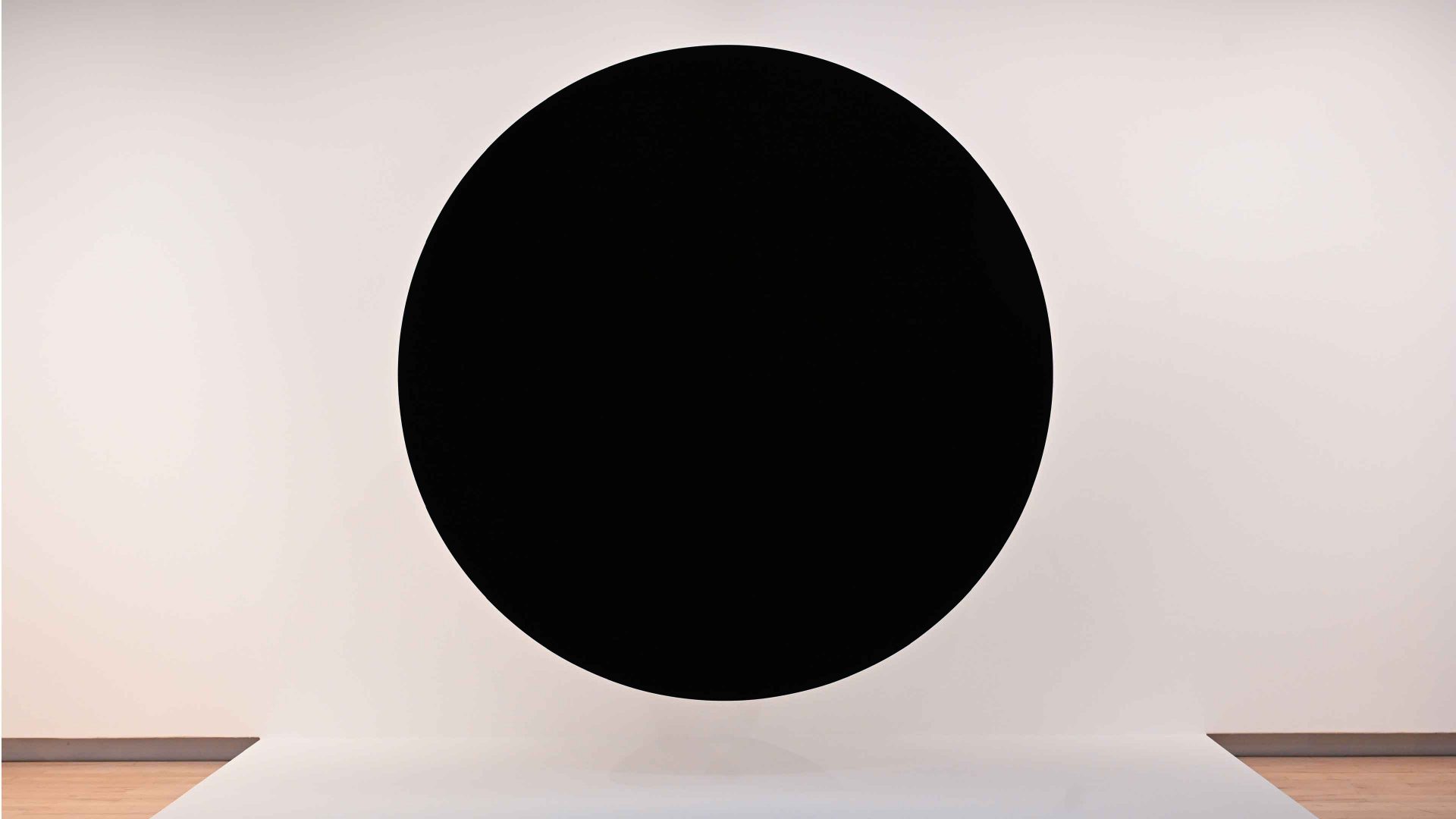
How much more black could this be? That’s what you’ll find yourself asking if you visit the latest exhibition at London’s Hayward Gallery by British-Indian artist Anish Kapoor. And you might find yourself intoning the immortal answer of Nigel Tufnel, Spinal Tap’s guitarist, as he stared into the sleeve of their “black album”: None. None more black.
Kapoor has a room filled with works that employ a pigment called Vantablack, devised more than a decade ago by the British company Surrey NanoSystems, which absorbs 99.965% of all visible light that falls on it. This means that the material isn’t just black in hue; it reflects almost no light whatsoever.
It’s hard to convey in words the visual effect of that near-total absorbance, which positively demands poetic metaphors. The blackness eliminates all sense of topography, indeed of materiality at all. It is truly like gazing into the void: I suspect this must be what it is like for astronauts looking out on the abyss of space.
The effect is dizzying, disorientating, disconcerting. You can’t tell if the black object is flat – merely a circle of pigment deposited on the wall – or concave or convex (in fact some have protruding objects). Perhaps it’s actually a black-coated thing suspended in front of the wall? You have to take an oblique view to figure it out, and even then you’re not sure.
I found the effect thrilling, in part because it shows how we have firmly rooted expectations about matter – what psychologist Elizabeth Spelke has called an intuitive physics – and are unsettled when these are undermined. The experience brings to mind the way our brains rebel when we pick up a bottle of mercury and are shocked at how it seems far heavier than it has any right to be – or conversely, if we hold a lump of the material called aerogel, a porous mesh that can be more than 99% air and which seems almost obscenely weightless.
Suggested Reading


What if we’ve got ultra-processed foods wrong?
I have another reason to be excited by Kapoor’s Vantablack, however. It is a coating made from carbon nanotubes: hollow tubes of carbon typically a few micrometres long and a few nanometres in diameter. As I was present at the birth of carbon nanotubes, so to speak, they are close to my heart.
To turn them into Vantablack, the trick is to lay the tubes down on a surface as a kind of carpet in which all the tubes stand upright, side by side. The visual effect, with its ambiguity of shape and space, is precisely the sort of thing Kapoor has long experimented with. Vantablack becomes almost a “non-material”, he says, “rest[ing] on the liminal edge between an imagined thing and an actual one”.
In this, as in a wider delight in the lustre of rich, raw pigment, Kapoor shares much with the French painter Yves Klein, who likewise explored the spiritual possibilities of colour and (im)materiality, for example in his efforts to create an “invisible architecture” from jets of air.
There’s another thing the two artists share in common. When I say “Kapoor’s Vantablack”, I mean it. The artist controversially negotiated an agreement with Surrey NanoSystems that gave him exclusive rights to use the material artistically, recalling Klein’s patent on his trademark International Klein Blue (allegedly to “preserve the purity of the idea”).
Is that proper? Kapoor’s coup seemed to restore the advantage enjoyed by elite Renaissance painters who had privileged access to the best materials, such as expensive ultramarine. Some artists protested when Kapoor’s monopoly was established in 2016.
But making carpets of aligned carbon nanotubes is no trade secret. Researchers at Rice University in Houston did it in 2010, allowing the Belgian artist Frederik De Wilde to use a comparable black in minimalist squares. And the Massachusetts-based nanomaterials company NanoLab created a rival, Singularity Black, in 2017 specifically to counter Kapoor’s gambit. Meanwhile, in 2019 MIT researchers made a nanotube black slightly blacker still. Nigel Tufnel would surely approve.