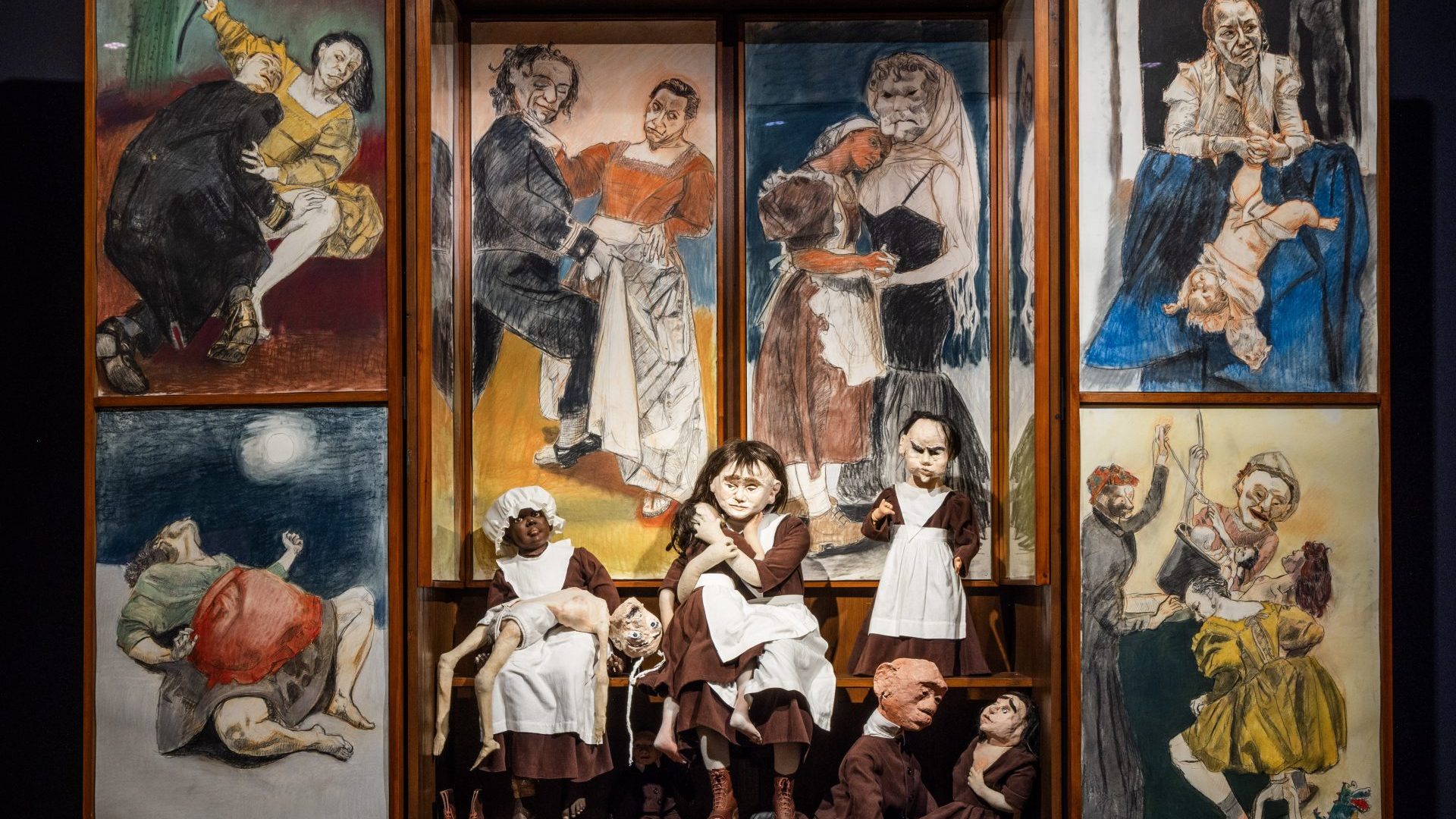
The instinct to expose the rot lurking beneath supposedly respectable society is a constant across the career of Paula Rego, the British-Portuguese artist who died in 2022. An exhibition of her work in Oslo includes a late, lesser-known series titled The Wine, 2007, which began as a commission to design a series of wine labels for a Portuguese winemaker.
In one, a mother clutches a bottle tight to her breast while her baby plays listlessly at her feet; another woman vomits into a lavatory, another into a washbasin. Another, titled Nursing, shows an exhausted woman pacifying her baby with wine straight from the bottle.
To Rego, the commission was evidently a provocation to address the realities of alcohol dependence in Portugal, where it continues to be a growing problem, especially among young women. Exactly what the client had hoped for is not clear, but it cannot have been the Hogarthian tale of moral decay that she came up with, and which they rejected.
Rego was 18 when she painted Drought, a small, narrow canvas in which a mother holding a baby gazes imploringly up at a fiendishly hot sun. The turn of the mother’s head, the pointy nose, the low viewpoint are unmistakably Rego – everything else might have been painted by the Norwegian master Edvard Munch.
Drought was only discovered a matter of months before the opening of Paula Rego: Dance Among Thorns, at MUNCH in Oslo, the first major museum exhibition of her work to be held anywhere in the Nordic countries. A letter from the young Rego to her mother, written after visiting a Munch exhibition at the Tate Gallery, London in 1951, was discovered at about the same time, and together with the painting provides definitive evidence of Munch’s influence on Rego.
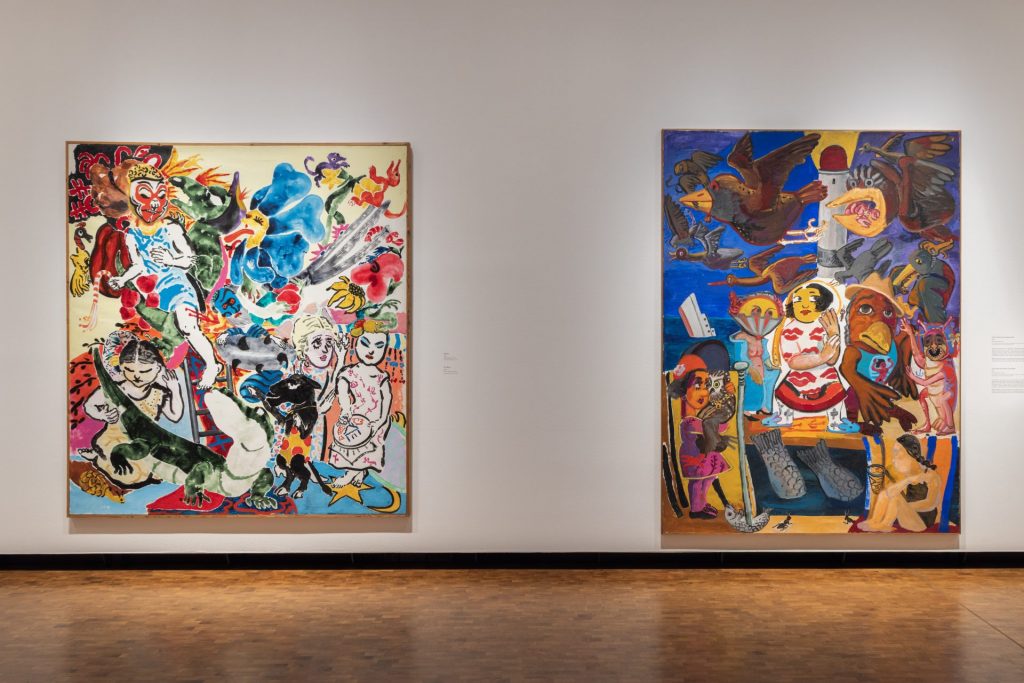
Curator Kari J Brandtzæg became increasingly convinced of the link between the two artists while she was preparing the exhibition: “It was almost as though Rego’s work was in a silent conversation with the Norwegian artist’s visual world”, she explains in the accompanying book, and she points to the artists’ shared concern with the spectrum of human emotional experience – the “dance among thorns” of the exhibition’s title.
Dance is a major motif for both artists – though separated by almost a century, Munch’s pen and ink drawing for Dance of Life, 1898-99, chimes unmistakably with Rego’s The Dance, 1988, and establishes a sympathy between the artists from the exhibition’s start. Staged in a museum that holds almost 27,000 artworks by Munch, the exhibition wisely limits itself to just three graphic works by him, sufficient to illustrate the points of overlap in their themes and motifs while also emphasising the two artists’ shared commitment to drawing.
We don’t know if Rego had a sketch book with her in 1951, when she first encountered Munch as a 16-year-old on a trip to London from her Kent boarding school. In her letter to her mother, she wrote: “I don’t know if you are familiar with that quite famous painting The Scream – that’s his”. Of all the works she saw, Inheritance, 1897-99, “which shows a seated woman crying with a skeleton child, all painted green in her lap”, made the biggest impression.
This horrifying image clearly remained in Rego’s mind’s eye as a model for the distressed mother and child in Drought, and very particularly the emaciated, dying baby. Though she clearly responded to the emotional drama of Munch’s painting, as a 16-year-old, she might not necessarily have understood the full implications of Inheritance, a commentary on the tragedy of hereditary syphilis, invariably passed to women and their unborn children by their infected husbands, who caught the disease from sex workers.
Prostitution was illegal in Norway from the mid-19th century, except in Kristiania (now Oslo), where, despite the high morals of the Lutheran church, it was allowed but heavily regulated, and sex workers were required to be examined for signs of disease by the police, who effectively operated as pimps.
There were no curbs at all on the men who visited Kristiania’s sex workers, and in Inheritance, Munch joins Ibsen, whose play Ghosts he designed the set for, and the painter Christian Krohg in their disgust at the sordid hypocrisy that left so many women trapped by disease, shame and grief. In fact, similar double standards existed across most of Europe, and Rego’s 2006 pastel Broken Promises shows a group of half-doll, half-child prostitutes, their weirdly helpless bodies an echo of their traditional status in Portugal as “toleradas”, subjected to unhygienic and undignified inspections by the police well into the 1960s just as had been the case in 19th-century Kristiania.
Rego’s most famously political work is her Abortion series from 1998-99. Seven of the 10 pastels have been brought together here, a rare achievement since they are distributed among several collections, but one that emphasises the immensity of this project – “propaganda”, Rego called it – to force attention on the failure in 1998 to legalise abortion in Portugal.
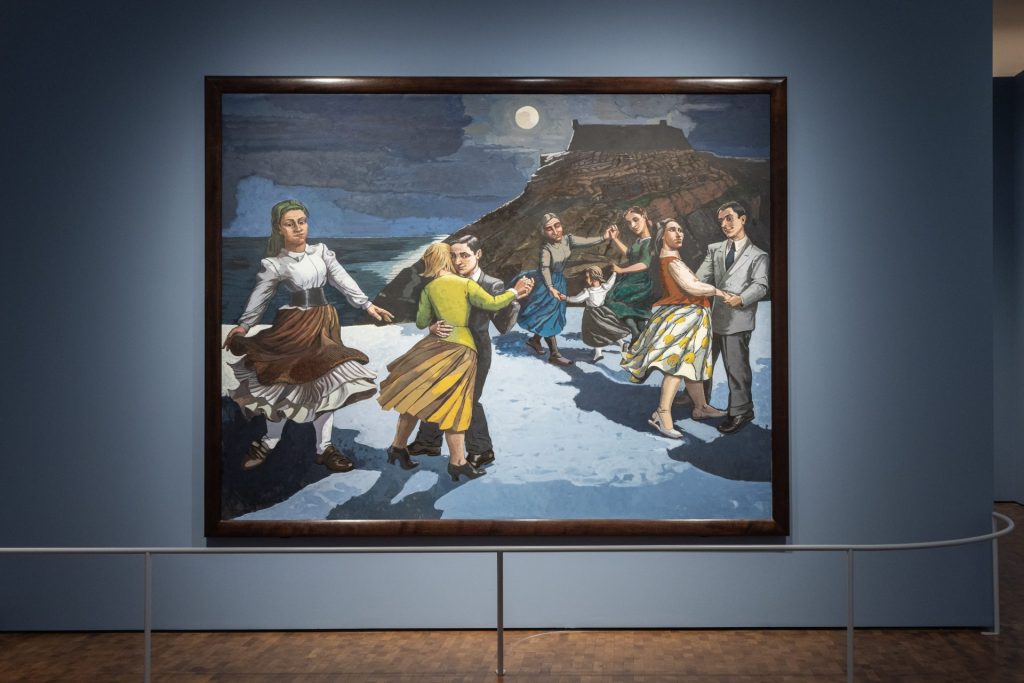
Valuable as the parallels with Munch are, Rego’s first large-scale outing in Scandinavia rightly keeps the focus on her. And while aspects of Rego’s practice – the lingering unease, the concern for suffering and injustice, and even formal elements such as use of colour and the focus on single figures or small groups – link back naturally to Munch, there are plenty of differences too.
Textile works, such as the monumental tapestry Battle of Alcácer Quibir, 1966, may be completely new to many visitors, who will recognise in the various handworked techniques parallels with the collages of Rego’s other political works from this time. Commissioned by a hotel on the Algarve, its references to Portugal’s colonial wars in Africa were not what they had in mind, and like the wine labels, the tapestry was rejected.
More familiar are Rego’s dolls, often life-sized, and deeply unsettling, which she began making in the last 20 years or so of her life as her subject matter became increasingly dark. Fairytales and folklore offered the richest seams for her to mine, and she looked particularly to Portuguese traditional tales which she said harboured “a kind of beautiful brutality”.
Dolls from her gallery of grotesques – Prince Pig, The Pregnant Little Princess, and The Pillowman were posed as models, in a studio that as the years passed seems to have looked more and more like the inside of her head – or perhaps a child’s nursery seen through the lens of a director of horror films.
Paula Rego: Dance Among Thorns is at MUNCH, Oslo until August 2