

To AC or not to AC? That is the question whose answer can increasingly mean the difference between life and death in France, which has been, in recent days, the hottest place in the world. Here, we have been ground zero for the climate crisis, as temperatures surged into the mid and even late-40s in some parts of the country.
It has been the worst heatwave in French history, but still the country is arguing over the intrinsic merits of cooling systems. France has always resisted air conditioning. Only 7% of French schools have AC and most hospitals only partial cooling – it’s the same with nursing homes. Around a quarter of French homes are air conditioned. In the United States, the figure is 90%.
France has now become split into pro- and anti-air-conditioning camps. On one side of the bitter and partisan cooling war are the emergency physicians and hospital directors, along with teachers and rubbish collectors who are now threatening to strike. Opposing them are environmentalists and left wing political figures.
There are also children of elderly parents denied the right to bring mobile AC into their beyond boiling hospital and nursing home rooms, local officials scrambling to cope with the crisis and researchers such as Yamina Saheb, a former lead author of the Intergovernmental Panel on Climate Change and now a researcher at Sciences Po in Paris. She describes the lack of cooling in hospitals, schools and elderly homes as “climate crimes” committed by the state against its most vulnerable citizens.
The anti-AC brigade argue that air conditioning remains an ecological mortal sin and should remain a last resort. Their priority remains insulating buildings, planting trees, creating vegetal walls and roofs, redesigning cities and avoiding what they fear would become a massive expansion of energy-intensive cooling.
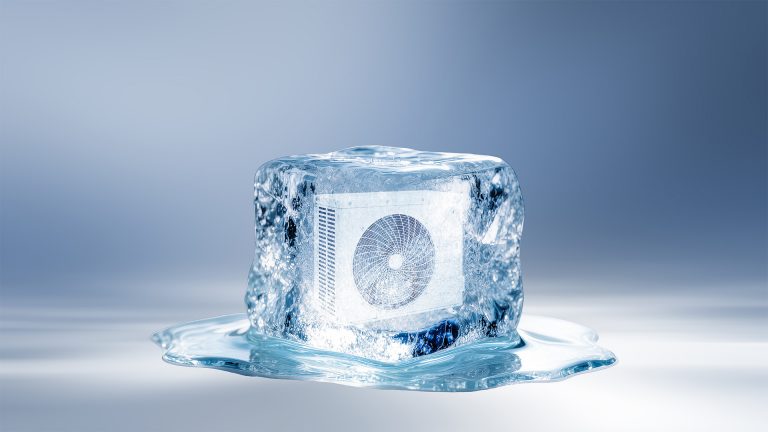

News channels are debating whether France has become “a Third World country”. Green politicians and Jean-Luc Mélenchon’s party, France Unbowed, accuse the right and far right of wanting to install air conditioning everywhere. The right, meanwhile, assail the environmental movement of sacrificing public health on the pyre of ecological dogma.
After years of climate scepticism and obstruction, Marine Le Pen’s National Rally has shamelessly abandoned its previous mockery of climate change and reinvented itself as the party of cooling. It now cites France’s own High Council for Climate and calls for a national air-conditioning plan, arguing that hospitals, schools, elderly homes and public transport should all be cooled.
It is a popular approach and one that could help push the far right party closer to power. France’s 2003 heatwave was a catastrophe that killed around 15,000 people in nineteen days. France was left traumatised. That makes this new heatwave a moment of high political significance.
More than 13,500 schools have already been forced to close or reduce classroom hours. Emergency departments are overwhelmed. An as yet unknown but large number of people are dying alone at home because of the heat, from heart attacks and strokes. For the first time, patients are dying in their hospital rooms where temperatures have reached 40C.
Sick people arriving at emergency departments are becoming dehydrated while waiting for treatment in baking, non-air-conditioned waiting rooms. “Patients are being admitted to hospital as emergencies primarily because of the extreme heat in their homes, only to find themselves in hospitals where some rooms are even hotter than where they live,” said Mathias Wargon, head of emergency medicine at Delafontaine Hospital in Seine-Saint-Denis.
“Crisis units and improvised solutions are being multiplied to accommodate them. We can debate defeating capitalism or building climate-adapted housing, but the reality today is that our hospitals are operating under wartime conditions because we have no air conditioning.”
Children and teachers are fainting in classrooms and bus drivers are collapsing after working in temperatures of up to 48°C inside new electric buses that were deliberately delivered without air conditioning. In Lille it has been revealed that the municipality ripped the air conditioning out of hundreds of newly delivered buses recently to avoid what it described as “overconsumption.”
Suggested Reading
Pakistan’s solar miracle – how the hell did they do it?
The government has declared its highest level of public health alert and prime minister Sébastien Lecornu has asked the postal service to send postal workers and citizens to check on elderly people living alone. The instruction is to knock on doors and see whether they have survived.
Transport is disrupted and power outages are spreading, while some nuclear reactors are being forced to shut down because the river water used to cool reactors has now become too warm. Millions cannot work or sleep properly.
France has one of the cleanest and most abundant electricity supplies in the world thanks largely to its nuclear power prowess. So why has it done so little to adapt to a climate crisis scientists have been warning about for decades?
“Every heatwave in France follows the same ritual,” writes Frédéric Halbran in Les Électrons Libres. “The country suffocates. Schools shut. Hospitals tape survival blankets over their windows. The media tells people to sleep in wet sheets. The government opens a hotline reminding everyone to drink water.”
“And then, inevitably, someone appears to explain why air conditioning is supposedly not the solution.”
Halbran argues that years of “guilt-inducing arguments, bureaucratic barriers and entrenched myths” have convinced many French people that refusing air conditioning has become a civic virtue. He points to the Paris Olympics, where organisers sought to stage “the greenest Olympic Games in history” without AC before foreign delegations rushed to buy thousands of portable units.
Halbran argues that there are twelve French received ideas about air conditioning, beginning with “the myth of the ecological sin.” France’s hostility rests on outdated assumptions about emissions, refrigerant gases and electricity consumption, while modern reversible heat pumps are among the most efficient low-carbon technologies available.
He dismantles the myth of the “perfect solution” or the belief that insulation, trees, fans, geothermal energy or simply enduring the heat can replace active cooling. Finally he torpedoes the “myth of tolerable heat,” demonstrating that extreme temperatures are a growing public health emergency that damages health, productivity and learning.
“The question is no longer whether air conditioning should be deployed to adapt the country to a changing climate,” Halbran writes. “Biological reality will answer that for us. The real question is how much longer we will take to admit the obvious – and how many lives… will be the price of our delay.”
The French Revolution was supposedly sparked by a lack of bread and Marie-Antoinette’s fabled throwaway line that the revolting masses should eat cake. France’s next political upheaval may arrive for a different reason: a lack of life-saving air conditioning and repeated de haut en bas instruction to millions of French people that, when the heat starts to build, they’ll just have to sweat it out.
 Most popular

My day out with Danny Tommo

I was at Eton with Charles Spencer – this is how it explains his battle with the royals


Emily Maitlis’s diary: Trump doesn’t fear the AI apocalypse – but he’s terrified about the midterms


Memo to Burnham: this is how you beat the populists