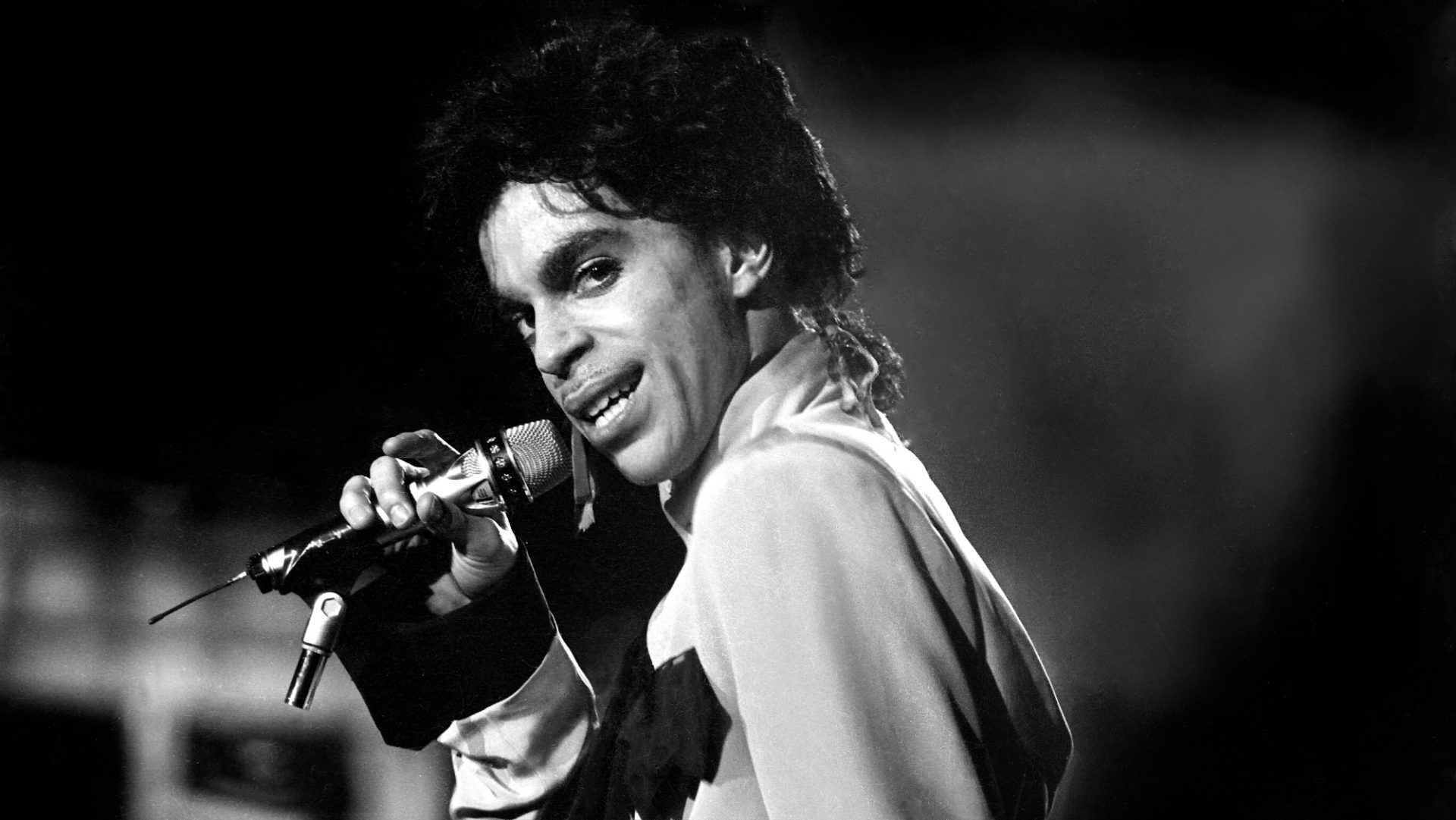
“Tokyo, this is for you,” Prince says from the stage at Yokohama Stadium, introducing the 30th and final show of the worldwide 1986 Parade tour that is reaching its glorious conclusion.
The show is everything a Prince crowd wants: bass, capes, energy and joy. But during the Purple Rain encore, Prince isn’t happy. Mid-solo, he throws his guitar to the ground. He doesn’t smash it, doesn’t destroy it, he just doesn’t want to hold it in his hands any more.
A willing tech hands him a fresh guitar, the solo resumes… but the same again. Another guitar thrown to the ground.
Guitarist Wendy Melvoin immediately realises the significance of the broken pieces. This is not showmanship or Woodstockian anarchism; this is visceral, it’s personal, it’s a message. She looks over at drummer Bobby Z and whispers, “It’s over.” She looks up, shakes her head at Lisa Coleman on keyboards and as the crowd screams for more, she mouths the words again. “It’s over.”
Her worries are confirmed in the coming weeks. The Revolution, formed by Prince in Minneapolis in 1979 as the backing band for his first tour, never step on stage with Prince again.
At his next show, six months later, with a band made entirely of new personnel, his most famous song – the one from the film that cemented his international celebrity, the one never fully recorded in a studio and whose most famous version is taken from the very first time the Revolution played it live, in Minnesota on August 3, 1983 – isn’t on the setlist. These are new beginnings.
After the Revolution, life was very different for Prince. He built his own compound, Paisley Park, with state-of-the-art recording studios, soundstages and his own living quarters. Working alone, he shaped new material into a magnificent double album, Sign o’ the Times, showcasing a new lyrical maturity, with songs about spirituality, struggling to cope with the world and “a big disease with a little name”.
Though the material would become uneven and the persona increasingly eccentric, in this new phase, Prince seemed to relish his role as ethereal musician, and at times it seemed he just loved being Prince. With a rare combination of shyness and complete authority, he made occasional public appearances where he showed he could be erudite, charismatic company with a completely unique deadpan sense of humour.
“If you weren’t Prince, what would you do for a living?” the chat show host Arsenio Hall once asked him. The side-eye in response told everyone watching “…but I AM Prince”.
Having infamously replaced his name with a symbol, he was asked by Larry King about the battles he’d had with Warner Bros over losing creative control of his work, meaning he no longer owned the rights to his own creations, including Purple Rain, which he now called his “albatross”. Prince’s reply was sanguine:
“They are businessmen, they are doing what it is to make their business successful,” he replied with a wave of his arm. “I chose to step away from that. I sent a nice letter to the then-president and told him that I loved him and that I was glad I’d had this experience.” He omitted to mention he had spent much of 1993 with “slave” written on his forehead.
A seismic appearance of Purple Rain came at the Super Bowl in 2007, hailed afterwards by the New York Times as “the best halftime show ever”. With Prince ready to go on stage in Miami, the heavens opened. Don Mischer, who was in charge of the performance, called him on a walkie-talkie, saying, “Hey man, it’s really coming down now.” Prince’s response? “Can you make it rain harder?”
The final time Prince played Purple Rain was on 2016’s Piano & a Microphone tour, where audiences from Sydney Opera House to his own intimate Paisley Park venue witnessed a man on his own playing stripped-back songs. No bass, no backing band, just a piano, the same set-up as when he was learning to play for the first time.
Growing up, he’d marvel at how his father, a jazz player with the stage name Prince Rogers, would sit down and play the piano for hours. These shows felt like coming home. One of the songs on this setlist was Heroes, in tribute to David Bowie, who had died a few days before the tour started.
Suggested Reading
George Michael, the man on a quest for identity
The Purple Rain that ended those piano shows was not the full-blown epic of Yokohama Stadium in 1986, nor did actual purple rain fall from the sky as it had at the 2007 Super Bowl. These were thoughtful deliveries, with Prince weaving the song’s verses in and out of other songs – Diamonds and Pearls, Sometimes It Snows in April.
On the last show of the tour, the Atlanta crowd sang along to every word of a melody they had heard so many times that brought the show and tour to an end. A perfect moment then, and one that now radiates for ever. A week later, at the age of 57, Prince died at his Paisley Park home.
Prince once said Purple Rain “pertains to the end of the world, being with the one you love and letting your faith or god guide you through”. As his fans across the world united in the hours and days after his death, so too did his former bandmates. It fell to Wendy to announce the Revolution’s own tribute to the frontman they loved: “After being together and grieving, we realised we needed to play. Not just for us, but for everyone.”
For the first time since that night at Yokohama Stadium, almost 30 years to the day, the Revolution performed Purple Rain again – in Prince’s beloved Minneapolis, presenting an opportunity for his fans to come together in mourning and celebration. As the song played, the pain of his absence was surpassed by the joy he had left behind. He never meant to cause us any sorrow, after all.