Between 2021 and 2024, I lived and worked as a journalist in Israel and I have to admit, I always thought that a two-state solution was still a possibility. But almost immediately on moving there, it became clear to me that it wasn’t.
There is a chant that has gained popularity recently, which goes, “From the river to the sea, Palestine will be free.” It can be heard on pro-Palestine marches around the world. The river it refers to is the Jordan, and the sea is the Mediterranean. For that reason, the chant is fiercely criticised for appearing to suggest that Israel should be wiped out.
But whichever way the chant is interpreted, it is out of date. Because Israel now controls the land from the river to the sea, and its domination is iron clad. I remember interviewing a doctor from Gaza. Her mother had contracted kidney disease and couldn’t get the treatment she needed. She applied for a permit to leave Gaza for medical treatment in Israel. Months passed, with no response. The doctor had to watch her mother die waiting.
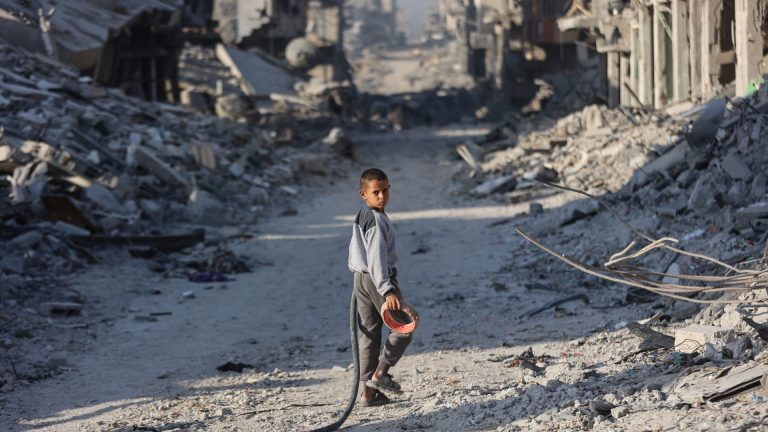
That was the state of Israeli control even before the Hamas attacks of October 7 and before the war in Gaza began. Now, after two and a half years of relentless bombing, Hamas has been decimated, the ancient coastal enclave is mostly rubble, and the Israeli hold on the territory is even stronger. As of early 2026, according to data from the UN, 81% of Gaza’s structures have been hit, 77% of the road network is damaged or destroyed and 90% of the population has been displaced.
When stats are presented this way, it’s easy to switch off from the scale of the devastation. Instead, picture the Al-Baqa Café. It’s a wooden, two-storey, seaside retreat café in western Gaza City with open, umbrella-shaded balconies overlooking the Mediterranean. For over twenty years, it’s where artists, students, residents, journalists and international aid workers gathered to eat, rest or work. They had good WiFi and even better food, and the owner, Saher Al-Baqa, tried to keep the prices low while the war raged.
On Monday, June 30th, 2025, the IDF dropped a 500lb bomb on it, killing the owner along with 33 of his clientele. “We mourn everything there,” one regular said. “Even the walls.”
Suggested Reading
Gaza: the killing continues and the world looks away
For over two and a half years, Gaza’s population has been living in tents, herded into ever-smaller areas, and pushed this way and that at Israel’s whim. The ceasefire announced by Donald Trump, hasn’t stopped the violence. Gazans are still being killed. Israel has total control over Gaza’s future, although nobody knows what that future will look like. No one knows who will govern it, how much land Israel will take as a “buffer zone”, or how the brutalised population will ever recover.
There was intense media attention in the aftermath of the October 7 attacks by Hamas, and during the war of destruction waged against Gaza. But in the midst of the constantly fluctuating Iran situation, the international media has all but forgotten Gaza. It has become an afterthought on the news agenda – a blank space in the world’s moral conscience.
According to the Gaza Health Ministry since the beginning of the war, at least 72,208 Palestinians have been reported killed.
One was a friend of mine, and the story of his killing was widely reported because it captured something fundamental about what it now means to be a Palestinian. My friend’s name was Awdah Hathaleen, and on the afternoon of 28th July, 2025, he filmed his own murder.
The footage found on his phone revealed a scene familiar to many Palestinians. A huge yellow Hyundai bulldozer inching its way towards a village, while its inhabitants screamed in desperation for it to stop. A settler named Yinon Levi stood to the left of it, brandishing a gun. Levi raised his arm and fired, Awdah’s phone flipped and went black.
You’d think this would make for strong evidence in court, but that’s not how it works in the occupied Palestinian territories. Levi was roaming free the very next day – unlike Awdah, whose body was held in custody.
The first time I met Awdah Hathaleen was in the summer of 2021. I was working on a project in the occupied territories and travelled to his village of Umm Al-Khair to photograph a new wrestling school there.
It was dusk when I arrived. The sky was a dusty pink, and the roosters’ crows echoed over the rolling hills of Massafer Yatta. The air was crisp and fresh and smelled like a million meadows. It was hard to imagine that a place this peaceful could be the centre of unspeakable violence, but all I had to do was turn 180 degrees towards the settlement of Carmel to get a taste of the tension.
Awdah wandered over with a child under his arm. He introduced himself, told me I was very welcome, and told his little one to say hi. One of the boys, who must’ve been about 10, asked me to take a photo of him walking around looking serious with his hand up to his ear. It took me a second to realise this kid was pretending to be on the phone, imitating the emergency calls that activists like Awdah regularly made. That image stayed with me. This young kid was seeing into his own future.
Suggested Reading
It’s not about protesters, it’s about Gazans
An Israeli can shoot dead a Palestinian on film, and nothing happens. And now, a law passed in Israel imposes the death penalty on Palestinians convicted of violence. That law does not apply to Israelis. It’s no wonder then that Palestinians regard the two-state solution as a joke.
It was meant to be a framework for resolving the Israeli-Palestinian conflict by establishing two states for two peoples: Israel for the Jewish people and Palestine for the Palestinian people. In 1993, the Israeli government and the Palestine Liberation Organization (PLO) agreed a plan to implement a two-state solution as part of the Oslo Accords. But now there’s only one state.
There are now 700,000 Israeli settlers in Palestine. When I spoke to Yair Dvir, from the Israeli NGO B’Tselem, he said over 170 outposts have been built across the West Bank in the last two and a half years alone.
A new outpost doesn’t just take up the land it sits on. “It’s controlling all the area around,” Yair says. “The moment they establish an outpost, the [local] Palestinians cannot access the agricultural land surrounding it. So sometimes one outpost is controlling hundreds of kilometers of land.”
New outposts also mean new roads – and they’re for Israelis only. Today, a vast network of what can only be described as apartheid roads link outposts, settlements and Israel, while cutting Palestinians off from each other and their land.
If there’s one thing Palestinians, Israel’s far-right and the Israeli and international left can agree on, it’s this: the two-state solution is dead, and the “E1” settlement is the final nail in that coffin.
Suggested Reading

The Gaza war comes to the Berlin film festival
Soon, 3,401 housing units covering 12 sq km will sever Jerusalem and split the West Bank in two, cutting Bethlehem off from Ramallah. This will force Palestinians into a series of isolated enclaves. “They say it openly: they’re destroying the possibility of a two-state solution and of any Palestinian state in the future,” Yair says.
Yair lays out three possible scenarios for the West Bank. One is realistic, one is dire, and I requested an optimistic one, just for my own sanity.
Let’s start with realistic: “If things continue like today, we’ll see the formal annexation of most parts of the West Bank,” Yair says. “This will involve a huge amount of ethnic cleansing, more than is already happening, with tens of thousands pushed towards the big cities. We’ll see one big Israel with six or seven enclaves, separate, without any connection, for Palestinians.”
Then dire: “The worst possibility is there will be any kind of resistance,” Yair says. “This will justify Israel doing things that we saw in Gaza.”
And the optimistic scenario: “It’s that the international community will take action,” Yair says. “The whole idea of international law is just collapsing all around the world. But still, Europe and even America, with another president, have the power to push Israel and to shift their policy in a way that will stop this and head towards another solution.”
Perhaps that’s why the international community still holds onto the dream of a two-state solution. The alternative is too awful to contemplate. And yet, by doing nothing, the alternative is fast becoming the reality.
I often wonder if the international community knows how embedded settler expansion is in Israeli policy. When we think of settlers, we often think of radicalised young men charging down mountains with balaclavas and M16s. But we don’t think of the young families who move into settlements because of the subsidised housing and tax benefits. We don’t think of Ukrainian-Jewish refugees who emigrated to Israel only to find themselves inadvertent occupiers, placed in housing deep in the West Bank.
Few people realise that it’s possible to grow up in a settlement without knowing it. The Jewish-only roads to and from Israel do not have checkpoints or signs to acknowledge they are now driving on stolen land. They simply live in a moshav (village) in Judea and Samaria, and the soldiers at the entrance and the Palestinian villages in the distance are all just part of the landscape.
In 2024, I visited a Palestinian village called Kirby Zanuta that had been successfully cleansed of its people. It had only been empty a few weeks but it already felt like a ghost town. Bushes that once lined the footpaths had grown waist high. The homes were soulless and the quiet was eery.
But it was only when we came across the school that the violence of it hit me. The rectangular building had a courtyard in the centre and about three classrooms covered with plastic roofing. The desks were smashed up, the chairs strewn at awkward angles on the floors. Arabic text books lay trodden and torn on the ground, pages ripped out and scattered. On the walls, in blue paint, were Stars of David.
Suggested Reading
The trial of Benjamin Netanyahu
Instead of being offended by chants of “from the river to the sea” on university campuses, Jews should be outraged and incensed by the use of ancient Jewish symbols to gloat over the destruction of a child’s place of learning.
That should be what offends us. Because it certainly endangers us. If Jews in Israel feel safe under the iron dome and its illusion of ‘security’, Jews in the diaspora don’t. Our synagogues and people keep getting shot and fire bombed.
Just as people shouldn’t shoot up synagogues, settlers shouldn’t destroy schools and then draw Jewish symbols on the wreckage. It conflates all Jews with these terrorist actions. If it all continues, Jews in the diaspora will feel so unsafe they will emigrate to Israel, further justifying the need for more settlements. All of it plays into the Israeli narrative and creates a cycle that is abhorrent.
My friend Awdah’s body was held for ten days before it was released, and that wasn’t even the end of it. Israel had a whole litany of requirements for his burial. He couldn’t be buried in his beloved village of Umm Al-Khair because its cemetery was “illegal”. Then, they demanded one of the most adored people in Palestine only have 15 people in attendance.
Eventually, the family’s lawyer and state representatives agreed he could be buried in a nearby village with unrestricted access, but on the day, the army and police prevented non-residents from reaching the site. Friends, family, activists and supporters were forced to travel on dirt roads by foot to reach the funeral ceremony, and many of them didn’t make it in time as a result.
Clearly, there’s just one entity controlling the land between the river and the sea – Israel.
 Most popular

My truly deranged encounter with Trump apologist Kellyanne Conway

Is this the real reason Trump keeps falling asleep in public?


Why are all AI posters so bad?

23 stupid reasons why Britain should never rejoin the European Union