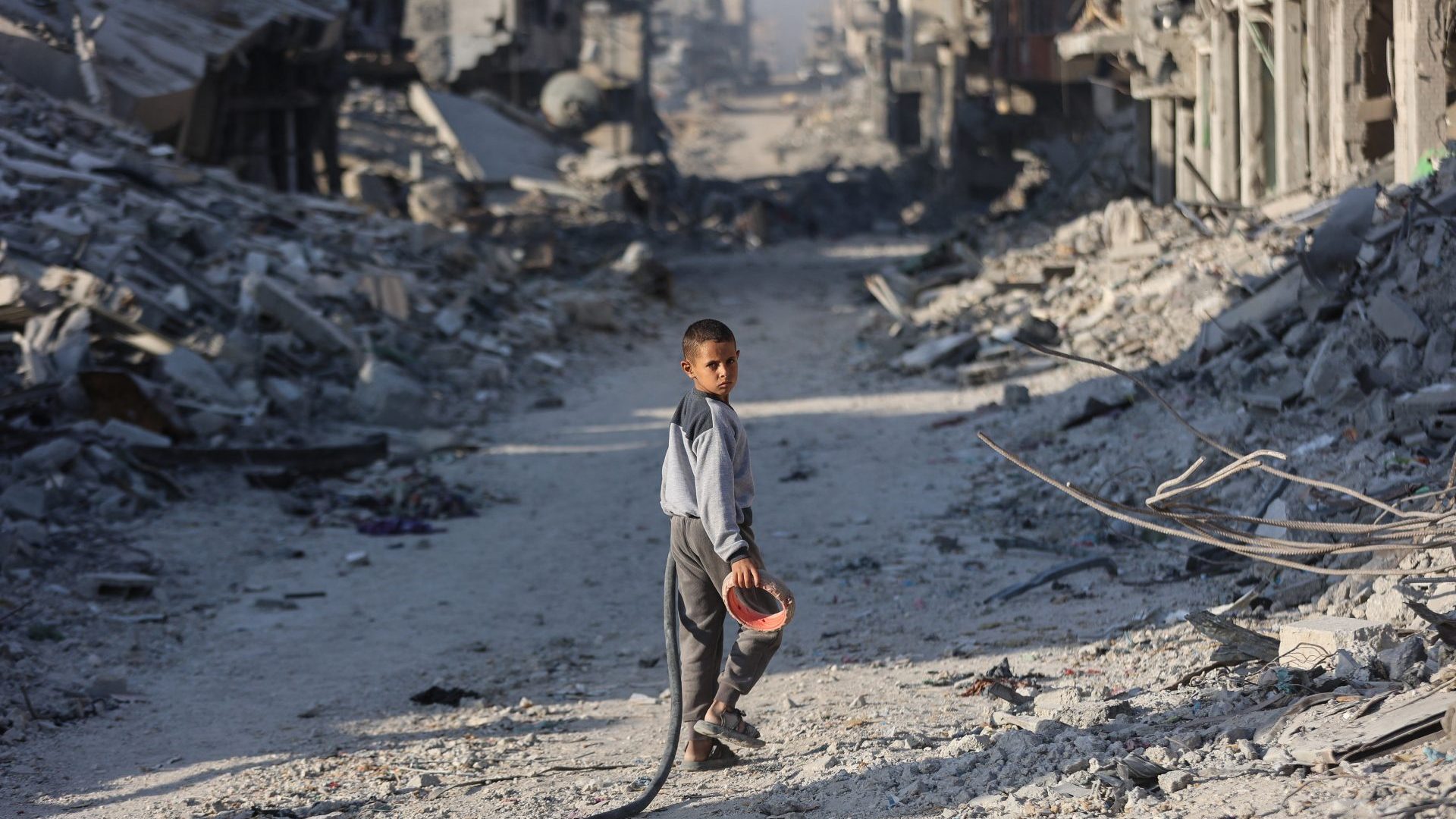
There isn’t much that Raed Athamneh doesn’t know about civilian wartime life in Gaza. Twenty years ago, 18 of his close relatives were killed by a barrage of Israeli artillery shells that hit their house in Beit Hanoun. During the 2008-9 war, his own home was destroyed, along with the car on which his livelihood depended. Yet he has never felt lower than he does now.
With the world’s attention fixed on Iran and the attendant oil crisis, the continuing exhaustion and immiseration of Gazans seem to have been barely noticed – let alone condemned – by most western governments. But there are few places in which Donald Trump’s triumphant, if woefully premature, proclamation six months ago that he had ushered in “the historic dawn of a new Middle East” rings more hollow than Gaza.
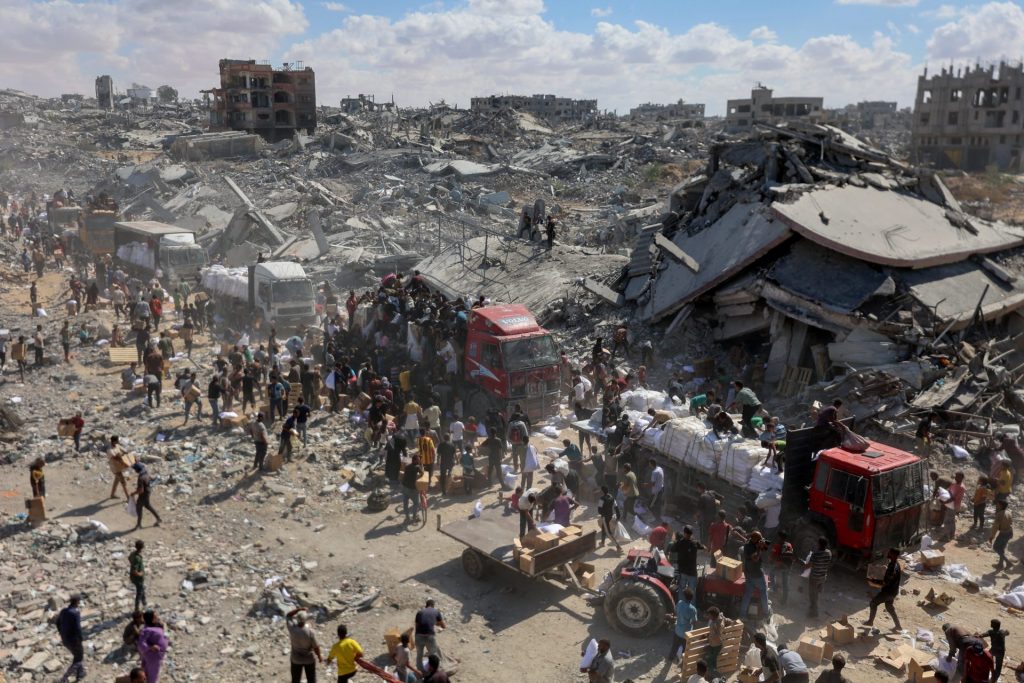
Aid trucks arrive in Khan Yunis duringa ceasefire in October 2025
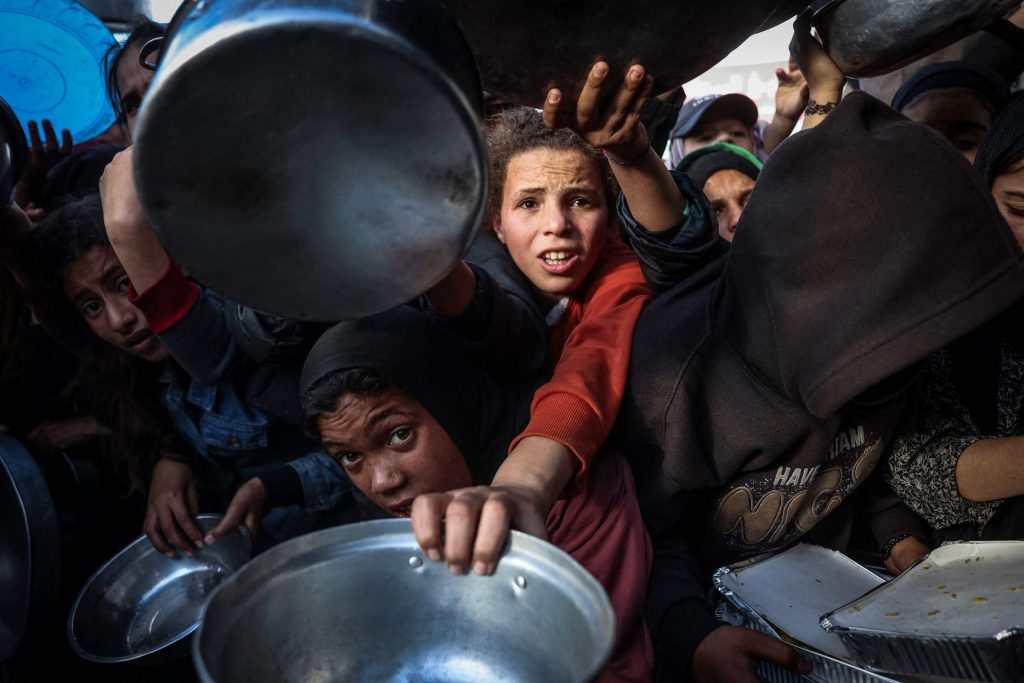
Palestinians wait to receive food at a soup kitchen in Khan Yunis in February
IMAGES: OMAR AL-QATTAA; BASHAR TALEB/ AFP/GETTY
Athamneh, 53, has no time for Hamas and worked hard all his life until its attack on Israel on October 7, 2023. Now he is crammed with his wife and eight children between the ages of 15 and 30, his five grandchildren, and 35 members of his brothers’ families in a Gaza City house borrowed from a friend who went abroad before the war.
Desperately short of money, he worries chronically about how to feed his family. A decent chicken-based, home-cooked meal for 10 that used to cost 50 shekels (£12.50) before the war would now cost 300, he says. He worries about meeting the exorbitant price of the medicine he needs to treat a mini-stroke he suffered three months ago. But most of all, he worries that one of the children will be injured or killed in the street by a stray Israeli missile.
“All I want is a safe place for my family to live,” he told me. “I’ve had three years of this. It’s too much.” He added scornfully: “Ceasefire? There is no ceasefire in Gaza.”
Suggested Reading

A Gaza peace built on sand
It’s hard to argue with Athamneh. Since Trump brokered a deal which, last October, brought home the last surviving Israeli hostages still held by Gaza militants, at least 800 Palestinians in Gaza have been killed and more than 2,000 wounded.
Only by the gruesome earlier standards of an onslaught in which at least 72,000 people were killed by aerial bombardment, shelling and ground fire can that be seen as any respite from Israel’s war of revenge. A significant majority of the dead were women and children.
A “yellow line” now delineates the boundary of the more than half of the Gaza Strip that is fully occupied by the Israeli military. Killings are taking place on both sides of that line. The UN’s human rights chief, Volker Türk, said this month that some killings are of Palestinians who simply wander too close to that “shifting and poorly marked” line.
“Movement itself has become a life-threatening activity,” said Türk. “Incidents of Palestinians killed by Israeli forces while walking, driving, or standing outside are recorded nearly every day.”
Türk cited – as just one example of the deaths for which he said Israel is now enjoying “sweeping impunity” – nine-year-old Ritaj Rihan, who was fatally shot in the head on April 9. She was in a maths lesson studying subtraction when Israeli forces fired on the tent encampment housing her makeshift classroom in the rubble of Beit Lahiya. This is within the occupied and supposedly “safe zone”.
And for many of the living, conditions are worsening. Rats are increasingly infesting Gaza, like the one that bit 28-day-old Adam, the youngest member of the Al Ustaz family. They live in a tent west of Gaza City after moving several times since being displaced (like 90% of Gazans).
Adam’s father, alerted by his son’s screams, saw the rat escaping. The boy’s face was covered in blood – they rushed him to hospital.
Suggested Reading
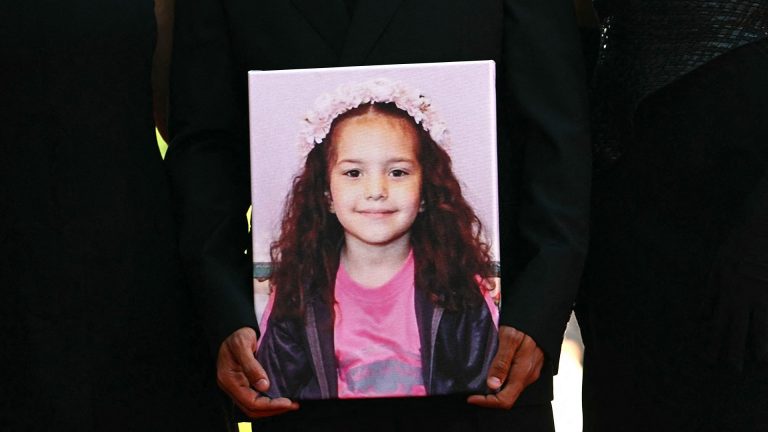

The Gazan child who spoke to the world
According to the WHO, more than 17,000 cases of “rodent-linked infections” have been identified so far this year among Gaza’s displaced residents – 90% of the population – and more than 80% of displacement sites report skin infections, such as scabies, lice and bed bugs. As the agency’s senior regional official, Dr Reinhilde Van de Weerdt, remarked, this is “the unfortunate but predictable consequence when people live in a collapsed living environment”.
All of which requires not only “globally recognised essential medicines” that are not getting into Gaza, said Van de Weerdt, but also essential laboratory testing equipment. Infection and illness are driving a catastrophic healthcare crisis that has left an estimated 300,000 patients chronically ill and in need of medication. A further 18,000 – a tenth of the number of war wounded – have been identified for medical evacuation, but are unable to leave. Around 5% of that number have been allowed to pass through the Rafah crossing into Egypt.
Not nearly enough goods are being allowed into the Strip. An estimated 100-230 humanitarian and commercial trucks are currently getting in each day, but this is well short of the 600 that were envisaged in the ceasefire terms.
Even before October 7, they were coming in at a rate of 500 a day. That was at a time before the destruction of hospital capacity and clinics across Gaza, when Gazan farmers were still able to produce food for domestic consumption. It was also before the draconian wartime blockades that led to the official declaration in August 2025 of a famine afflicting half a million people. All of this has created an exponentially greater need for assistance than before the war.
Since last October, Israel has imposed heavy restrictions on supposedly “dual-use” goods, unconvincingly classified as potentially convertible for military use by militants. This has ranged from diagnostic equipment for MRI scanners to generators and tent poles, desperately needed by the many hundreds of thousands camped along the coast of southern Gaza.
Suggested Reading
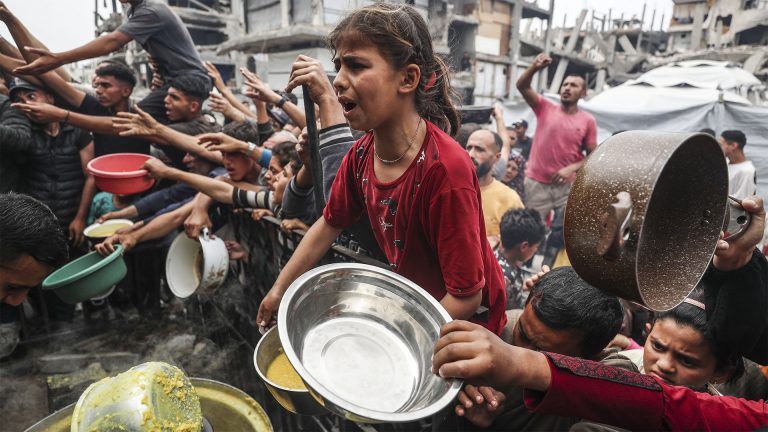
Wherever you stand on Gaza, starving children to death is indefensible
This at a time when large amount of unexploded Israeli ordnance is imperilling every aspect of Gazan life, from children playing in the street to humanitarian convoys. There is also a dire shortage of clean water.
According to Médecins Sans Frontières, 90% of Gaza’s water and sewage infrastructure has been destroyed by war in what the agency charges is an act of “collective punishment” by Israel. This has included shooting at “clearly identified” water trucks and the destruction of boreholes.
One of the several political consequences of the Iran war that Benjamin Netanyahu persuaded Trump to join has been the lack of outcry from foreign governments. Amjad Shawa, the Gazan civil society leader who heads the umbrella organisation of local NGOs, told The New World: “I can tell you this is a failure of the international community. Israel has succeeded in switching their focus away from Gaza. If the international community had acted, we would not be where we are.”
When Trump was rightly condemned for his threat in early April that in Iran “a whole civilisation will die” if its leaders refused to reopen the Strait of Hormuz, it was hard not to think that Israel has already perpetrated something very close to that in Gaza. It’s not only that so many of the ancient landmarks of this civilisation have been demolished, or that its university and school capacity has been destroyed in an egregious act of “scholasticide”, or that so much of Gaza City, the most metropolitan of all Palestinian conurbations, is in ruins. It’s also all too often forgotten that Gaza had a vibrant, resilient and entrepreneurial economy until the crippling blockade was imposed by Israel and Egypt in 2007.
Which is why there is something maddening about the short speech Tony Blair made in February at the launch of Trump’s “Board of Peace”. Complaining that Gaza’s past “governance” had been characterised by “a complete absence of any route to prosperity for the Gazan people”, he made no mention whatever of that blockade – one incidentally that hurt the Palestinian population very badly, but Hamas not at all.
Suggested Reading
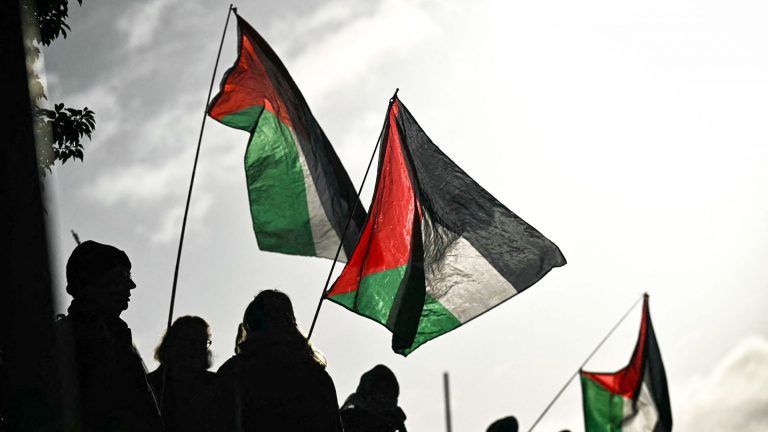
It’s not about protesters, it’s about Gazans
This followed the condescending, almost colonialist approach by the Trump administration to Gaza’s future. It’s as if having razed Gaza – or allowed Israel to do so – the US alone could now rebuild it in its own Trumpian image. The same idea was present in Trump’s fatuous vision of making Gaza “the Riviera of the Middle East”, as if Palestinians had never thought of exploiting its coastline, or hadn’t previously developed a hospitality industry as good as any in the region.
Outside money (of which only a fraction so far seems to be forthcoming) will be needed for reconstruction: $70bn by one estimate. But the idea that Palestinians in Gaza are incapable of owning and directing that huge task is as indefensible as it is dangerous.
That is the future. The immediate issue is Israel’s continuing and collective punishment of Gaza’s 2.2 million residents, the vast majority of whom had nothing to do with the Hamas-led attack that killed 1,200 Israelis in 2023.
At present, Israel’s military grip on Gaza is intensifying. Shawa calculates that it now effectively controls 61% of Gaza rather than the 53% it held six months ago. Hamas, which two years of unprecedentedly high-intensity warfare failed to eliminate, controls the rest. Though less discussed, the expanding tract of Israeli-occupied Gaza has marked similarities to the “buffer zone” that Israel has established in southern Lebanon.
For now, the complex of institutions created under the Board of Peace is largely inert. The National Committee for the Administration of Gaza (NCAG), the body of Palestinian technocrats that Hamas has agreed can take over its administration, has not yet been allowed to enter Gaza. The envisaged “international stabilisation force” appears to exist only in theory.
The most active figure representing the board, Bulgarian diplomat Nikolay Mladenov, recently resumed his attempt to break the deadlock by pursuing the ceasefire provision for Hamas to disarm. Hamas has so far resisted, partly arguing that Israel is not fulfilling its own obligations, including on aid and a pull-back of its forces. Mladenov has now reportedly said it will not hold Israel to those obligations unless Hamas agrees to disarm.
Is Israel ready to yield its control of Gaza? The task the international community should be confronting but isn’t is what Volker Türk, the UN official, rightly describes as “the sweeping impunity” afforded to the Netanyahu government. The Israeli leader now holds to the Spartan, highly questionable belief that war rather than diplomacy is the pathway to security.
That impunity extends to its lack of accountability for the war crimes committed in the last two and a half years. It also applies to its policy of allowing and indeed encouraging the violent seizure of Palestinian land and the depopulation of villages in the West Bank.
Foreign governments too busy or too distracted to worry about this might consider what history will judge more important: the pointless war in Iran, or their failure after two and a half years of devastation in Gaza to achieve a just solution to the wider Israeli-Palestinian conflict, which Netanyahu has long resisted. For it is the absence of the latter that provides Israel’s most dangerous neighbours with the excuse for their enmity.
But if that seems too ambitious, the very least that Israel’s allies can do is to call a halt to the carnage and suffering still afflicting civilians in Gaza, a full six months after Trump claimed that he had achieved peace in the Middle East.
Donald Macintyre is a former foreign correspondent at the Independent and author of Gaza, Preparing for Dawn