I started watching the Apple TV series Margo’s Got Money Troubles somewhat reluctantly. I am slightly suspicious of depictions of sex work in the media, because they often prove to be completely unrealistic or downright harmful, feeding into negative stereotypes that add further fodder to the stigma that already exists.
Margo’s Got Money Troubles was pleasantly surprising. If at times it wasn’t realistic, it was at least never harmful, and there were a few aspects of the plot that I even appreciated for offering a refreshing outlook.
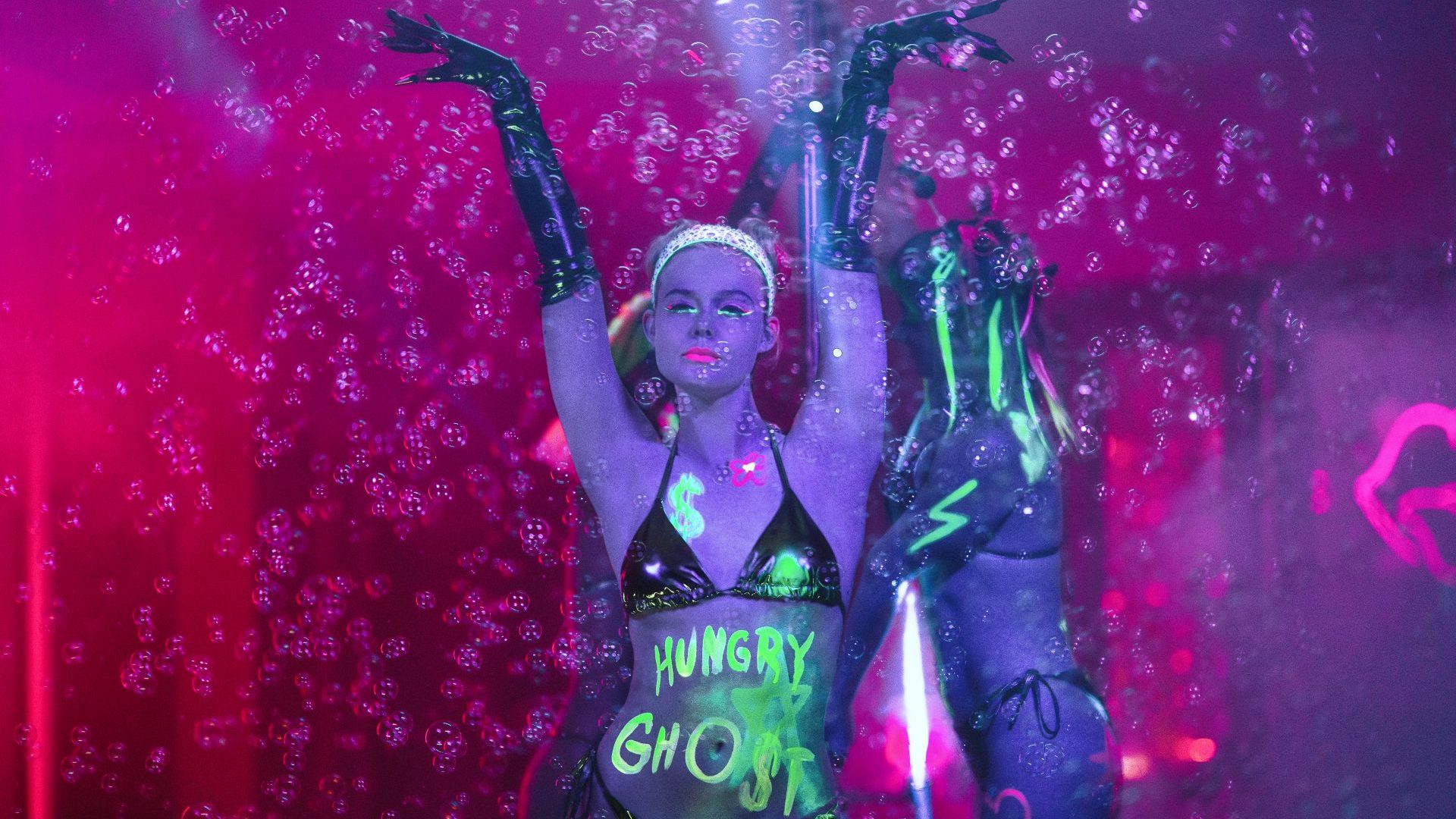
It follows the story of Margo (Elle Fanning), a university student in Orange County, California, who, after having an affair with her married professor, decides to keep the resulting child and turns to OnlyFans to support them both financially when the father abandons any responsibility.
The initial premise was believable – many women in sex work are single mothers because it allows more flexibility than other jobs and has low barriers to entry. There’s always been a beautiful irony to me that women who are deserted by the men in their life then turn to exploiting the desires of other men, who are perhaps also deserting the women in their own lives. This results in a self-generating ouroboros of men defecting from the Madonna to the whore and thus in the process creating another whore.
Margo’s foray into OnlyFans is barely sex work. She herself says her photos are “more suggestive than overtly sexual”, and it seems at most they show her topless. I would personally consider her more of an erotic labourer, having more in common with content creators than with a full-service sex worker like me.
Suggested Reading

What Believe Me gets horribly right about the John Worboys fiasco
Carol Leigh, who coined the term “sex work” in the 1970s, intended to unite erotic labourers and prostitutes, recognising the ways in which discrimination united them and their fight for labour rights – and so under that umbrella Margo fits.
She enters OnlyFans via the realm of cosplay, drawing upon her own father’s past as a wrestler, stating that “TikTok is the wrestling promo, OnlyFans the PPV [Pay Per View] and Hungry Ghost [her persona] is the gimmick”. This reminded me of Brie Larson’s storyline in Diablo Cody’s 2009 show United States of Tara, and it does say something about North American culture that Elle Fanning is not depicting anything more graphic than Brie Larson did almost 20 years ago.
I wondered why the programme makers decided to make the sex work Margo engages in so unobtrusive. I suppose it was a Trojan horse, designed to create sympathy for sex workers more generally – she is, after all, an extremely palatable version of the reality. Or perhaps it was to show how ridiculous the stigma and furore around OnlyFans is, given the public reaction Margo gets is so disproportionate to the content she is creating?
Regardless of the motive, what she is doing is certainly hardly controversial and yet in the show it garners controversy, largely because she is a mother, and once you are a mother you are not allowed to be a whore, or even adjacent to a whore.
Suggested Reading
How Epstein used sex as a weapon
Margo is doxed and harassed, something that happens to sex workers every single day. She also has her job used against her in a custody filing, something that also happens to sex workers regularly. Even under decriminalisation, the legal model that I work under which is by far the safest and preferred model, I know three women who have had their sex work weaponised in custody battles for their children.
It is an affront to people that she is a mother, that she is still desirable to people, that she is monetising that desirability, that she is making a public spectacle of herself, ignoring why she is doing it. As she says, there is “nothing wrong with doing what you have to do to take care of your child”.
Some have mocked the ease with which Margo is able to build a following so quickly, and make money out of doing cosplay topless photos and rating dick pics. That is a fair criticism – it is unfeasible.
Suggested Reading
So you want to have a child. Why?
However I wasn’t so concerned with those logistics. Instead I liked the fact that the show focuses both on her naivety and the consequences of that paired with society’s condemnation. Another online worker says to her “it’s easier to get into than it is to get out of.” Margo seems to heed that to a degree in that she tries to hide her identity by painting her face another colour; a pretty bad idea that confirms the comment that she has a “pattern of doing things without thinking of the consequences.”
The component that appealed to me most of all though, was the deliberate comparison between her work and another kind of performance-based, precarious labour – her father’s wrestling. They are both industries that are front-facing, include risk of injury to your body and, for women, rely on sex appeal and are perceived as low class.
Margo utilises the character tropes of wrestling to create her promotional videos for social media, supporting my hypothesis that porn is one of the last refuges of the genre of melodrama. Though she states clearly that her work “is not pornography” and refers to her content creating as “time to make art”, I would argue that that binary is as always reductive and the two can co-exist.
I think the series is most interesting, and most successful, when it is taken less as a depiction of sex work specifically and more as an illustration of modes of labour that are frowned upon, and the ways in which mothers are held to impossible standards.
As her father says, “we’re all just putting on a show, entertaining”. Is his putting on a costume and using his body to perform for an audience really that different to her doing the same?
Tilly Lawless is a Sydney-based sex worker. She is the author of two novels: Nothing But My Body (2021) and Thora (2024)