
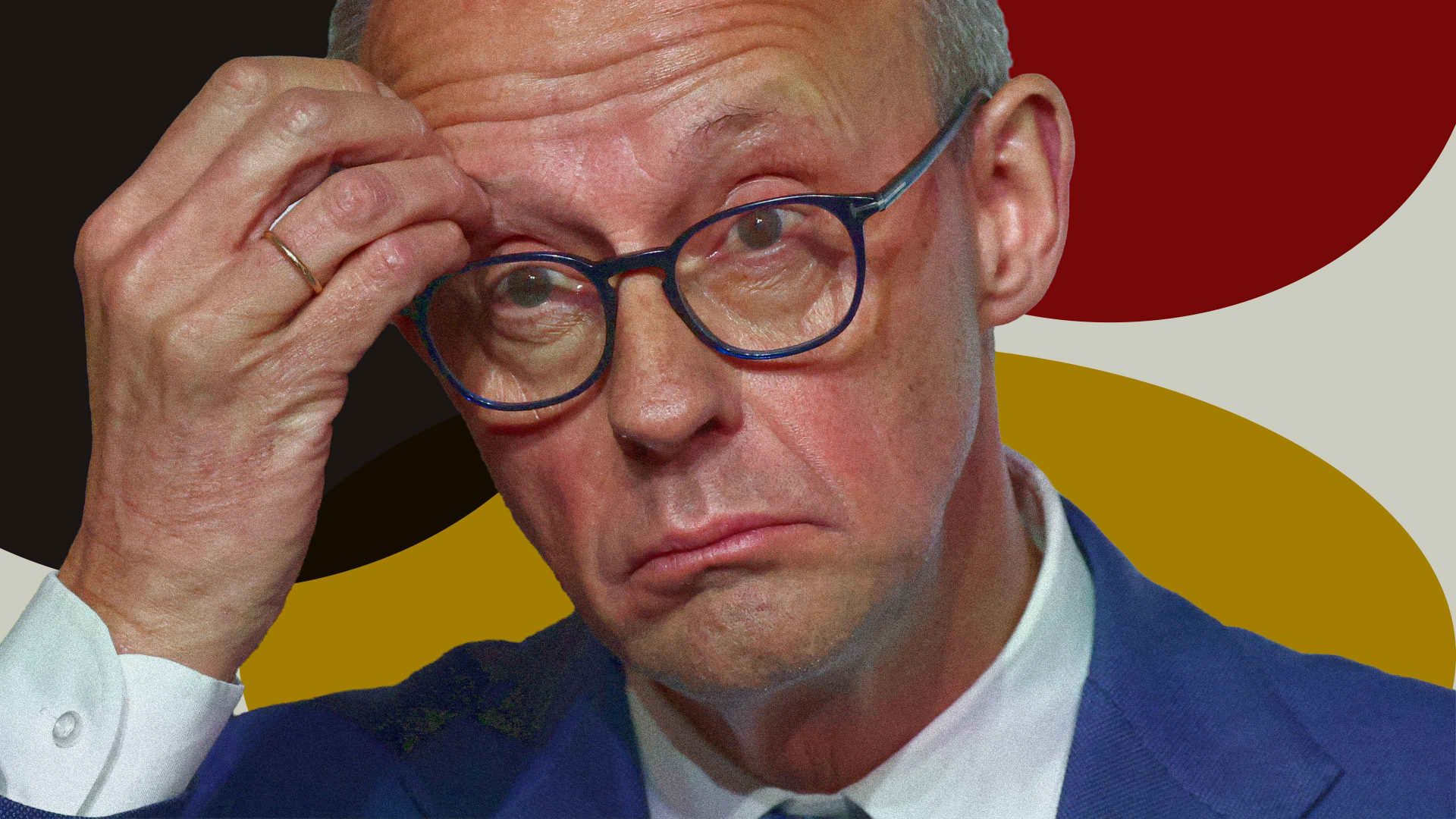
Friedrich Merz didn’t come into office quietly on May 6, 2025. He arrived like a man kicking open the door to a stuffy club, announcing that the Gemüt-lichkeit was over and Germany was about to get its act together. He promised something towering and transformative.
A year on, the door is still swinging… and not much else has moved. Merz’s coalition looks as frayed as Olaf Scholz’s did in its final stages: stagnation and ministers publicly contradicting one another before lunch. But even Scholz, not exactly a charisma machine, and the least liked Bundeskanzler so far, was more popular at his lowest ebb.
Merz’s disapproval ratings are in the 70-80% range. There is a growing sense that the paralysis isn’t despite the chancellor – but because of him. So what’s going wrong? Five points, none fatal on their own, but together rather disastrous:
Many words, few results
Merz’s bold lines and sharp diagnosis are followed by very little that sticks. He unsettles the public mood with quotes like “Statutory pension insurance alone will, at best, still provide only basic cover for old age.” Or: “The welfare state as we know it today can no longer be financed by our economic output.” And: “People need to work harder again, and above all, more efficiently.” The statements aren’t wholly wrong – but pointless if not tied to reforms that people accept as a necessary evil.
Suggested Reading


Merz puts art back on Germany’s political map
A weak partner weakens the coalition
Because of the Brandmauer, the firewall against AfD and the far left, Merz has locked himself into dependence on the SPD. But they are at their weakest point, and in existential fear of going the way of the dodo. As such, they lack the courage to do what Gerhard Schröder did: go confrontation-mode and take Germany out of its structural misery. And Merz isn’t the man to nudge them.
Lack of shrewdness
Merz is a “what you see is what you get” conservative. Lars Klingbeil, however, head of the SPD and vice-chancellor, plays the long game – if only for his own political survival. He has convinced Merz to make awkward concessions that often bear a distinctly SPD fingerprint and that’s hardly the promised Politikwechsel (political change).
No team spirit
Merz even went so far as to publicly reprimand economics minister Katherina Reiche, a Christian Democrat, when she did what, in the eyes of many, he should have done: clash with Klingbeil on how to address the oil crisis. The backlash within Merz’s party, the CDU, was foreseeable. But Merz lacks what every chancellor before him could count on: a loyal, tight-knit inner circle to serve as trusted advisers and a link to the party. The result is poor communication, preparation, negotiation and bad discipline.
Suggested Reading
The TV star fighting deepfake porn – and her husband
A self-made credibility problem
This is the big one. In record time, Merz has become nicknamed the “chancellor of broken promises”. He won on raising expectations of a bourgeois reset: fiscal discipline, tax relief, economic dynamism, border control. Instead, voters got record borrowing, delayed tax cuts, talk of higher burdens for top earners – and, to be fair, border control. Each U-turn can be explained. But on the whole, they form a pattern. When pollsters ask why people are dissatisfied, the answer is consistent: big promises, little delivery.
People don’t expect perfection in times of crisis. They want coherence. And that’s what’s missing: Merz exercises Angela Merkel’s caution without her control, and Scholz’s aloofness without his stoicism.
Suggested Reading
Face to face with Trump, what do you do?
On foreign policy, he looks more comfortable. But the temptation to compensate for domestic weakness with international visibility may be seen as an escape route at some point.
Can Merz turn things around? Possibly. The ingredients are there: a parliamentary majority, albeit slim, an environment that rewards decisive leadership, and a political centre that remains intact.
But it would require a shift in style as much as substance. Merz needs to reset the coalition dynamic, and things aren’t looking good on that front, with several state elections coming up.
If by the summer a coherent programme for tax, health and pension reform, and growth policy is on the table, Merz could be a late bloomer.
Germans are, after all, a patient bunch when they believe in the plan. But the growing suspicion is that there isn’t one.