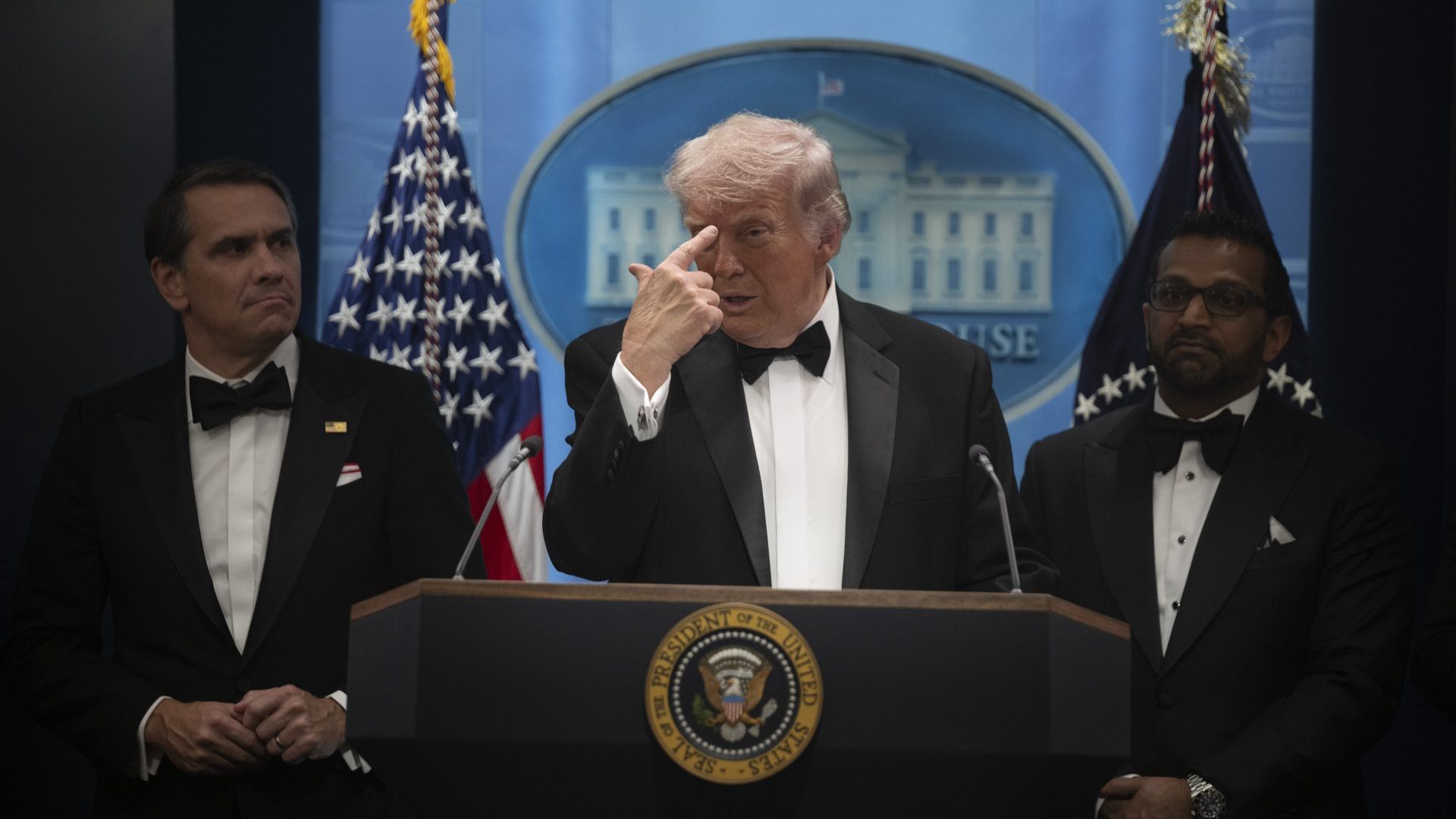
Anyone trying to follow what happened to Donald Trump on Saturday night in the immediate aftermath of the event – shortly after 8pm local time, or around 1am Sunday morning in the UK – would have faced a confusing picture indeed.
After reports that gunshots had been heard in the vicinity of the president, media outlets published contradictory reports. Early social media posts claimed shots had been fired at Trump himself.
Others reported seeing a limping RFK Jr being supported by security officials. C-SPAN said the incident had been a false alarm, while CNN said a shooter had been killed. The White House pool reporter, by contrast, said – correctly – that a suspect was alive but in custody.
Confusion almost immediately turned into ridicule, because the event the president was attending on Saturday night was the White House Correspondents’ Dinner, and so the incident had taken place in a room full of hundreds of the biggest names in American journalism.
If they can’t get a story right when it’s happening right in front of their noses, the online critics snarked, how can we trust them with anything else? Like much armchair media criticism, the point is superficially profound, but in reality, disintegrates under the tiniest bit of scrutiny from anyone who’s actually done reporting, rather than just glib commentary.
Within a few hours, we already had a much better sense of what had actually happened: a gunman had opened fire near the metal detectors at the security cordon around the ballroom of the Washington Hilton. One Secret Service agent was shot and injured, but the alleged shooter was captured alive and arrested.
Being in a nearby ballroom when this happens is probably about the worst location to try to accurately report it in the immediate aftermath. In the wake of a violent incident, rumours always fly, and people pass on half-heard or misunderstood information. Victims or plainclothes security officers get confused for the gunman, adrenaline is running high, and people misremember or misinterpret what they saw just minutes before.
Sifting through this is what journalists are paid to do, but a lot of that job simply relies on waiting for official information and confirmation before reporting. Reporting works because the journalist trying to assemble the story has some detachment from it, is outside the incident, and is piecing together often contradictory information from eyewitnesses.
A roomful of journalists was always going to feel obliged to try to report on an incident at an event they were attending, but they were never going to be very good at it. Journalists are humans first and foremost, and humans make terrible eyewitnesses. The media covered the event as well or as badly as it usually covers such things – the story took a few hours to come out properly, but is getting clearer all the time.
Suggested Reading
Nigel Farage’s Trump problem
In the clear light of day, few of us need to shed tears over the egos of journalists attending a White House Correspondents’ Dinner at which Trump was the guest of honour. But to start with the snark before we knew if anyone had been killed or severely injured relies upon a casual callousness that is essentially dehumanising.
Yes, perhaps there is something to say about America’s journalistic elite – as well as many of MAGA’s leaders – coming face to face with the fear that too many of its schoolteachers experience each year. But with that, they are probably owed at least the basic sympathy we give to others who have close brushes with gun violence.
That this statement is even contentious is a sign of what America has become, though. Another widespread online reaction to the shooting on Saturday night and Sunday morning was to suggest it was a false flag – either expressly, or by supposing it was all a bit convenient, or useful to Trump.
Just a few short years ago, doing this was utterly beyond the pale, left to the likes of Alex Jones and Infowars, and roundly condemned by everyone else. Now, it’s routine. A shooter can be detained yards from the president and next to a roomful of journalists – with photographic and video evidence – and people will immediately jump to conspiracy theories for their explanation.
Paranoia, cruelty and the faux-knowing cynical cluelessness of conspiracy theories all extend far beyond the Magaverse now. They are qualities routinely displayed across the political spectrum, from leftists, to centrists, to the right. This might be Donald Trump’s lasting legacy: he has already reshaped America in his own image.
If we can’t be better than this, then Trump’s legacy will be a grim one indeed. Only grifters and populists can thrive in this sort of media ecosystem, and we can only become more polarised and divided under such regimes.
There is an old adage: never get into a mudfight with a pig. He’ll drag you down to his level and beat you with experience.
Donald Trump has dragged America into the gutter. His opponents seem to be enthusiastically throwing themselves in.
 Most popular
His dad tried to overthrow Putin – now Pavel Prigozhin runs an African country
Liz Truss’s new mini-book is every bit as bad as her mini-budget
I was at Eton with Charles Spencer – this is how it explains his battle with the royals
18 things that will absolutely, definitely happen if Trump gets whopped in the midterms