A real sense of perspective can often only be found with hindsight, but at least I had the advantage of several thousand miles distance in Texas when Britain’s politics began going through convulsions that could finish off our already stricken prime minister.
It was difficult to answer the questions I faced there from American friends about why this, the latest episode in the “who-knew-what-and-when” saga about the appointment of an ambassador to their country more than a year ago, now spelt such big trouble for Keir Starmer. “Well,” I would try telling them, “he’s accused of being a bit misleading about there being security clearance for Peter Mandelson when, it turns out, there were some red flags raised by an arcane vetting process that few people understand and about which no one in Downing Street was ever told.” My hosts, by now inured to having an unhinged and unaccountable president spewing out so many falsehoods each day before his breakfast that they now no longer choke on their own, gave me puzzled looks.
And maybe Britain can feel some pride in caring enough whether our head of government always tells the whole truth that we make an enormous fuss if there is any suggestion he has not. Even so, there was nothing much to admire about the stampede from most of the media and every opposition party leader – including the generally rational Ed Davey – to brand the prime minister a liar or casually draw false equivalence between him and those who genuinely debase democracy. It is all part of how our own dumbly destructive and sulphurous political culture raises the likelihood of elected leaders making the kind of mistakes about which there can be more justifiable criticism.
By the time I got back to London last week, the main charge against Starmer had already changed shape. There was a grudging acceptance that he had not been deliberately untruthful. Instead, many of those who made that allegation were now being rather shameless in attacking him again for his reaction to it.
Starmer is, I am told, “hating every minute of this”. He has good reason to be angry that no one informed him about the concerns raised during the vetting process, even after his judgement in appointing Mandelson had been called into question. But those close to him also acknowledge that the haste by which Olly Robbins was then publicly blamed for this and sacked as the Foreign Office’s chief official has done the prime minister real – potentially lethal – harm.
Once again, it is not easy to explain to someone who does not reside in the Westminster village why that matters so much. And there is usually scant media sympathy for an establishment mandarin saying he had followed “due process” to protect the integrity of a secretive vetting system. But Robbins’s testimony last week seems to have acted as a sort of catalyst, crystallising the previously inchoate doubt that has increasingly swirled above Starmer’s head into a solid grievance that may now be too heavy for him to bear.
I have long defended him, in this magazine and elsewhere, as a serious and rules-based leader that Britain needs to guide it through the current storms. During the recent Iran war, as well as other multiple other occasions on the global stage, he has carried the weight of these times well by demonstrating that he respects the rules and will take evidence-based decisions in the national interest.
His worst moments, however, have come when he has strayed into a faux populism, sometimes posing as an “insurgent” who rails against civil servants for slowing the pace of change, or echoing Enoch Powell’s racism with a speech warning that immigration was turning the country into an “island of strangers”. And his critics, now joined by elite Whitehall opinion, point out the panicky treatment of Robbins is not an isolated example of someone being tossed precipitously – perhaps peremptorily – from Downing Street’s windows to appease the mob below. The body count outside his front door now includes a pair each of cabinet secretaries and chiefs of staff, at least three heads of the policy unit, four communications directors, as well as many more senior ministers, advisers and officials who have been “moved on” since he took office just 22 months ago.
Although friends would still say this is uncharacteristic of Starmer’s innate decency as a person, it seems rather too typical of his behaviour as prime minister.
The original decision to make Mandelson the UK’s ambassador to Washington back in December 2024 was similarly surprising to those who heard Starmer saying before the election that he was deliberately keeping this scandal-stained former cabinet minister “at arm’s length”. It seemed as if, in response to complaints early in his premiership about being too cautious, the prime minister decided against one of those stuffy career diplomats and made a bold and risky choice.
Suggested Reading

Keir Starmer: his fatal character flaws
And, of course, for a time this was applauded for this by many of those same commentators who now denounce it. Mandelson’s taste for narcissistic displays of wealth and power seemed to make him a perfect fit for Donald Trump’s Washington. Only when further and much grimmer details emerged of the ambassador’s relationship with paedophile financier Jeffrey Epstein, of which Starmer says he knew no more than what was already in the media, did it become obvious to everyone that the appointment had been a terrible mistake.
But it was, nonetheless, his decision. And, though the prime minister has issued a stiff apology, he dilutes its force and diminishes himself by continuing to blame others – mostly Morgan McSweeney who recently left the post as Downing Street’s chief of staff – for giving advice on the appointment that he alone ultimately chose to take.
For too long Starmer sub-contracted his authority to those, like McSweeney, with a proficiency in the kind of politics he himself always disdained. Last summer, some of those aides were infuriated by a profile interview I wrote for The Observer in which Starmer expressed genuine contrition for various missteps including the “island of strangers” speech.
Ever since, the prime minister has apparently been convinced that owning up to any more errors would make him look weak. But that was the best way he could have let people understand the pressure and most difficult choices faced in his job, as well as demonstrate he has the strength to learn from mistakes and prove he is the grown-up in a political landscape where so many of his rivals behave like infants.
Indeed, Starmer’s reluctance to own properly his error of judgment about Mandelson is precisely why he has been unable to move on from it. A special kind of agony awaits him if this single decision on the appointment of an ambassador, about which he now bitterly regrets not following his first instincts, comes to define his end in office.
Nor do the next few days offer much respite because he will be trapped in a political psychodrama, the cast list of which contains many of those who have cause to resent their treatment at his hands over the past two years. There is an opportunistic Tory motion in the House of Commons designed to entice more slighted Labour backbenchers to speak out against the prime minister as Diane Abbott, who was almost blocked as a Labour candidate two years ago, has already done.
The inquisitory foreign affairs committee to which Robbins gave evidence, is chaired by Emily Thornberry, who only got this post as a consolation after being sacked immediately after the election despite being the longest-standing member of Labour’s shadow cabinet in opposition. Her witnesses on Tuesday include Robbins’ predecessor, Philip Barton, who allegedly left the Foreign Office after facing some pressure to speed through the ambassadorial appointment, as well as McSweeney who so many assume must have applied that pressure.
Suggested Reading
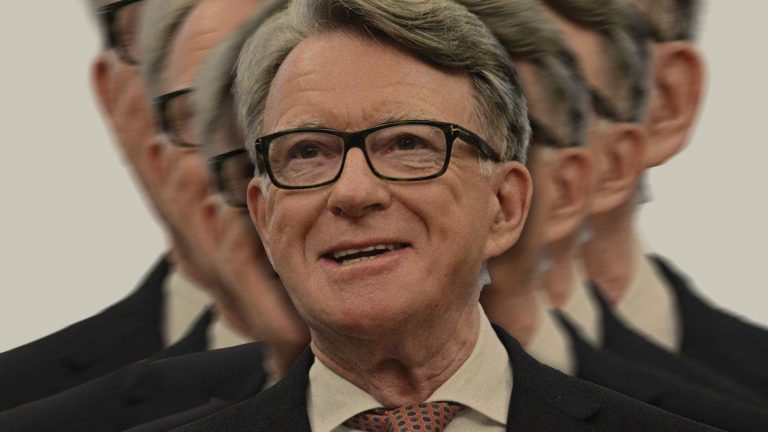

Westminster is obsessed with the Mandelson scandal. Voters are not
There are plenty in the cabinet and beyond who have given up on Starmer. Conversations are already being held among them about whether it would be better for the prime minister to announce a timetable for an “orderly transition” over the next few months or dig in ahead of disastrous election results on May 7 that they predict will result in a leadership challenge which he would lose.
But the prime minister is both stubborn and proud. He has not put himself through a decade of political pain to leave like this. The same arguments that gave him a stay of execution back in February, the last time a scaffold was built for him, still apply and perhaps have been given even more force since the war in Iran.
The obvious candidates – Andy Burnham, Angela Rayner, Wes Streeting and Ed Miliband – are unavailable, unready, unsuitable or unwilling. For all his faults as a retail politician, Starmer has many of the qualities that these alternatives lack. And, above all, this is an intensely dangerous moment when the problems facing Britain are so much bigger than the collection of scabs accumulating on him.
Although insisting at the weekend that he would fight on to the next election, perhaps the better solution right now is to leave open the question of when or if Starmer will quit by setting out a programme around which Labour could unite for the next year. A big “fight back” speech is already in the works based around security and “keeping the country safe”. Maybe that could include measures that would really make people sit up and take notice such as beginning negotiations now for a pledge in Labour’s next manifesto on rejoining the European Union without crossing any “red lines” from the last one, or scrapping the triple lock for pensioners so that there is money to get young people off benefits and back into work.
Or how about a Defence Bonds scheme which every community in the country could buy into so that the ten of billions needed for a rearmament programme that might revitalise areas of industrial decline? We can but hope.
Certainly, for many outside Westminster, rows about civil service procedure seem microscopically irrelevant compared to the imminent prospect of this country running out of oil or the threat to European democracy posed by Russia’s war in Ukraine. Would voters ever forgive Labour if, with its massive Commons majority and no reason for a general election until 2029, it embarked on an inward-looking contest to pick a new prime minister that sent interest rates and debt levels soaring? How would history judge it if our national defences were exposed at a crucial moment or failed to address the towering global challenges of climate change and artificial intelligence because it was too interested in itself?
No one has the benefit of hindsight on these questions just yet, of course, and all we know for sure is that politics is very febrile and change can come very fast. But what seems starkly apparent, even from a distance of several thousand miles, is that neither the prime minister nor this government can carry on with more of the same.
Tom Baldwin is the author of Keir Starmer: The Biography