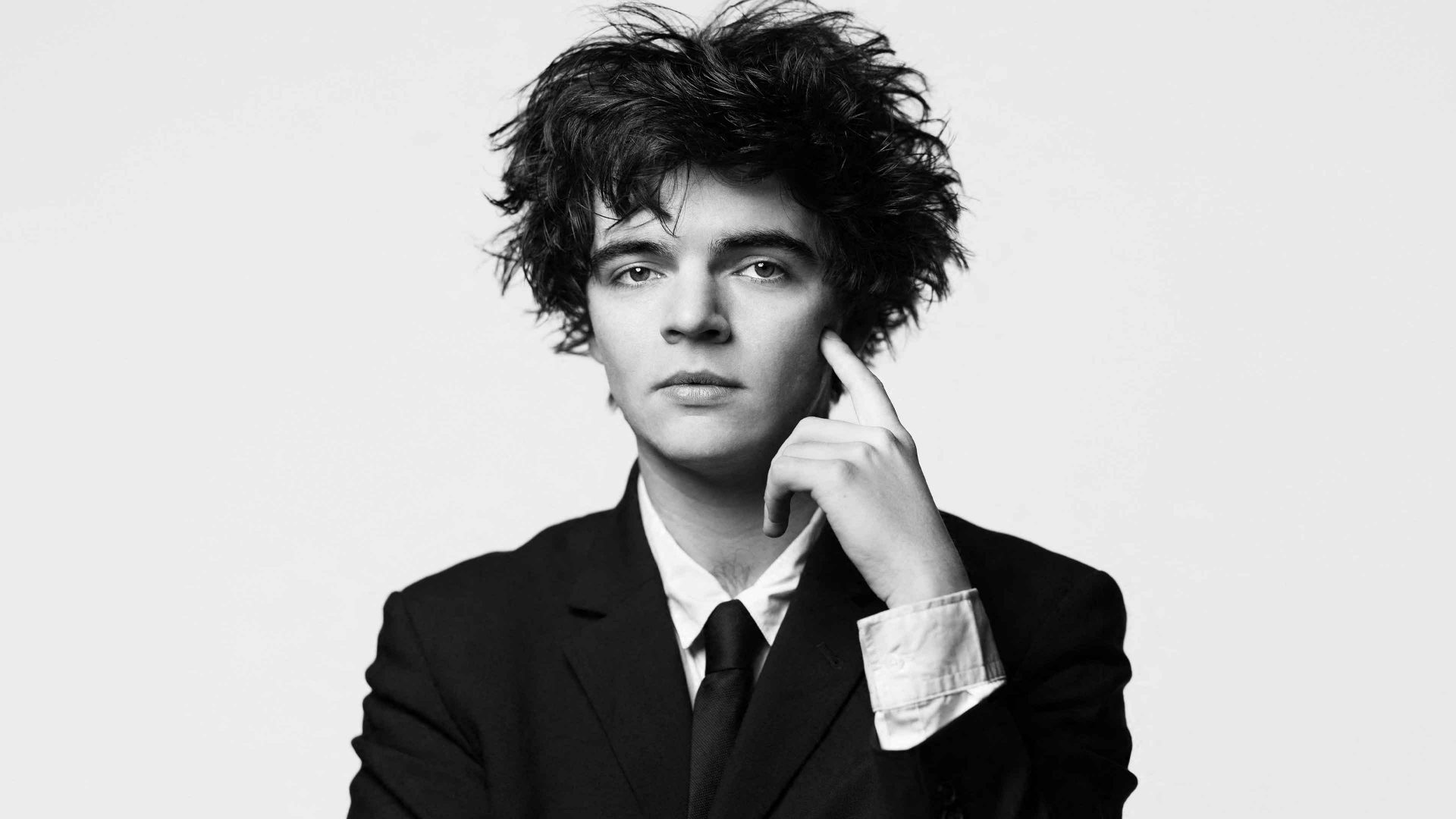
It might be an outrageous cliche but Sam Sauvage sure has a bit of Gainsbourg about him, non? He’s got the look. He’s got the throaty vocal. Even the name of one of his chansons – Je ne t’aime plus – chimes with a famous Serge number.
What’s less sure is whether Sauvage, winner of the révélation masculine (best male newcomer) at Victoires de la Musique (France’s Grammys) could break out of his native country and into the UK’s public consciousness without having to resort to singing in English or heavy breathing lusty moans down the airwaves.
“I’d love to,” the 25-year-old tells me in a window between the release of his first album Mesdames, Messieurs! and a 39-date European tour. And something about the way he glides seamlessly between French and near-perfect English (“my grandparents had a campsite when I was little. I had to speak English to make friends”) tells me that if he did get noticed in the UK, at least he could handle the comms.
But if French pop music’s track record is anything to go by, no, he can’t break through. Your average Brit can probably count on one hand the number of French hits they know (and – sorry – half of them are Belgian). If the linguistically stunted nation that is the UK can’t get to grips with French lyrics, is it game over?
Not that it’s unheard of for something unexpected to land on British shores (I’m looking at you, Bayeux Tapestry) and Sauvage arguably has a je-ne-sais-quoi look, on top of a ear-catching sound, that could feasibly pique generational curiosities from X to Z.
Take his breakout song Les Gens Qui Dansent (J’adore) – also its video in which a suited Sauvage not only flaunts all the multidirectional leg action of Jarvis Cocker but gets everyday Parisians to put down their shopping bags to join him. It’s an energy that could spur Brits to search up the lyrics or decide – bof! – who cares what they mean anyway.
Already tuning in is Sparks’s Russell Mael. When he gushed about Sauvage on BBC Radio 6 Music’s Radcliffe and Maconie: “charming; cool; I hope he makes some dent on the public”, Radcliffe gushed right back: “great hair, great moves”.
“My hair is not a choice,” Sauvage laughs, uncoiffed and on brand. “It’s natural. The wild side of Sam.” And his equally wild stage name is – what? – just showbiz chutzpah? “Hugo Brebion just wasn’t wow enough,” he says of the name on his birth certificate.
“Sauvage is an expression of freedom, it’s from nature. It means to not conform. I’m actually quite a conformist but when I was 16, I was into rock and roll and everything, so that’s why I chose Sauvage.” True, we agree that Sam Domestiqué doesn’t quite have the same ring to it.
“As for Sam, it’s been my nickname ever since I was 14 and too scared to drink the alcohol my friends had nicked from their parents,” [A Sam in France is shorthand for an alcohol-abstaining responsible driver following a former national road safety campaign.]
Back to Sauvage, though. Image-wise, isn’t wild at odds with the signature suit? That’s the domain of insurance brokers, maths teachers and funeral goers, on this side of the water at least.
“When I was a teenager I wasn’t comfortable in my own skin,” he says. “I wanted to hide from the other kids and so I wore a black blazer, but it had the opposite effect and drew more attention. It was at the same time as I discovered a guitar and I thought, you know what, I’m just going to stick with this.”
The stagewear might not change but the music does. “I don’t just like to make music of one genre,” says Sauvage of his eclectica. “I’m part of a generation who get bored quickly, overstimulated by phones and scrolling and everything. So, my music is a reflection of that. I need to do a lot of things to not be bored.”
Suggested Reading

Loana Petrucciani, the French Britney Spears
You don’t need to be a French music expert to detect it. In Les Gens Qui Dansent, it’s a blend of retro 80s pop, clean-sounding electronic and rock, with a lack of melodic line recalling Talking Heads’ Once in a Lifetime and a clever refrain in that the lyrics pause just at the moment you’re most likely to throw your arms up in the air.
In Mon Grandpère à Moi it’s a nouvelle chanson française style. “My mother listened to a lot of Alain Bashung, Serge Gainsbourg and so on when I was young, so that comes in too,” he says.
And lyrics-wise? What might non-Francophones be missing out on, beyond a recap of every -er verb under the sun in Gens Qui Dansent? There’s a lot of spoken word, so is it poetry? “Well, they might miss out on the true meaning sometimes. A song might sound like a really upbeat and happy one but actually it’s driving a sad story.
“But no, I’m not a poet. I don’t do metaphor and I don’t do surrealism or anything like that. I’m just a realist and write what I see.” The social commentary of Un Cri dans le Métro is perhaps a case in question.
Maybe the fact we’re even contemplating listening to a French song means we’ve been sniffy about our musical superiority for too long. Perhaps the cultural gatekeepers at Dover customs could do with letting down their guard a bit. There’s only so long we can tell ourselves that that Europop song on our Dordogne campsite was the sum of France’s musical worth.
Frenchies have enjoyed recent success in the UK: there’s Louane, who captured her nation’s heart on France’s The Voice; Zaho de Sagazan, whose breakthrough moment came when her take on Bowie’s Modern Love reduced Greta Gerwig to tears at Festival de Cannes. “And there’s Last Train,” Sam adds of the rock band from Alsace. “They have a following in London and gigged there. Sold out.”
So what does the guy who could practically see our white cliffs from his native Boulogne-sur-Mer actually think of the idea of international acclaim? “I would love to do concerts abroad. Touring is my favourite part of what I do. If one day we can play in London, it would be amazing. Or maybe in Canada. A way to get better at English and to meet people.”Will we see Sauvage on the Pyramid Stage? Who knows. But wouldn’t it be good to see, in place of a provocateur with an ever-present ciggie, a boy who said non to booze at parties, asked Brit kids at campsites to play, and taught himself the guitar at 16? Yes please. Whether he sings in English or not.
Sam Sauvage’s album Mesdames, Messieurs! is streaming now.
Lucy Shrimpton is a freelance writer and editor specialising in France