

In 2027, Britain may well experience net emigration. But how much political difference will it make?
That depends on who you ask and who gets heard in the public argument. The political paradox is that falling immigration may lead to a more polarised argument than when the numbers were at record highs.
Up to a quarter of the public has anti-immigration views so strong as to be almost insatiable. They may not quite close the borders, but would allow only the narrowest of exceptions for doctors, nurses and the super-rich. The online right sees its big achievement as shifting the Overton Window from reducing immigration to reversing it.
For them, net migration hitting zero will not be “mission accomplished”, but an opportunity to change the argument to being about who should leave. The politics of what Enoch Powell used to call “repatriation” has returned.

It would be a mistake for progressives to conclude that most of the public are simply irrational about immigration. Those with insatiable anti-migration views may believe that almost everyone agrees with them – but their political opponents should not fall into the trap of making the same assumption about their own views.
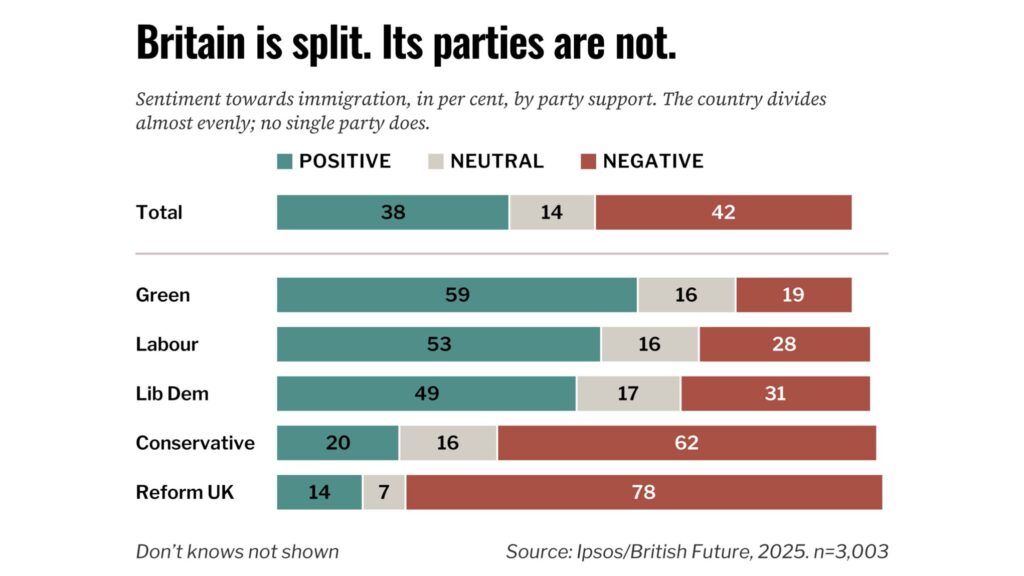
In reality, according to the British Social Attitudes research organisation, roughly equal thirds of the public are broadly positive, negative or on the fence about the economic and cultural effects of immigration. Yet those attitudes cluster much more by political tribe in 2026 than they did in 2016.
Immigration is an overwhelming priority for Reform UK voters: 60% see it as the most important issue, compared with just 7% of Labour voters. Over three-quarters of Nigel Farage’s voters have it as a top-three issue; but less than a quarter (23%) of Labour voters agree, making it their fifth priority issue.
Beneath the noise, most people are balancers on immigration, as British Future’s research shows. Balancers believe in both managing the pressures and securing the gains of immigration, fusing control with compassion when it comes to refugees. They want to treat people fairly who come to contribute to Britain, but also think about how to manage the impact on existing communities.
Andy Burnham’s challenge is to speak across that balancer coalition. Having reduced net migration so significantly, the Burnham government should answer a question that the Starmer government avoided: what does it believe a sustainable level of net migration would be? Ministers have been reluctant to give a figure, for fear of missing it.
Yet a lack of any serious planning has delivered boom and bust immigration politics, with Tory ministers having no idea how high net migration was going in the last parliament, and Labour ministers unaware of how fast they were eliminating it in this one.
A proper “immigration budget” process could set an upper speed limit, while defending the contribution of migration to the economy, higher education and public services. It would contest calls for a decade of emigration, aiming for an inflow of between 100,000 and 250,000 a year, and reject the net emigration slogans from Reform and Restore.
Burnham’s ambition is to get Britain much closer to Europe – but he will need to spell out how free movement could be handled better than last time, particularly if the UK integrates further with Europe. He also needs to address the post-Brexit chaos in the Channel.
Suggested Reading


Immigration is falling sharply – why haven’t politicians noticed?
The government has softened Shabana Mahmood’s plans to make care workers already living in the UK wait 15 years before they gained settled status. Labour MPs and unions insisted that people who had come to Britain to make a contribution should be allowed to stay.
That bruising internal argument over fair settlement rules contained a political lesson. It showed why Labour will never make a credible competitor in a remigration auction with the populist right. So the Labour government needs to decline that contest, and concentrate on building a case – and a mechanism – for managing immigration fairly.
The aim should be to offer a contrast, not an echo, of the hard right politics of remigration and racism. That could win the trust of an engageable balancer majority.