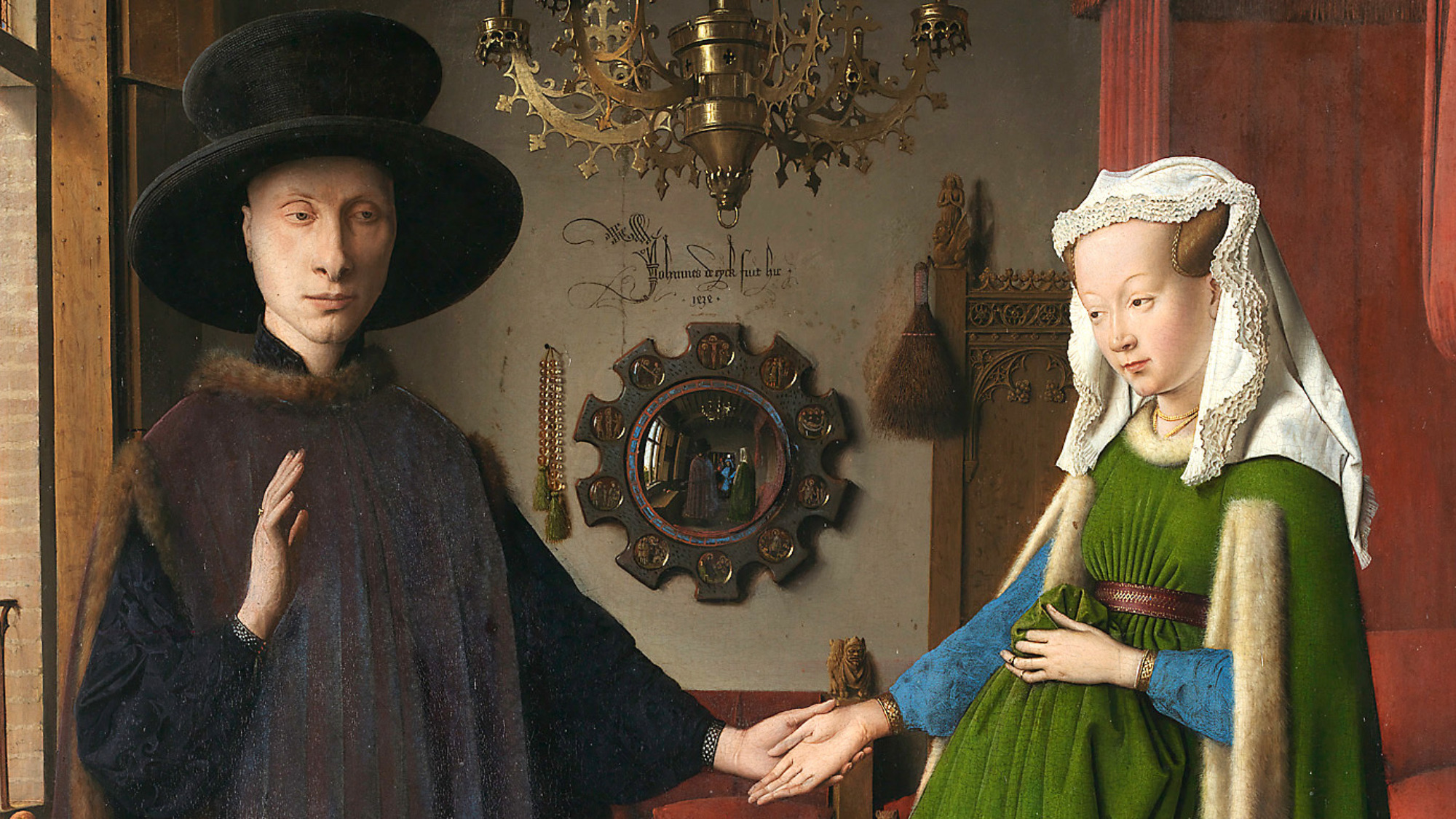
At first glance, one of the best-loved pictures in the National Gallery shows an intimate domestic scene. A couple stands solemnly in a small room with a handful of choice household objects around them. They are formally dressed and look contained, both physically and mentally.
But when we step with the painter Jan van Eyck into this sombre chamber with a couple who may be Giovanni Arnolfini and his wife, we pass from 1434 through centuries of mystery and history stretching across several European countries.
The Arnolfini Portrait, as it has become dubbed, was one of the National Gallery’s earliest acquisitions. It was the first 15th-century painting to enter the 200-year-old collection, having travelled far and wide in the meantime.
A small oil painting on oak, it might have gone the undoubted way of other works by Van Eyck and contemporaries – lost or, out of favour, destroyed. However, it passed in the 16th century into the collection of Philip II of Spain, and stayed with the Habsburg dynasty until the early 19th century, when it fell first into French hands, and then was acquired by a British army officer, James Hay, who, bafflingly to any art-lover today, passed it for some years to a friend.
Turned down by the future George IV, who had it for two years on approval, it was later displayed in a mixed exhibition in London, and bought by the National Gallery in 1842 for 600 guineas. (That’s less than £100,000 in today’s values. Van Eyck paintings never come on the open market, but if they did, they would fetch millions.)
It benefited from “benign neglect” during its prolonged stay in the Madrid court, says Nicholas Flory, the Simon Sainsbury curatorial fellow at the National Gallery and curator of a forthcoming exhibition there dedicated to the portraiture of Van Eyck. And although we instinctively look for a narrative in this unprecedented double full-length portrait, we should beware of interpreting the picture by pictorial norms.
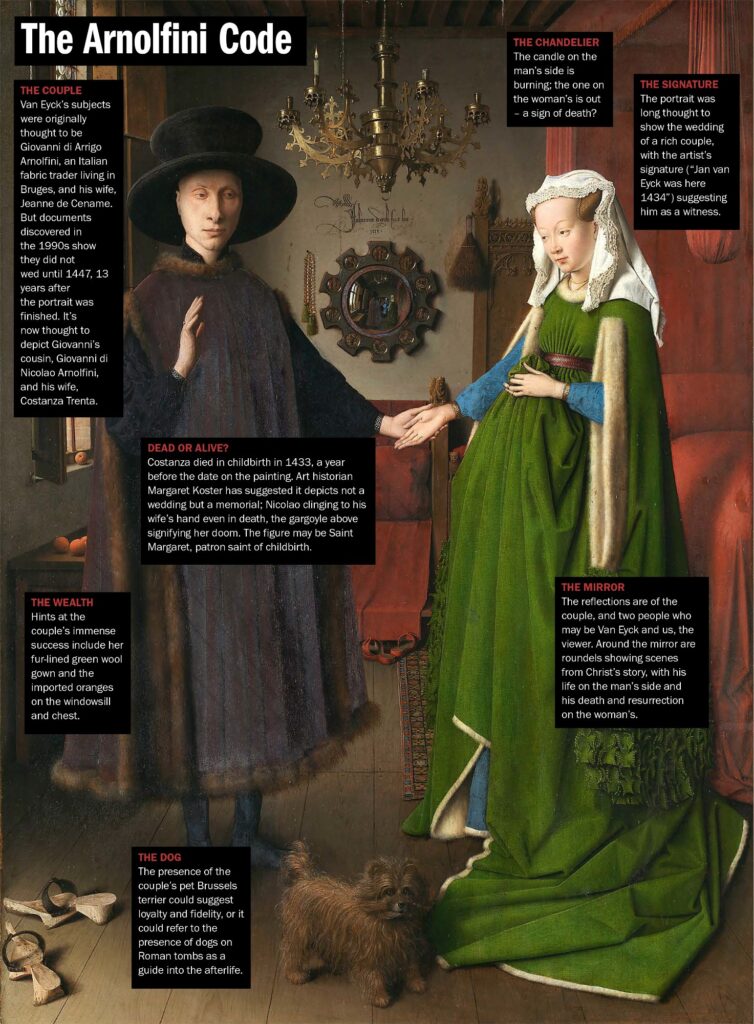
Theories have abounded – it marks a wedding, or even depicts a wedding. The signora is pregnant, or has died in childbirth. We don’t know, and it doesn’t really matter.
“Van Eyck is not in the room painting that couple,” says Flory. And the convex mirror on the back wall bears this out: there is no reflected image of the painter at work. And in this it contrasts with the huge and complex interior of Diego Velázquez’s Las Meninas, in which the painter is visible in a mirror.
In the chequered history of the Arnolfini Portrait, there is every possibility that the Spanish painter knew it when it resided in Madrid, among the earliest of many artists who have been influenced by Van Eyck. The reach of the painting and its creator is limitless.
In 1977, David Hockney’s double portrait of his parents, now in the Tate collection, has something of the same distant air. It too includes a mirror that does not reflect the painter, as it should.
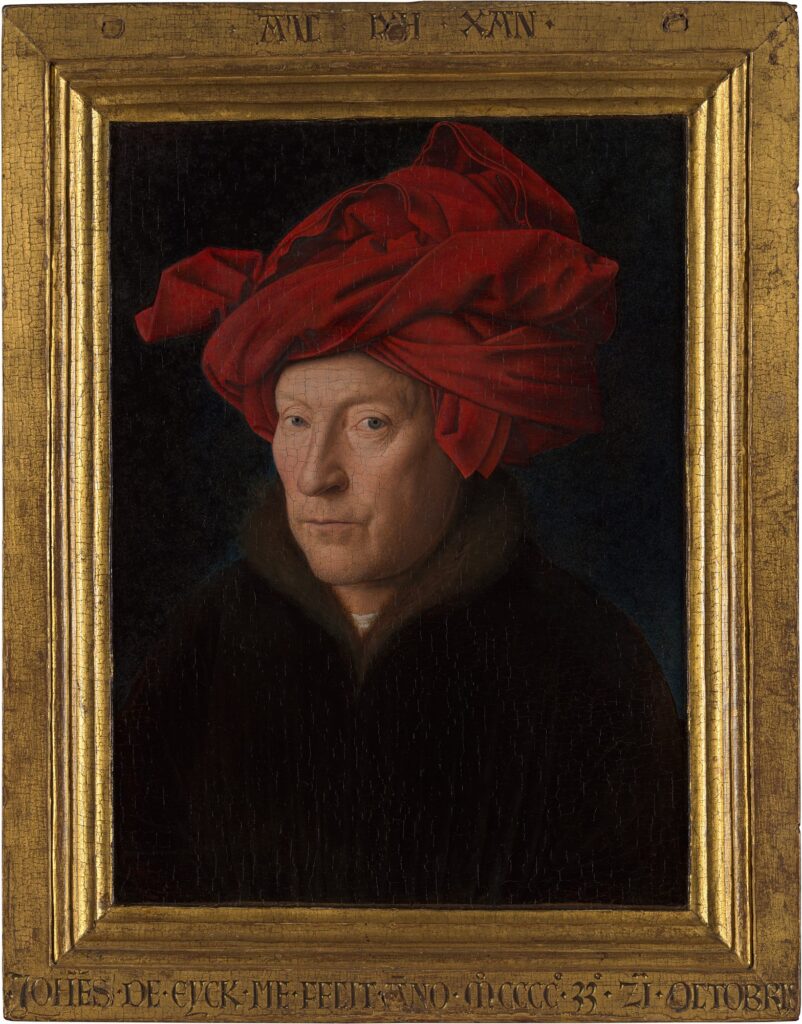
The pioneer of Op Art, Bridget Riley, demonstrated the huge influence of Van Eyck at the start of her 70-year career by copying what is considered to be his self-portrait with its sumptuously wound red turban. Also a National Gallery acquisition, only nine years after the Arnolfini Portrait, this compelling portrait is among the works to be seen together, thanks to loans from Berlin, Vienna, Dresden, the British Museum, and the painter’s native Bruges.
Viewers will stare long and hard at this likely self-portrait, eye to eye with its subject. We know very little about the man, not even his birth date.
He was one of four sibling painters, with a sister and two brothers. He worked with brother Hubert on the complex Ghent Altarpiece, still under conservation and constantly revealing new information about its creators. Jan appears to have altered some of Hubert’s contribution, after his brother’s death, exactly 600 years ago.
Some observers have tried to make a case for the Arnolfini Portrait depicting Van Eyck himself, but a single portrait of his wife, Margaret, painted in 1439 and loaned by Musea Brugge, is of a woman very different from the richly clad “bride” of 1434.
The woman in the Arnolfini Portrait is swathed luxuriously in a costly woollen cloth, a reference to the textile source of the family’s wealth. Originally from Lucca in Tuscany, they prospered in Bruges at a time when the city enjoyed even more lucrative trade links than Venice.
The objects around her speak of great luxury – a costly carpet, an ornately crafted chest, an opulently draped bed, an intricately worked chandelier, and, to one side, laid with no great care, outrageously expensive, imported, fresh oranges.
“Everything in the room is about their status and wealth,” says Flory. Even though outside cherries are ripening, in late May or early June the couple wear garments fully lined with fur.
These very deliberate details are coupled with what we know from the underdrawings are afterthoughts. The beady-eyed little terrier at the couple’s feet was an impromptu addition, so lightly painted in that the divisions between the floorboards can still be detected through his appealing fur.
Only one drawing by Van Eyck survives, preparatory to an oil painting on wood, and both are in the exhibition, the former on loan from Dresden, the latter from Vienna. (British gallery-goers dismayed by borders can continue to rejoice at the uninterrupted cooperation between European collections, and this unprecedented exhibition is attracting interest and cooperation from all over the west.)
The sketch, in gold- and silver-point on paper, is a doubly interesting document because it also features 18 lines of notes by Van Eyck in his own hand, recording the colours that he will need to employ in the finished portrait and textures that might have been ambiguous in the drawing. The elderly sitter’s stubble, for instance, is not drawn in, but noted, and only appears in the final portrait of 1438.
Two other drawings on display, by contemporaries from the same era, are probably copies of Van Eyck portraits now lost. As so often, the artist seems to have revelled in the sitter’s headgear. But it is not only the hats and scarves that enclose these distinctive and minutely observed faces from the past.
The painting’s frames themselves tell us a good deal about the artist’s personality and practice, and about the way in which these small pieces were owned. “When you look more carefully, you realise that Van Eyck is playing these games of trompe l’oeil,” says Flory. The painting does not stop where the face and cloth run out, in short, but continues, as it were, off the page.
Thus the 1439 portrait of his wife, with red, fur-lined gown and elaborately ruffle-edged headdress appears, so convincing is her husband’s brushwork, to have a stone frame. Why stone? Is she, perhaps, his rock, with her firm mouth and capable air? If the portrait was used as a demonstration piece in the studio – look here she is in real life and here’s her likeness! – perhaps Van Eyck threw in this trompe l’oeil detail to further amaze potential customers.
When it came to the portrait of Jan de Leeuw, a goldsmith, Van Eyck let rip with what looks like metalwork lettering on the frame, even distinguishing between gold and alloy, a reference to the master craftsman’s role in regulating metals used by his guild. And beneath the portrait of a man known as the Léal Souvenir (“faithful memory”, another National Gallery acquisition), a pitted, cracked and deep “stone” sill below the figure has three lines of “engraved” text – the top one, incomprehensible but with Greek lettering, the second bearing the title, and the third an elaborate signature.
When the motto “Als ich kan” appears in text that accompanies a portrait, it is a play on words: it contains the sound “Eyck Jan” as well as making a case for the artist’s skill with its suggestion of “as I can do” or even “as I [and only I] can do”…
Suggested Reading
Arnaldo Pomodoro built for eternity. Then history happened
Jan van Eyck’s legacy was not only to generations of artists and art lovers. In the employ of Philip the Good, the Duke of Burgundy, he was handsomely paid, and upon his death in 1441 his wife and children continued to be supported by the duke. Philip was a generous benefactor who, correspondence shows, got into trouble with those who looked after his accounts for paying Van Eyck so much.
Upon the birth of the couple’s first child, he presented the baby with a silver cup. Such documentation sheds some of the little light on this elusive artist, so much of whose work has gone. He may well have had a hand in the decor at a Burgundian palace in Lille, where he is known to have stayed. He drew a map of the world, completely to scale, according to the knowledge of the time, for his patron, and appears to have undertaken a trip to the Holy Land, possibly one of several forays as an emissary.
In pursuit of this great master, whose few surviving pictures – maybe only 20 – speak volumes, we must pay microscopic attention, as Van Eyck did to his sitters, picking over every clue.
Van Eyck: The Portraits is at the National Gallery, London, from November 21 to April 11, 2027