In the early months of 1919, the French painter Henri Matisse visited Pierre-Auguste Renoir, his friend living out his last days at Les Collettes, in Cagnes-sur-Mer, near Nice. At the age of 78, Renoir, celebrated for joyful paintings of contemporary life, was crippled with rheumatoid arthritis but still painting a large-scale work, The Bathers, 1918-1919.
The manual dexterity needed for painting was gone – his hands were gnarled and he was in constant pain – but Renoir persevered with a paintbrush placed between his thumb and forefinger while his hands were strapped with bandages.
He was determined to paint. As he said of this arduous process, “the pain passes, but the beauty remains.”
The beauty of Renoir’s work lay in his interpretation of colour and light and the people and locations he chose to paint. His definitive portrayals were those of leisurely social gatherings, private and public.
They are reminiscent of the 18th-century fête galante (courtship party) paintings by French-Rococo artists Antoine Watteau and Jean-Honoré Fragonard, both of whom Renoir admired, and both of whom excelled at depictions of elegantly dressed aristocrats amorously liaising in pastoral settings. From the 1860s, Renoir created his own contemporary versions in working- or middle-class leisure locations in and around Paris, which kickstarted his career as a painter of modern life.
For the next 20 years, Renoir concentrated on scenes of public and private friendships, as in Mother Anthony’s Tavern, 1866. It shows three of his friends in conversation, seated around a table in their favourite inn – an artists’ hangout – just south of Fontainebleau forest.
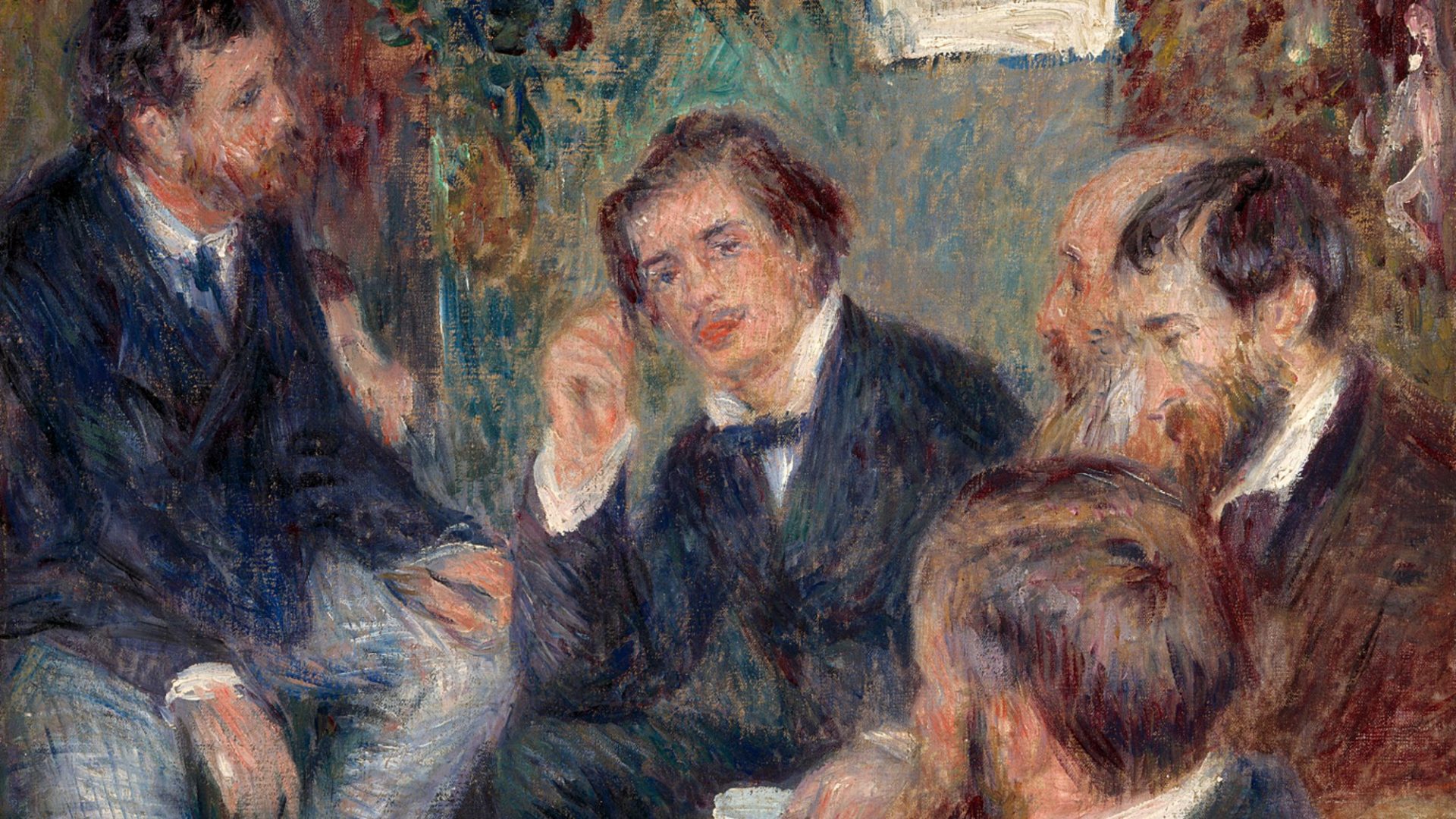
Ten years on, in At Renoir’s Home, rue Saint-Georges, 1876, he caught the same camaraderie between five of his friends, including the artist Camille Pissarro. They are all seated in Renoir’s living room, deep in conversation.
These are depictions of people getting along, enjoying each other’s company, but critics complained that his paintings lacked depth and complexity. He tried to ignore the critics.
Renoir was from a humble background. Born in Limoges in 1841, his father was a tailor, his mother a dressmaker. The family moved to Paris in 1844 and Renoir’s talent for drawing gave him an apprenticeship from 1848-1858 as a colourist of porcelain at Lévy Frères et Compagnie in Paris.
From 1861 he attended the artist Charles Gleyre’s studio where he befriended Alfred Sisley, Frédéric Bazille and Claude Monet, painters attempting to break into the art market with “new paintings” of contemporary life. But Renoir, in between army call-ups for national service (1862, 1864 and for the 1870-1871 Franco-Prussian war) worked differently. He concentrated on painting the social interactions of people.
His compositions looked impromptu but were planned in detail. A seminal work was La Grenouillère, 1869, which he painted alongside Monet, also creating a depiction of the Frogs’ Pond, a bathing and boating resort near Bougival on the Seine, 12km west of Paris.
The pair camped out together, and at one point Renoir wrote to their wealthy friend Frédéric Bazille, begging for money: “For eight days no bread, no wine, no light. It’s atrocious!” But Renoir and Monet persevered.
La Grenouillère was a popular spot for young Parisians socialising at the “camembert”, a small island with a lone tree, linked by walkways to the Île de la Grenouillère and its floating restaurant. In both Monet and Renoir’s compositions, the brushwork is loosened, Monet using broad, fragmented strokes; Renoir with shorter, vibrant brushstrokes.
Renoir concentrated on the people, Monet on the effect of light on water. This occasion surely was the “birth” of Impressionism.
The National Gallery’s exhibition Renoir & Love explores this crucial first half of Renoir’s career, which concentrated on contemporary “fêtes galantes”. Christopher Riopelle, co-curator of the exhibition, explains that the title reflects Renoir’s images of love, the trysts, flirtations and intimate moments but states that “… the underlying theme, that he largely invented, is the imagery of sociability that Renoir takes as his chosen subject in the first half of his career from the 1860s to 1880s.”
While many artists of “new painting” depicted modern Paris – the train stations, the wide boulevards, the lone drinkers in bars – Renoir concentrated on Parisian sociability at a time when society’s barriers were breaking down and different classes were mixing socially. He visited guinguettes (French open-air taverns and cafes), and dance halls, the theatres and the opera house – fully lit during performances until composer Richard Wagner insisted on the lights going out.
In these places, Renoir got a feel for the “people-watching” ambience of it with everyone “on show” and staring across at other people, as in At the Theatre (La Première Sortie), 1876-1877. Chiara di Stefano, co-curator of Renoir & Love, points to the “play of gazes” to watch out for in Renoir’s work of this period, as in The Swing, 1876, where meaningful looks are connected and deflected between two men and a young woman on a swing.
The extraordinary dappled light in The Swing was from the trees in the gardens of Renoir’s Montmartre studio. His rue-Saint-Georges apartment had a studio but for larger paintings Renoir rented a studio at 12 rue Cortot (now the Musée de Montmartre) because canvases were heavy to carry up and down the many steps of Montmartre’s hill.
Suggested Reading
Was Churchill any good at painting?
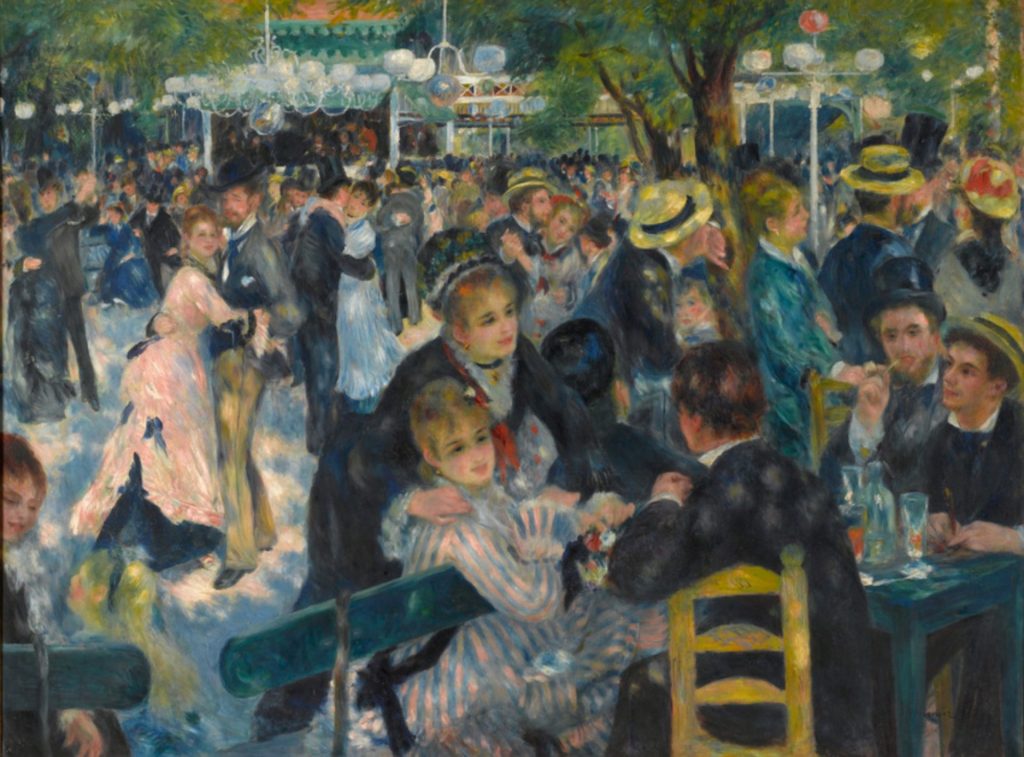
It resulted in the multi-figure masterpiece Dance at the Moulin de la Galette, 1876 (Musée d’Orsay, Paris), set in Montmartre’s open-air dance hall between two windmills. Renoir captured the exuberance of the couples, mostly working-class men and women, dancing together minus chaperones, while the animated crowd, seated at tables, gossiped and flirted. Without words Renoir’s art from the 1860s-1880s commented on the new social order unfolding in Paris.
In 1883, around the time that the Durand-Ruel Gallery in Paris held a successful major solo exhibition of 70 paintings by Renoir, the painter had a crisis, shunning his contemporary paintings of sociability. He travelled through France and to Algeria and Italy, returning with a new interest – to paint idyllic classical nudes without reference to any place, realised in The Great Bathers, 1884-1887.
One moment had passed, but the beauty remains.
Renoir & Love is at The National Gallery, Trafalgar Square, from October 3 to January 31, 2027