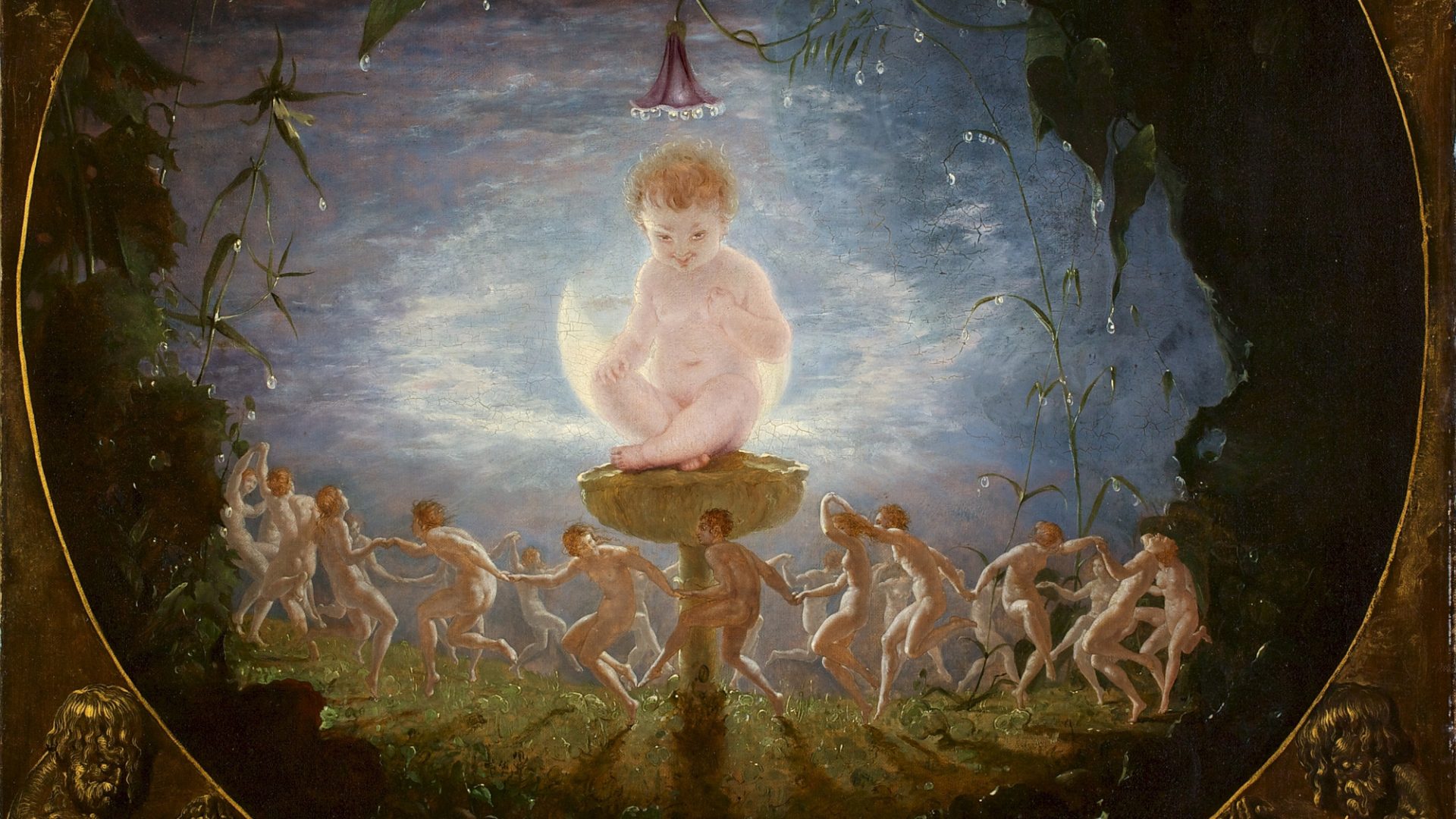
A winged water nymph floats gently on a lily surrounded by female companions. It has a gentle charm.
Underneath, a caption in a meticulous hand: Designed and etched by my son Richard. Signed: Robert Dadd. Dated: May 1843.
It is a note by a proud father, a note made horribly poignant when you know that, barely three months later, in August, 1843, Richard stabbed to death the father he loved and respected, believing him to be the devil.
Dadd fled to France, attacked a passenger in a coach, but was arrested, extradited and imprisoned for life in what became known as Bedlam – the state-funded criminal lunatic department of Bethlem Hospital in Southwark, London (Now the site of the Imperial War Museum).
It was under its auspices that Dadd (1817–1886) stayed for 42 years, painting portraits, scenes inspired by the enticing Orient, seascapes and wry asides on the failings and foibles of the world beyond the confines of its walls.
Above all, as Richard Dadd, Beyond Bedlam at the Royal Academy demonstrates, he dreamed up his best-known works, the “fairy paintings” that were inspired by his passion for William Shakespeare and are, as a caption in the gallery puts it, “explicitly precise and giddily disorientating”.
He had been a model student at the Royal Academy Schools, which he joined in 1837, and formed a sketching group known as The Clique with other tyros such as William Powell Frith and Augustus Egg.
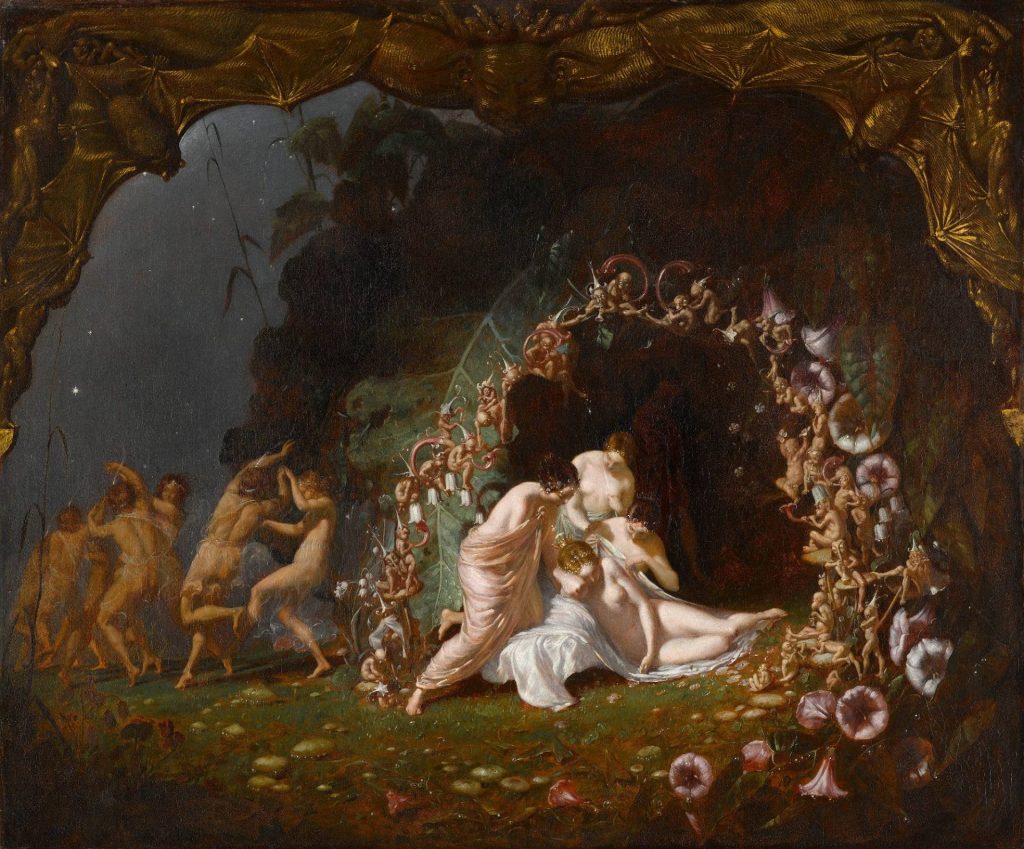
His first major success was Puck (1841), in which a cheeky, somewhat satanic version of the sprite from A Midsummer Night’s Dream perches on a toadstool in a leafy bower while naked fairies dance around. In the same year he painted Titania Sleeping, where the queen of the fairies is lulled into slumber by her attendants in a cave ringed with bats. Fairies cavort and bizarre little naked creatures flit around blowing on misshapen musical instruments.
By the summer of 1842, an enthusiastic Dadd decided to improve his education by touring Europe and the exotic east. Travelling with one Thomas Phillips, he described what he saw as “pageants from a dream rather than a substantial reality”, though he admitted he found it tricky sketching while on horseback.
But sketch he did, filling his notebook with a stream of pencil drawings of camels and souks, the desert shores of the Nile, narrow streets and men in their local costumes.
After 10 months the weary couple reached Malta, where Dadd displayed what Phillips described as “nervous depression with reserve and moodiness”.
By the time he reached home in May 1843, his family were so worried they considered putting him in an asylum. The tragedy was about to unfold.
Today he would probably be diagnosed with schizophrenia, but no treatment was offered to the inmates of Bethlem, which was moved to Broadmoor, near Reading, in 1864. For the first eight years, Dadd was more or less ignored, judged to be a “risk of violence”.
Conditions improved with the arrival of 29-year-old William Hood as the institution’s first full-time superintendent. He treated inmates with empathy and kindness, a tradition that has been followed and considerably enhanced by today’s Bethlem Royal Hospital, which moved to Bromley, Surrey, in 1930 and where the Museum of the Mind celebrates works by Dadd himself and inmates past and present.
Hood described the artist as paying “no sort of attention to decency in his acts or words… a thorough animal”. But he nonetheless found Dadd to be “a very sensible and agreeable companion” with “a mind once well educated and thoroughly informed in all the particulars of his profession had circumstances not opposed.”
It is no coincidence that the paintings most commonly associated with Dadd were painted during Hood’s benevolent regime, including the Fairy Feller’s Master-Stroke, which he painted between 1855–64 and Contradiction: Oberon and Titania (1854-58). Minutely drawn, they encompass a universe of mystery and fantasy.
In the latter, he depicts the moment in A Midsummer Night’s Dream when Oberon and Titania are fighting over a “changeling boy” who Titania had adopted and refuses to hand over to Oberon to be one of his knights.
The painting reflects Shakespeare’s “mazed world”, densely packed with flowers, pine cones, toadstools and fallen leaves while satyrs dance in the background and in the foreground a butterfly perches on a lily pad. Inexplicably, a green egg is poised above their heads.
The Fairy Feller is altogether darker. Based on Mercutio’s Queen Mab speech in Romeo and Juliet, it is set in a tangle of undergrowth in which figures creep and peep from behind flowers and boulders. Enigmatic couples look on as the “fairy feller” is poised, axe held high to split a large chestnut to be used as a carriage for Queen Mab. In front of the feller sits a small bearded figure who seems fearful of the axe man and the possible trajectory of his blow.
Some suggest that the scene is a re-enactment of Dadd’s killing of his father.
But for the most part the shadow of his past does not cloud his work. His watercolours animate the people and places he visited in Jerusalem, Damascus and Turkey, with none more evocative than The Artist’s Halt in the Desert (c. 1845). Travellers gather round a blazing fire in a darkened landscape while a pale moon beams through the scudding clouds.
A series of allegorical watercolours, Passions (1853), satirises the good, the bad and the morally bankrupt with headings such as Jealousy, Love, Treachery and Patriotism. Some are positively charming, like the dozy Ballad Monger and the bargain hunters at the Curiosity Shop, but the mood changes with Murder, in which a man is clubbed to death, and Sketch to Illustrate the Passions. Agony – Raving Madness in which a distraught, half-naked prisoner writhes in chains.
It is tempting to see something autobiographical about such a disturbing scene but Dadd was, in fact, well treated in the asylum and allowed to work in his studio as he wished. Little is known of his emotions.


We might draw conclusions from a photograph by Henry Hering in 1857 of an unkempt Dadd, staring eyes, hunched and intense as he painted, which was taken for an album designed to show patients “in their accesses of mania, and in their lucid moments”.
Dadd was clearly both those – manic and lucid – yet by simply looking at the works there is little to attest that the author was a “lunatic”. Certainly the fairy paintings reflect a feverish intensity, but one could say that about many of the more fantastical artists from Hieronymus Bosch to Max Ernst via William Blake and Henry Fuseli.
As arch surrealist Salvador Dalí once said: “The only difference between me and a madman is that I am not mad.”
Richard Dadd, Beyond Bedlam is at the Royal Academy until October 25