The Beatles, as a rock and roll band, make a certain amount of sense. They’re miraculous, don’t get me wrong, but their steps and mis-steps have an inevitability to them. Start out small and simple, get noticed, get bigger, get ambitious, take control, get over-ambitious, lose control, go back to the beginning, die. Your typical rock band sort of thing.
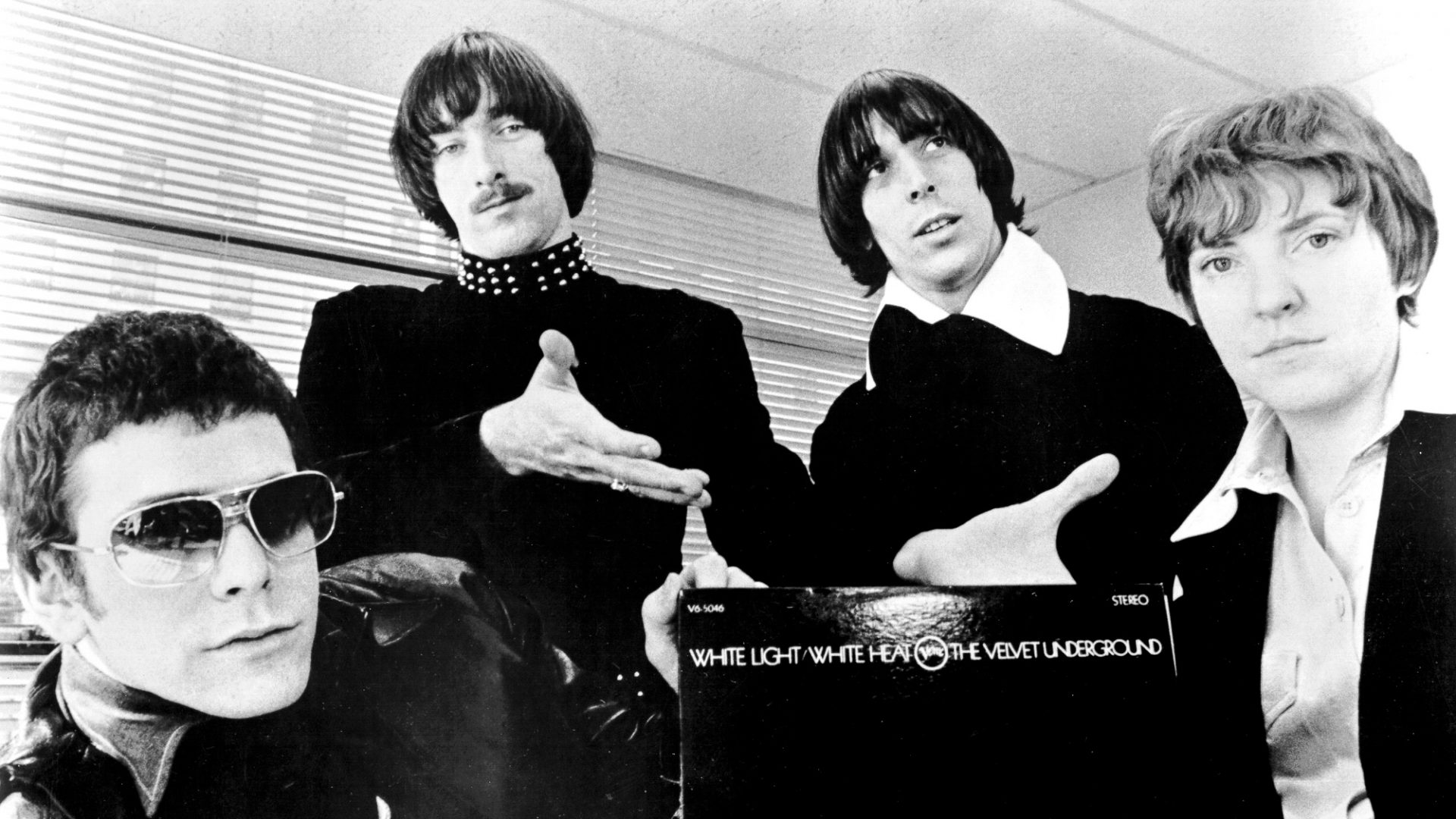
The Velvet Underground make no sense at all, in the best possible way. Their trajectory was: incompatibles join group, flail, join the crazed circus of a famous artist, leave said circus, flail some more, die. And in between the flailing, create some of the most astonishing music ever made.
The first track on their first album is a twee, delicate paean to Sunday morning (and smack-induced paranoia). Eight tracks later they’ve moved, via S&M, hard drugs and death, to European Son, which travels from the chorus to the bridge by releasing one of the most terrifying sounds ever committed to vinyl (it’s just a chair scraping across the floor, but sounds like Death is right there in your headphones enforcing instructions for the afterlife).
Oh, and the album cover, designed by Andy Warhol, features a very phallic banana with pink flesh, beneath a peelable skin.
It’s quite a leap. Perhaps the most extreme leap in the history of recorded music. This was barely 1966 after all.
The biggest hits of that year were Tears by Ken Dodd and Tom Jones’s The Green Green Grass of Home. Granny music. Elsewhere, the Velvets were unleashing merry death and blithely singing about heroin. Not just singing about heroin, BUT calling a song Heroin, all while jiggling around in leather and being whipped on stage.
And just like the Beatles, alongside whom they arguably rank in terms of influence, the Velvet Underground have always offered a certain mystique. So much has been written about them, usually in abstract.
The book Up-Tight kicked it off. It was like some sort of holy document when it first appeared in 1983, dropping into an era devoid of any useful information. Here were actual facts about a band who seemed so implausibly distant, revealed by the people who were there and compiled by Victor Bockris and Gerard Malanga, who seemed to know what they were doing.
Obviously a lot of the facts in the book were bullshit. As so much about the Velvets turned out to be bullshit. The Warhol hive of the late 1960s had so many operators desperate to right their own wrongs and get their own rarefied version of the story across that misinformation was the preferred currency.
But that was all part of the fun. Prior to Up-Tight it was even quite difficult to establish who was actually in the band. Why was Nico there, for three songs on the first album, only to then vanish for ever? Did Andy Warhol actually play the tambourine? What’s a Doug Yule?
Suggested Reading
David Wojnarowicz, the angry ghost on the White House lawn
As the recent Todd Haynes documentary testifies, there’s barely any decent film footage of the band (even though they were “managed” by serial filmer Andy Warhol who appears to have recorded hours of footage of the band without ever turning the microphone on. Thanks, Andy).
And in later years, band members Lou Reed and John Cale became two of the most taciturn interview subjects available, liable to simply stare at you in disgust if asked any questions about their past efforts (or even current ones).
Though when active, commercial success would have been desirable, the mystique associated with their general failure has worked in their favour. Generations of bands, from punk onwards, delighted in discovering this bizarre, unique band who had the tang of David Bowie patronage, plus Andy Warhol’s artistic credentials but were still fervently obscure. Any decent band cites the Velvets in reverential esteem and Lou Reed’s fingerprints are all over punk, post-punk, post-post-punk and whatever happened after that.
In the pre-internet age, people loved discovering and adopting the Velvet Underground. They were the ideal band for that purpose. Rare, drug-tinged, occasionally unlistenable. Every young man’s dream. And the lies and legends that sprouted up around them simply added to the magic.
For years, Up-Tight felt like the only thing to read about the Velvets. And then the floodgates opened. The CD era saw the inevitable boxset, Peel Slowly and See (1995). Tracks that were only available on dodgy bootlegs got the lick of authenticity.
The band actually re-formed in the 1990s (I had a chance to go, I declined – mainly because Lou Reed insisted on using a guitar without a head on it). The song Venus in Furs was used in a tyre ad, which was both thrillingly transgressive and mildly depressing.
More books by Velvets and Warhol acolytes started to drift out. Stories and legends began to pile up. This relentless barrage of anecdote seemed to dilute any solid information about the band. They were more tangible and still, somehow, distant.
But Richie Unterberger has had enough of all this nonsense. An esteemed music writer (his Unknown Legends of Rock’n’Roll is particularly marvellous) and self-confessed Velvets obsessive, he’s taken one for the team and decided to sift through every document, news clipping and speed-addled memory to put together a conclusive and decisive volume on the band. Clocking in at over 800 pages, and the girth and weight of a portly dachshund, Do What You Fear Most is both the title of the book and the feeling I got when my arthritic wrists were forced to pick it up every morning.
Unlike the Beatles, whose mystique was undercut by having every nano-second of their existence documented and notarised, the Velvets lived in a far more liminal space. Even with Unterberger’s meticulous eye for detail, there are still fundamental facts about the band that can’t be confirmed (such as the dates records were officially released or whether singles ever actually came out at all – which perhaps says more about the lax documentation methods of the late-1960s music business).
But everything that can be established, is established. Which, I guess, is a vital public service and helps quell any further misinformation about the band. But that isn’t always the funnest thing to read.
In between the deep dives and forensic research, Do What You Fear Most provides some highly entertaining gems, such as the ongoing battles between the Velvets and Frank Zappa’s Mothers of Invention or the bizarre “Mod wedding” in Chicago at which Andy Warhol officiated and the Velvets were the band at the reception.
Two things Unterberger is determined to clear up are the perceived idea that the Velvet Underground didn’t really have many fans during their existence and that everyone on America’s west coast despised them. He determines that the Velvets had more fans than you probably realised (if you’ve ever given such thing any thought) and that while some folks on the west coast did indeed despise them (including influential rock promoter Bill Graham, because one of their entourage ate a tangerine and left the peel on the floor, according to Warhol), they actually had an audience there.
Oddly, what transpires is that it was the band’s home town of New York that offered the most resistance. After their early meteoric rise as part of Andy Warhol’s Exploding Plastic Inevitable, they basically boycotted Manhattan, only returning to play a final residency at Max’s Kansas City before imploding.
They never made it to Europe either during their first incarnation. Things may have been different if they had. As mentioned, Bowie was an early fan, the Yardbirds were covering them and there was even a slight chance that Brian Epstein would sign them up.
According to reports, the banana album appears to have been adjacent to every dancette in Swinging London. If the band had dropped into the Roundhouse or similar, things might have been different. Not necessarily better – but different.
And so now here we are. We can finally close the book on the Velvet Underground (with a certain amount of difficulty – it’s heavy). The vaults are empty, the facts have been assessed and the lies reckoned with. And how do we feel after all that?
I bring it back to the Beatles. For some reason, I can’t get enough of the Beatles, in terms of fairly useless information. I’ll happily rewatch Get Back or trawl through Mark Lewisohn’s heroic histories of the band. I love reading what George had for breakfast.
With the Velvets, I don’t know. I sort of enjoyed not knowing. I’m not sure it does them any favours to lose the mystique. They were a band – but they were more than a band. They were an idea that lodged in the minds of insatiable youths. An idea that blossomed into a band or a book or even just a different hairstyle for a while.
But they changed things and made them more uncomfortable. And I like them for that.
Do What You Fear Most: The History of The Velvet Underground by Richie Unterberger is published by Omnibus Press and out now