“I remember Mullah Zaeef,” said Lyse Doucet, “one of the founders of the Taliban, saying to me a few years ago, ‘95% of the Taliban don’t agree with the most severe edicts. Yes, we’re conservative but we believe Islam gives girls the right to go to school’.”
Doucet is the BBC’s chief international correspondent and has reported on Afghanistan for 30 years. “They’re willing to speak out, some of them,” she said. But when it comes to confronting the hard line leadership on women’s rights: “they’re not willing”.
Afghanistan’s Taliban regime has now been back in power for five years. Despite returning the country to a brutally restrictive regime, it has won formal diplomatic recognition, complete with a security pact, from Russia. It has exchanged ambassadors with China. As of June, it is on speaking terms with the world’s largest trading bloc, the European Union.
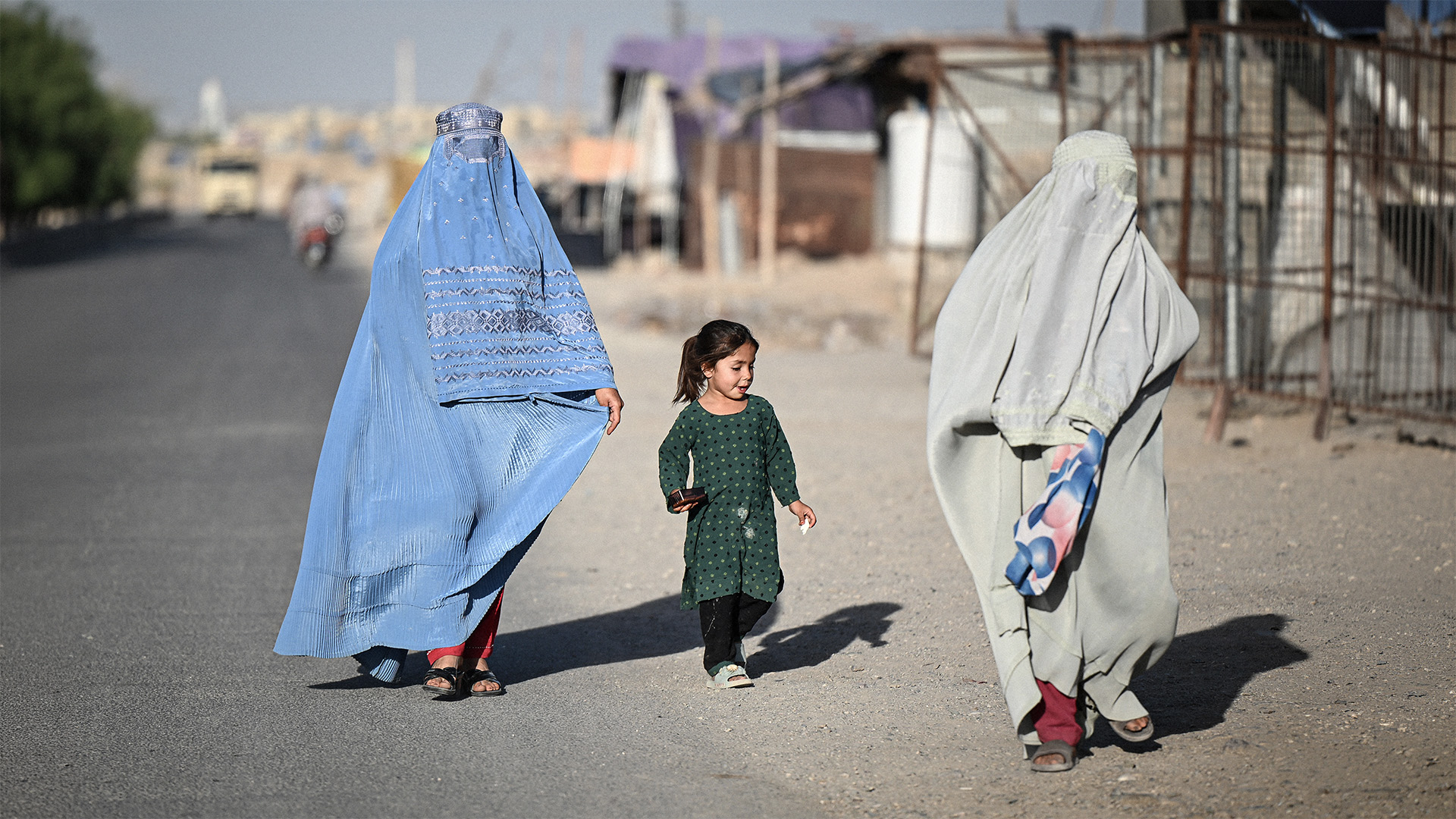
All this has been achieved while Afghanistan’s hardline government has pursued the state-mandated erasure of women. Since 2021, girls have been excluded from school beyond grade six and women’s right to work restricted. In 2022, women were barred from public parks and gyms and in 2024, the Taliban even prohibited women from speaking audibly in public.
What hope is there that Afghanistan can ever get past “gender apartheid”, the term used by human rights groups seeking its recognition as an international crime? Could the answer lie with Afghanistan’s Gen Z?
Afghanistan is an overwhelmingly youthful country, the youngest outside sub-Saharan Africa, with a median age of roughly 18. Its Gen Z mostly grew up in a post-9/11 world, with the internet and mobile phones, in a society where the Taliban was shorn of power and the US was engaged in a 20-year mission to reshape Afghanistan. But now, might the younger generations insist on returning Afghanistan’s culture to a time before it was defined by the abhorrent treatment of women?
Saad Mohseni is CEO of Afghanistan’s largest media group, Moby. He points to a dramatic rise in youth literacy from 2001, when the Taliban regime was ousted by the US for refusing to hand over its “honoured guest”, Osama bin Laden.
Suggested Reading
When the Taliban shut off the internet
Since then, urbanisation has changed the lives of nearly half of Afghanistan’s 43m people. “The momentum [for social change] since 2001 has not stopped despite the Taliban’s return,” Mohseni tells me. “Where women continue to work, study, and participate in public life in the major cities, that isn’t a credit to the Taliban – it’s a credit to a society that has already moved on. The genie is out of the bottle, and it’s very hard to put back.”
True. But how much do women participate in Afghan public life now? The United Nations paints a doleful picture. Restrictions on female education and employment have caused substantial change. Since 2023 there has been a fall in women civil servants from 21% to 17.7%. The UN warns that “the dwindling number of trained women professionals in schools and hospitals will devastate children’s learning, health outcomes and future opportunities”.
But Mohseni’s mother, Safia, a regular traveller to Kabul even after the Taliban returned to power, tells me that there are still women staff at airport immigration counters and that they stamp the passports of both male and female passengers.
Meanwhile, her son’s media outlets continue to employ women. Moby’s radio and TV channels reach more than 15m Afghans and Mohseni says there are “more women working for us today than 2021 as journalists, and they’re very brave and they challenge and push back.”
Lyse Doucet’s new prizewinning book on Afghanistan, The Finest Hotel in Kabul, gives further insight into the female grit and stoicism that’s required to endure life under Taliban 2.0. Doucet writes about Malalai, one of the first female waiters at the Kabul Intercontinental Hotel.
Sacked by the hardline new regime along with other female hotel staff, Malalai is hired back after repeated pleas. This time, her job is limited to something a man cannot do – patting down female guests in security checks. In the light of the terrible restrictions on Afghan women, such small gains have begun to seem like major triumphs.
Five years in, the Taliban shows no sign of changing their hideous treatment of women. All objections, including from major Muslim countries such as Saudi Arabia, that these restrictions are not Islamic, elicit a definitive Taliban response. They cite urf, a Pashto language word that means, “custom”.
Accordingly Mohseni’s book, Radio Free Afghanistan, an account of building an independent media entity in Afghanistan, also reveals the challenge of being female and a journalist under Taliban rule. There are some demonstrations of solidarity, for instance, when male TV anchors also donned masks on air. A female reporter says that being on TV today sends a clear message: “there are still women in public places in Afghanistan”.
But Mohseni also describes how all too often, women journalists are slighted and shooed away by Taliban officials, almost as if they were stray chickens. He also warns of the perils of sticking to a post-9/11 “made-for-Hollywood story” in which the Taliban is presented “as a monolithic enemy”, almost a foreign entity. In fact, they are Afghan and it is best to recognise and acknowledge this reality.
Mohseni describes a phone call from Abdul Karim Khurram, minister of information and culture from 2006-9 in Afghanistan’s western-backed government. Khurram was worked up about “women whose very presence on TV violated traditional Afghan values,” Mohseni writes. He notes dryly: “the Taliban certainly didn’t originate the panic about a woman being too independent outside of the home”.
Suggested Reading
Bashir Noorzai, the Taliban’s godfather
I examined that claim during a recent panel discussion on Afghanistan with Mohseni, Doucet and Christina Lamb, The Sunday Times’s chief foreign correspondent. Both Doucet and Lamb have reported from Afghanistan for more than 30 years.
Lamb, who has written two books on Afghanistan, spoke about what it must feel like to live “in a country where as a woman you’re kind of caged. Here we are in 2026 and there’s a country in the world where girls can’t go to high school and women can’t work”.
Is there a solution to Afghanistan’s problem with women? “Hardline elements within the Taliban will keep pushing to reverse these gains,” said Mohseni, “and this tug-of-war between an evolving society and a regressive leadership will continue for some time, with no guaranteed result.”
Mohseni, Doucet and Lamb were all clear that change had to come from within Afghanistan to have any chance of success. They also agreed that it would be folly to disengage with Taliban-ruled Afghanistan out of disgust or disinterest.
Though rights campaigners demand foreign intervention, much of the world seems to have come to the same conclusion.
At least 15 nations now have envoys in Kabul. Businessmen from many other countries are doing deals to extract and export Afghanistan’s mineral wealth. The EU is making nice to persuade the Taliban to take back some 20,000 Afghans.
Donald Trump’s America, which has been negotiating for the release of US hostages, said last year that financial assistance to Afghanistan would depend on the return of US arms and equipment worth billions. Notably, the US has set no conditions around the treatment of women.
Suggested Reading

The art the Taliban couldn’t stop
There is a burgeoning, if unlikely alliance between India’s Hindu nationalist BJP and the ultra-conservative Islamist Taliban. The Kazakh president’s special representative for Afghanistan recently gave the strategy a name, “pragmatic engagement”, as well as a catchy aim: “replacing the Great Game with the Great Gain”.
But for Afghan women, the balance sheet is about losses. Should the world’s pragmatism become a more permanent acceptance of the status quo, Afghanistan may build up to a full-blown structural crisis. The UN says that girls’ and women’s exclusion is already costing the country $84m annually in lost economic output. These losses can only compound over time. In a country ravaged by drought and where less than half the population has access to safe drinking water, this degree of economic loss is of huge consequence.
Lamb also points to the effects of female exclusion on Afghan society as a whole. “What does this mean for boys growing up? They’re going to school and seeing their sisters told they should not be educated and that women are not working. So they’ve got no female role models, they’re growing up with a very warped view of the world.”
“Afghanistan has had to go through many hard chapters of life,” said Doucet. The country, she says, “has lived through every possible political system the world has tried. They’ve had a peaceable kingdom, not perfect but Afghans recall them as the golden years. Then they had Soviet-backed Communism, then warlordism, then Islamism, then a would-be democracy backed by the West, then of course Islamism again.”
“I suppose if there’s one thread in Afghan history,” said Doucet, “which I trace in the book through the history of the hotel, is that nothing lasts forever.”
Rashmee Roshan Lall spent a year in Afghanistan and wrote a novel, The Pomegranate Peace (Hachette) about her experience. Her Substack is This Week, Those Books
 Most popular
My truly deranged encounter with Trump apologist Kellyanne Conway

Suella Braverman’s book has sold only 106 copies. This is why
The moral depravity of Robert Jenrick
Hungary’s lesson to the world: Populism isn’t permanent