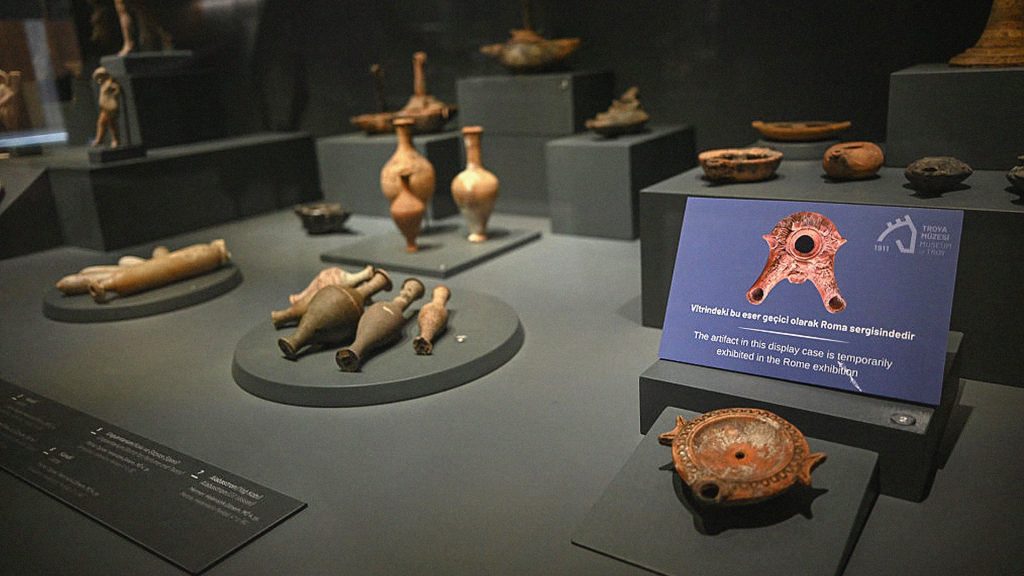
At the Troy Museum in north-western Turkey, glass cases hold arrowheads, terracotta lamps and spindle whorls – the everyday objects of a city that became one of history’s defining myths. They were excavated at Hisarlık, the archaeological site that’s widely accepted as the city that inspired Homer’s Troy.
When Christopher Nolan announced his film of The Odyssey, the museum’s response was to invite him to Çanakkale. Come and see the real Troy that inspired the story.
Suggested Reading

The tiny dolls with souls at the heart of a museum repatriation debate
Turkish archaeologists and museum officials largely saw the film as an opportunity. If millions of cinemagoers left wanting to know where Troy really stood, perhaps they could be persuaded to visit. In doing so, the film has quietly revived the question of who gets to claim Troy.
In the global imagination, Troy is part of ancient Greece, even though the ruins sit on the windswept plains of north-western Turkey overlooking the Dardanelles. But then modern nation states inevitably inherit histories that long pre-date them.
Italy did not build the Colosseum. Egypt is not the same civilisation that built the pyramids. Modern Turkey did not exist when the Bronze Age city of Troy flourished more than 3,000 years ago. Yet all understandably regard these places as part of their national heritage.
Troy occupies a uniquely awkward position. Homer wrote in Greek and his epics became foundational texts for the classical world. For centuries, European education presented ancient Greece as the cradle of western civilisation, with Troy cast as the dramatic backdrop. But what did Turkey inherit?
The world’s habit of treating Troy as instinctively Greek can feel like another example of Anatolia serving merely as the backdrop to someone else’s history. What is being contested is not the location of Troy, but the narrative through which the world understands it.
The more revealing story though is what did not happen. In today’s political climate, it would have been easy to turn the film into a point of nationalist grievance. Instead, the dominant reaction was one of missed opportunity rather than outrage.
Museum officials lamented Nolan’s decision not to film at Troy itself, while many Turkish commentators argued that the film could become a powerful advertisement for the real archaeological site.
That matters, because soft power is exerted through museums, television dramas, tourism campaigns – and also films. A single Hollywood production can shape the views of hundreds of millions of people, meaning that the battle over cultural memory has become every bit as significant as the battle over territory.
Suggested Reading
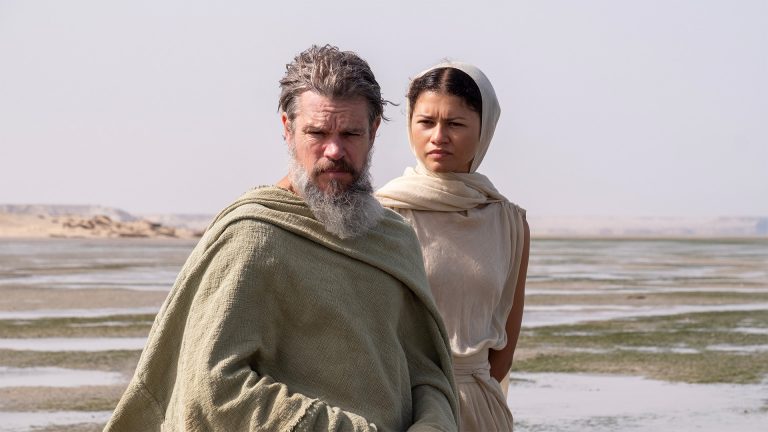

The Odyssey is a masterwork that reinvents the epic
That is why Nolan’s decision resonated in Turkey, where the concern was less about historical accuracy than about visibility. For centuries, the classical world has been presented through a Greek lens, while Turkey, despite containing many of antiquity’s most significant archaeological sites, has struggled.
Greece cannot claim Troy simply because Homer wrote in Greek, just as Turkey cannot claim the civilisation as Turkish simply because its ruins lie within modern borders. The city belongs to no nation.
Perhaps that is why Troy has endured for three millennia. It sits at the intersection of Europe and Asia, myth and archaeology, literature and politics, with every generation projecting its own concerns on to it. Victorian scholars searched for the historical Homer, 20th-century archaeologists searched for the real city and 21st-century governments increasingly see heritage as an instrument of influence.
Nolan almost certainly did not intend to reignite a debate about national identity, but by returning audiences to one of humanity’s oldest stories he has reminded us that history is never entirely settled.
The ruins belong to Turkey, Homer’s words belong to the Greek literary tradition and the myth belongs to everyone, which is perhaps why the battle over Troy was never really about who conquered the city, but about who gets to tell its story.