
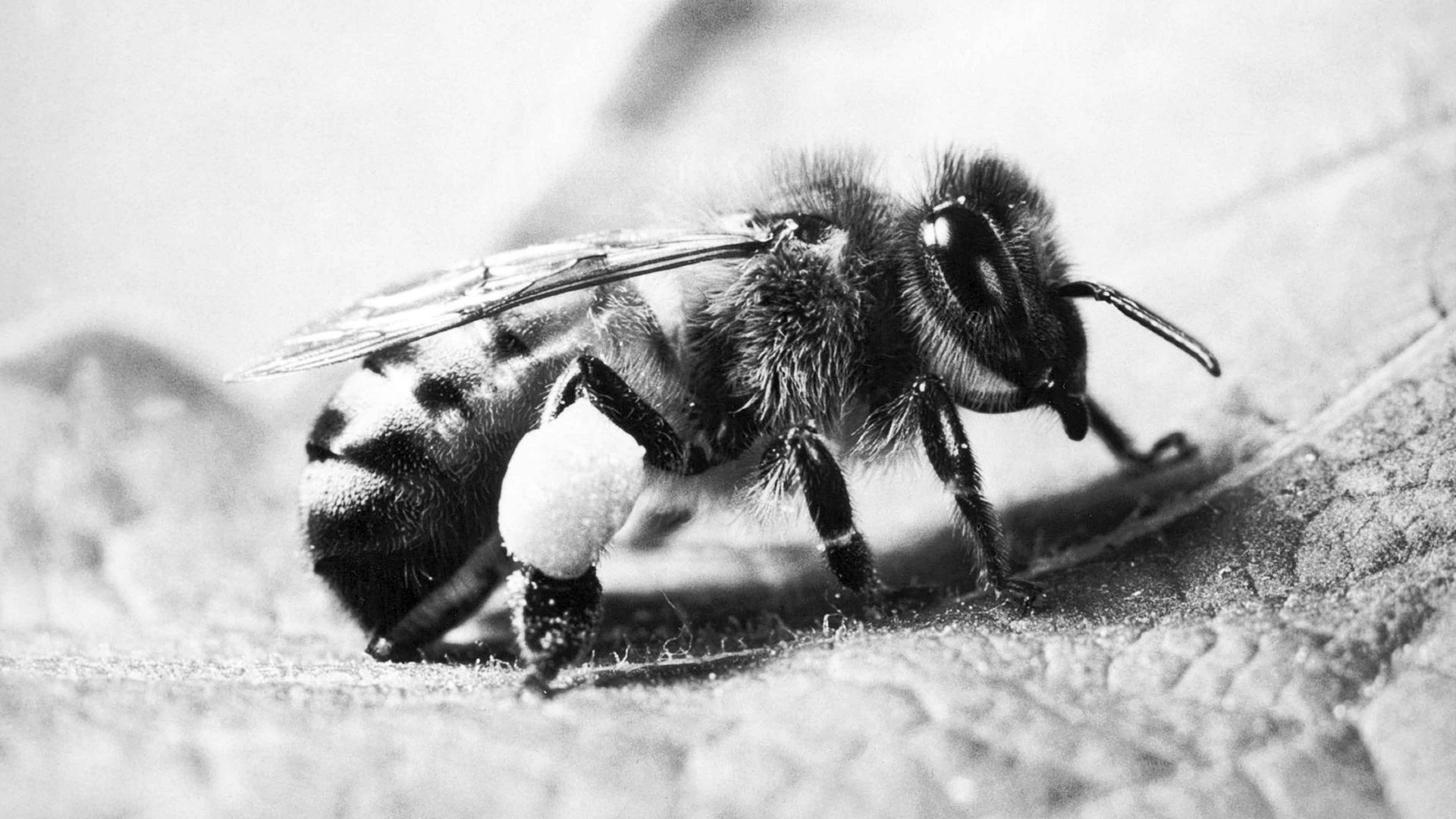
“We can hardly escape from the conclusion that worms show some degree of intelligence,” Charles Darwin wrote in 1881 after examining their behaviour in his garden in Kent. “Worms” had long been a catch-all term for the lowly creatures of the planet, including insects. But even Darwin would have been surprised at the mental agility now recognised in another familiar denizen of rural England: the bee.
The honeybee may be alone among non-human animals in possessing a symbolic, abstract form of communication – almost a kind of language. Through its “waggle dance” in the hive, a foraging bee conveys to its fellows both the distance and the orientation of a food source it has found.
Bumblebees can learn how to do a wide range of tasks, such as manipulating a small ball into a hole to gain a reward (call it bee golf, if you will). Their beliefs about the world even seem affected by “mood”: they treat an ambiguous stimulus about food more hopefully after being given a reward but more sceptically after a scare. Some researchers argue there’s reason to suppose bees have a degree of consciousness, although we’re unlikely ever to know quite what it’s like inside the sand-grain-sized bee brain.
Perhaps even more remarkably, a new study suggests that bees reveal their feelings in facial expressions. Look, I’m with you here: the idea of a bee grimacing sounds comically absurd. But hear me out. Researchers in China and Australia have filmed bumblebees feeding on various substances dissolved in a droplet of water: sugar, salt, and quinine (the bitter stuff in tonic water). Feeding bees extend their proboscis, at the tip of which is a hairy tube called a glossa that acts like a tongue, lapping up the liquid by trapping it in the hairs. The bees leave their glossa extended after finishing an enjoyable sugar drink, rather as mammals leave their tongue hanging out after a tasty meal. But encountering a bitter taste, instead they shake their head and wipe their mouth. Sound familiar?
Suggested Reading

Sorry Geoffrey Hinton, but AI isn’t conscious
These behaviours don’t by themselves prove that the expressions reflect a “Yum” or “Yuck!” response. But the researchers carried out further studies which showed that indeed they seem to be hedonistic reactions. (In one case, the bees were given a cannabis-like substance, known to affect hedonistic reactions in mammals. Yes, you probably know what I’m talking about.) The experiments suggest that bees really do experience something when feeding, and that they display this in a weirdly similar way to us.
The work comes hot on the heels of a report that bees can improvise solutions to complex problems. Researchers in Finland enclosed bumblebees in a compartment with an artificial flower on the ceiling containing sugar, just like a real flower. The bees couldn’t fly up to the flower in the enclosed space, but they were given a Styrofoam ball that they could roll across the floor and then climb to stand on. With no prior training, the bees figured it out – after pausing as though thinking it through.
We don’t need to be told how important bees are; without them, plants won’t get pollinated and crops will fail. But experiments like this give us another motivation to protect bees, says Lars Chittka, an expert in bee behaviour at Queen Mary University of London: respect for the fact that “they are, at some level, thinking and possibly feeling beings.”