
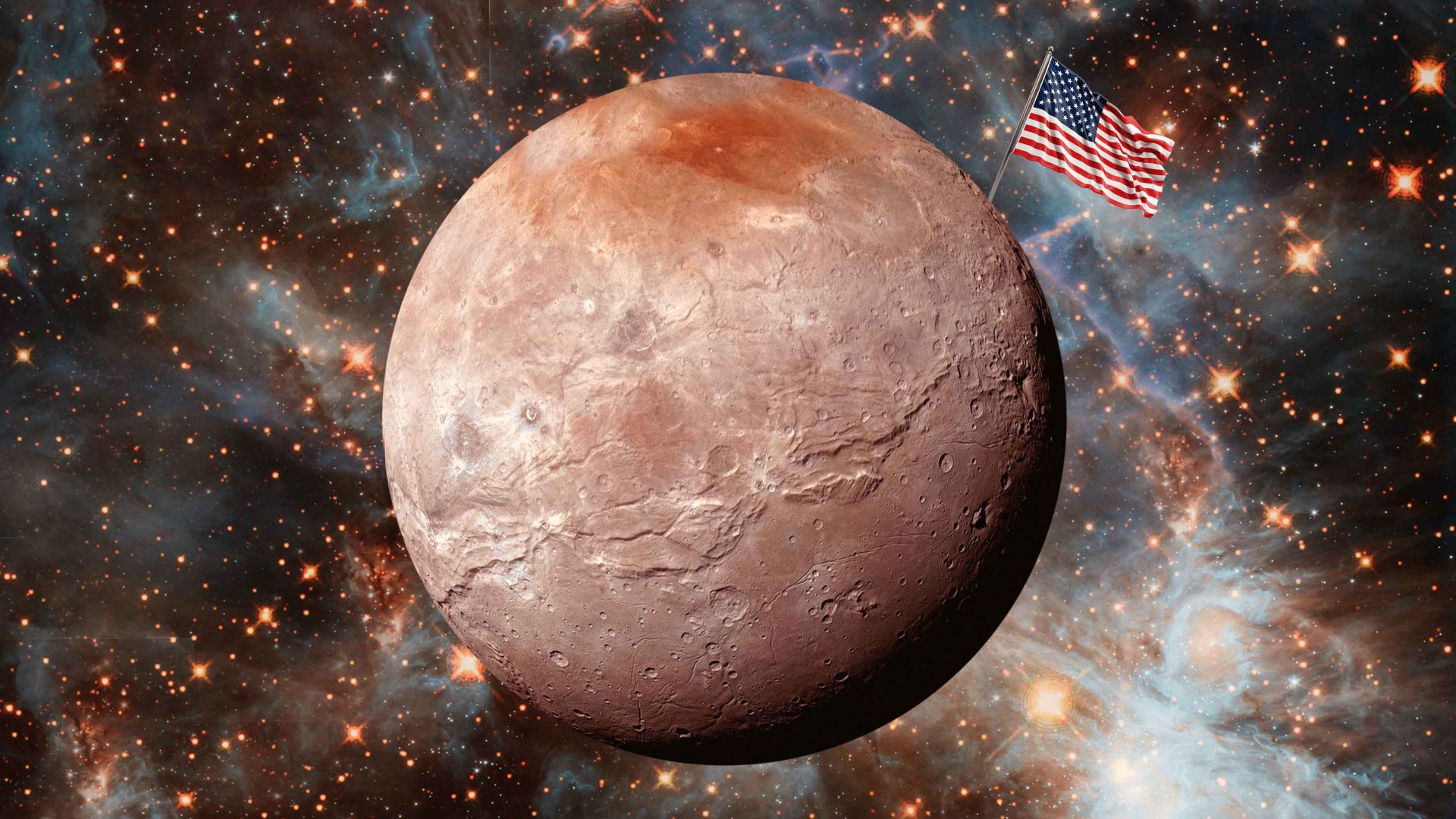
Who knew that populism can happen to astronomy? But so it seems. Jared Isaacman, Donald Trump’s appointee as the administrator of the US space agency Nasa, is working to reinstate Pluto, the dwarf planet in the Kuiper belt beyond the orbit of Neptune, as a fully fledged planet. No scientists have been agitating for a reversal of the 2006 decision by the International Astronomical Union (IAU) to relegate Pluto from its position as the ninth planet of the solar system. But Isaacman doesn’t like it – and one suspects he thinks that Making Pluto Great Again will go down well, especially in the US.
There’s a clue in Pluto’s history to the reason for this rather bizarre crusade. It was identified in 1930 by the American astronomer and telescope maker Clyde Tombaugh, making it the only “planet” to be discovered by an American. Spotting Pluto needed a powerful telescope. For one thing, it is so far away from us – its odd orbit, tilted with respect to the plane in which the other planets circulate the sun, holds it between 4.4 and 7.4bn km
from the Sun, compared with Earth’s 150m km. And it is tiny: less than a fifth the diameter of the Earth and 0.2% of the mass. It’s a frigid ball of rock and ice, its surface covered with frozen nitrogen.
Coming from a poor farming family in Illinois, Tombaugh epitomises the American boy made good. The Illinois Senate rejected the IAU decision in 2009, declaring that Pluto would still be considered a planet in the state; the New Mexico House of Representatives, that being the state where Tombaugh lived for many years, had already done so two years earlier. And Arizona, where the Lowell Telescope that Tombaugh used for the discovery was located, passed a law in 2024 making Pluto a planet. Evidently, Pluto’s status is freighted with American pride and patriotism.
As far as most astronomers are concerned, however, the ship has sailed. The IAU decision caused a lot of argument at the time. Alan Stern, the principal scientist on Nasa’s New Horizons mission launched in 2006 to study Pluto close up, said that “I’m embarrassed for astronomy… this [re]definition [of a planet] stinks.” But while a few continue to grumble, most accept that the case for demotion made sense. There are several known, and perhaps other unknown, bodies in the Kuiper belt that lies beyond Neptune, that are comparable to Pluto and would otherwise also need to be considered planets, including Pluto’s own “moon” Charon and the dwarf planet Eris, discovered in 2005 and even more massive than Pluto itself. Ceres, a 900km-wide object in the asteroid belt between Mars and Jupiter, would also have a claim.
All of these objects meet the first two criteria for a planet that the IAU accepted in 2006: they orbit the Sun (albeit peculiarly for Pluto and Eris) and are massive enough for gravity to pull them into a sphere. But they fail the crucial third criterion, which is that a true planet should have swept up all the debris in the neighbourhood of its orbit. Pluto has not cleared its own path, and so, like Eris, Ceres and two other known bodies in the solar system, it is classified as a dwarf planet.
Suggested Reading


Ebola, USAID and how Musk’s spending cuts will kill millions
Isaacman mentioned his desire to restore Pluto to planetary status in testimony to a US Senate committee, saying he was “working on some papers right now to escalate through the scientific community to revisit this”. He has provided no further clarification. But “there’s no reason an administrator at Nasa should care how a Solar System body is categorised”, says cosmologist Katie Mack, adding that “Nasa isn’t the organisation that makes classification determinations for Solar System objects [that’s the IAU], and if Isaacman wants Pluto reclassified again, he can lobby the IAU in his own time.”
To some scientists, the irony of Isaacman’s campaign is crushing. When Trump is proposing massive cuts to Nasa’s funding, and what money remains seems likely to be diverted from scientifically rich uncrewed missions to other worlds towards the spectacle of putting humans on the moon, this crowd-pleasing posturing is a slap in the face. “It’s wild to ‘make Pluto a planet again’ while decimating the careers of those of us that study it!”, says planetary scientist Adeene Denton. Sarah Hörst of Johns Hopkins University told a reporter that “I understand why you all are [reporting] this because it is flashy – but we are struggling with existential issues in planetary science in the US right now and I’m not really interested in talking about this.” Pluto is a massive (but not massive enough?) distraction.