Hossein Khosrow Ali Vaziri,
March 15, 1942 – June 7, 2023
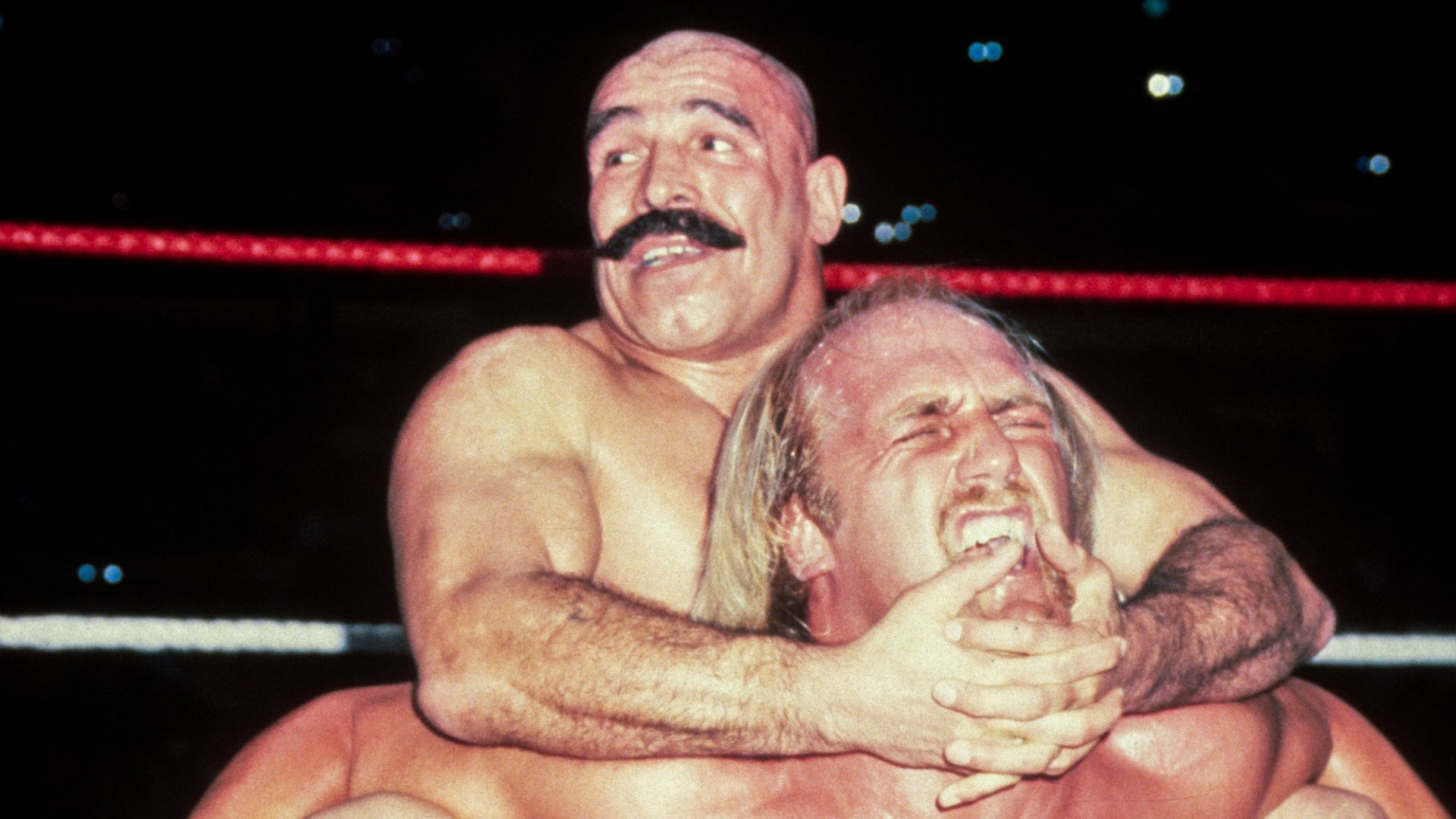
When the Iron Sheik enters the ring, Madison Square Garden is on its feet. “They have a lot of hate in their hearts for this man,” the commentator announces to the wrestling fans across the world who are glued to 1984’s mega-hyped WWF heavyweight championship bout.
The Sheik – never “Sheikh” – has been taunting the crowd with his familiar cry of “Iran number one! USA hack-phooey!” Wearing a keffiyeh, a robe and extravagantly curled shoes, he parades the championship belt he won just a month ago, defeating the WWF’s old-school Bob “All-American Boy” Backlund. If the 20,000 people watching get their way, it won’t be his for much longer.
Hulk Hogan, with “American Made” emblazoned across his red vest, is the new challenger – and, in truth, already the next champion. Sport and politics have collided many times in the American psyche, but here was the turn of “sports entertainment” to grab the imagination and the ratings: the “good” American man from Venice Beach versus the overseas “villain” with a thick accent and a bad attitude, from the country then second only to Russia among the US’s key political enemies.
Iran took up that status after the 1979 Tehran hostage crisis, in the dog days of Jimmy Carter’s White House years. Having realised that political tension does wonders for ticket sales, wrestling promoters were delighted to exploit intense anti-Islamic feelings, and so a wrestler called Hossein Khosrow Ali Vaziri – recently fighting under the moniker of The Great Hossein Arab – was rechristened.
In the Garden, Hogan rips off the Iron Sheik’s robe, drops an elbow in his face, then spits at him, the crowd going wild. The Sheik rallies, and puts Hogan in a submission hold – his famous Camel Clutch – but quickly Hogan struggles to his feet, forces his opponent backwards and finishes the bout with his patented Atomic Legdrop.
It is the moment Hulkmania is born… but every hero needs someone to beat, and the Iron Sheik has played his role to perfection in a well-choreographed defeat. The event goes down in history as one of the most important in the history of American wrestling.
When the first WWF action figures go on sale months later, anyone buying a Hulk Hogan figure has to buy an Iron Sheik figure too; you can’t have a favourite wrestling toy without giving them someone to clothes-line. With lunchboxes, MTV appearances, pop videos and sold-out arenas, as well as the revenue from that action figure, the ’80s were a good time to be a famous villain.
Suggested Reading
The childhood trauma that left Maya Angelou mute for five years
Born in Damghan, Vaziri had grown up idolising Iranian wrestling legend Gholamreza Takhti, a four-time Olympic medallist. While on national service, he joined the wrestling team and won the army championship.
He spent the 1960s as a serious Greco-Roman wrestler and was attempting to qualify for the 1968 Summer Olympics when Takhti died in mysterious circumstances. Scared for his life, he flew to America with barely a word of English.
After working as a coach in amateur wrestling – the real thing, popular in American universities – Vaziri joined the entertainment business. He became The Great Hossein Arab, and then the Iron Sheik. Often teamed with Soviet baddie Nikolai Volkoff and regularly fighting against the drill instructor character Sgt Slaughter, another personification of patriotic America, he was one of the faces of the rising WWF, appearing on merchandise, in cartoons and in a Cyndi Lauper video. He was always the bad guy, always hated.
With fame, and the pain of real injuries incurred in fake fights, came cocaine and a drug bust in 1987 that derailed his career. Vaziri fought on, rebranded during the first Gulf war as Colonel Mustafa, an Iraqi sympathiser, before age and injuries took their toll. He faced renewed misery in 2003 when his daughter Marissa was murdered by her boyfriend, leading to more cocaine abuse and finally to a successful rehab.
In the years before his death, Vaziri became a social media personality. Twitter was the perfect place for someone whose entire persona was an exaggerated caricature and allowed the Sheik’s (seemingly genuine) war of words with Hogan to resurface again while aiming barbs at everyone from Justin Bieber to Logan Paul.
Playing the pantomime villain to Mr America in the same year that the US labelled Iran a “state sponsor of terrorism” does a disservice to Vaziri as both an Iranian and someone who adopted America as their home. Few of the 20,000 baying for his defeat at Madison Square Garden would have known that Vaziri had helped train the US wrestling team for the 1972 Olympics, which emerged with six medals and three golds.
Back then, his ambitions were nothing like the one-dimensional character who came face to face with Hogan. “Wrestling comes from Iran, and Iran is the oldest country in the world,” he said proudly back in 1972. “I love my country, so I hope to study television and coaching and then go back to teach.” Instead he became the Iron Sheik, a cartoon character that America loved to hate, aware that the world will always need someone to boo.