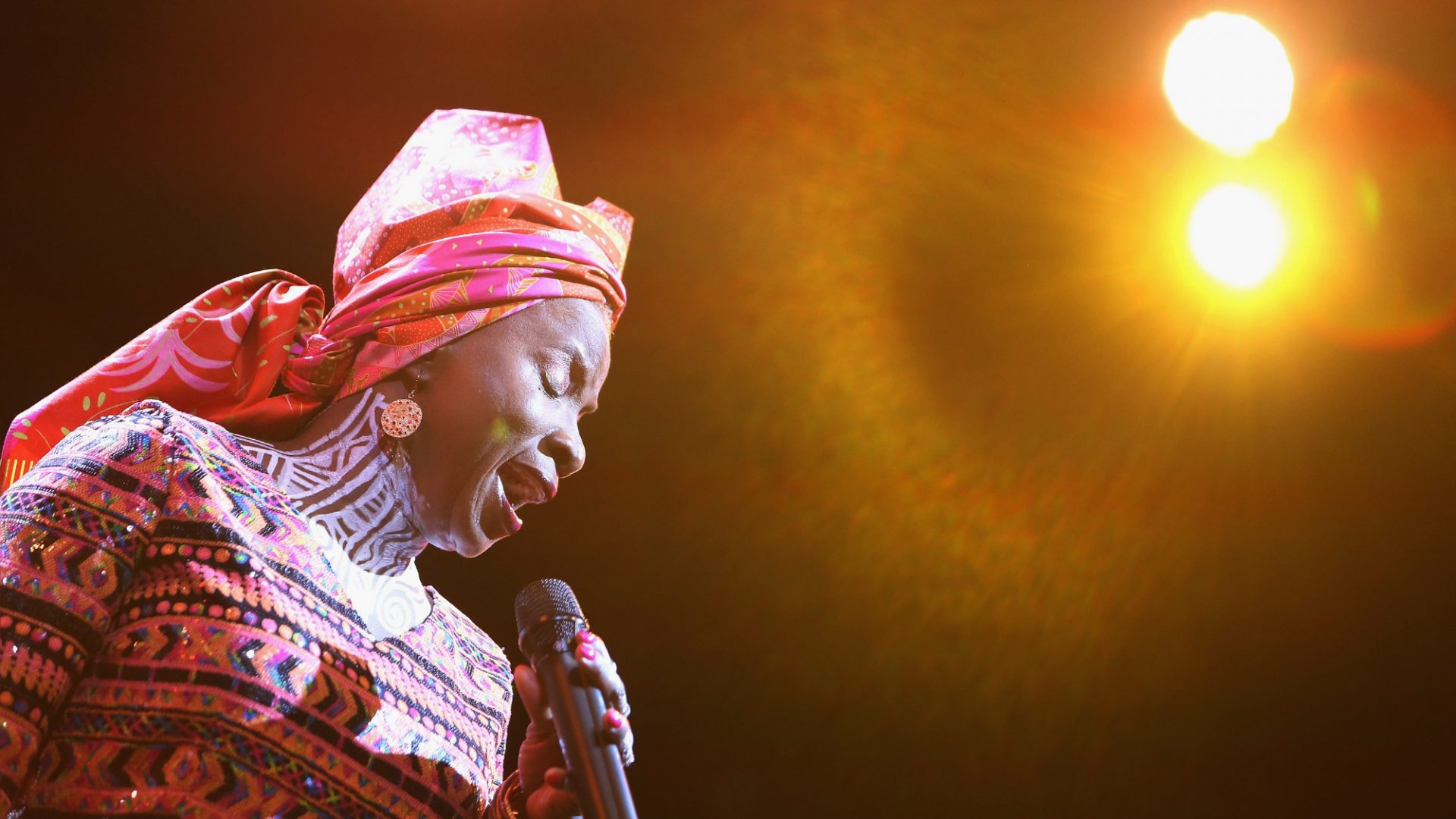
If there is a grand dame of world music, it must surely be Angélique Kidjo.
Born in Benin in 1961, Kidjo began her career with some sparkling Afropop (her debut album, somewhat bluntly entitled Pretty, is a joyful affair) and soon moved into the orbit of western fandom, people who love her powerful, emotive voice, her ear for a great tune, and her willingness to embrace eclecticism. Over the intervening years, she’s released duets and collaborations with what cynics might call the usual suspects and who more kindly folk would call the curious giants of western rock and pop: she’s sung with everyone from Peter Gabriel and Alicia Keys to Bono and John Legend (on the same song).
More interestingly, Kidjo has taken some unexpected turns in her recording choices, most notably in her decision to make her own version of the Talking Heads album Remain in Light, which was itself intended to be a kind of African musical forgery; in doing so, she created something both more African and arguably less colonial (and she did something similar but different with her album Celia, a tribute to the Cuban salsa legend Celia Cruz).
Kidjo has an impressive and lengthy back catalogue (although her tally of 18 or so albums is nothing compared with those of some of her compatriots: Benin’s great Tout Puissant Orchestre Poly-Rythmo de Cotonou released more than 50 in their lifetime) and it’s a testament to hser as a driving force in music that she’s embraced so much variety.
As well as those Talking Heads and Celia Cruz tributes, she has worked with the composer Philip Glass on both his Africa Sings album and his Lodger symphony, in which, in another example of reversing the polarity of a western-facing music career, Kidjo sings David Bowie’s African Nightflight and Move On.
Throughout her career, she’s mixed the sounds of her native Benin with forays into whatever the contemporary pop sound of the day is. Purists may prefer the swing and dart of her early work, but on albums like 2007’s Djin Djin, where she duets on the Rolling Stones’ Gimme Shelter with Joss Stone, or 1996’s Fifa where Benin-style songs like Wombo Lombo are given a contemporary pop-funk sheen, or 2002’s Black Ivory Soul, which has a Brazilian flavour and features an immaculately French cover of Serge Gainsbourg’s Ces petits riens, Kidjo has always shown herself to be adaptable and keen to shake things up – and that’s a good thing, music being ever-evolving.
And now in 2026, after a five-year hiatus during which she mostly performed at opening ceremonies, Kidjo is back with HOPE!! (italics, capitals and exclamation marks artist’s own). Once again, she mixes the sounds of Africa and the west. Once again there’s a multiplicity of musical collaborators, from Pharrell Williams, who contributes three songs, and Nile Rodgers (who has now surely played on every album released since 1977) to Nigerian hi-life duo the Cavemen and Tanzania’s Diamond Platnumz.
It’s a big, confident album that sounds neither “authentic” nor bland. It sounds like Angélique Kidjo: nobody else could harness all the different names and styles on this record and make them her own.
Suggested Reading
How heritage rock finally grew up
In recent years there has been a lot of discussion of the “exploitative” nature of popular music, the way western (meaning American and European) music makers have treated other cultures like wells to dip into and drink from with sometimes minimal acknowledgment (recently Brian Eno admitted his and Talking Heads’ debt to Fela Kuti’s Afrodisiac, saying, “If you listen to (Remain in Light) it’s so influenced by that. It’s sort of shameful in a way.”)
Should western artists be forbidden from co-opting the music of other lands? Of course not: but more credit would be good.
Equally of course, it’s a two-way street. There’s something exciting about Kidjo’s Remain in Light and the way she builds a kind of temple of Afrofuturism from the original – she could have called it Reclaim in Light. Everything she does, she brings her background to it: but more importantly, she brings herself to it.
On HOPE!! she ends the record with a new version of an old song, the achingly melancholy Malaika, a song she’s recorded before. It was, she says, her mother’s favourite song, and this time she sings it with an orchestra (and with French singer Florent Pagny). It’s a moving and cinematic take on the song, and Kidjo makes this new version her own: as she does with everything she lends her voice to.
HOPE!! is a good record, if not a great one, and in the end it’s another marker on this artist’s extraordinary career. At 64 years of age, with or without collaborators, Angélique Kidjo continues to chart her own path with style and grace.
HOPE!! by Angélique Kidjo is released by Warner Music France.
David Quantick’s latest book, Imagine a Friend, is published by Stars and Sabers