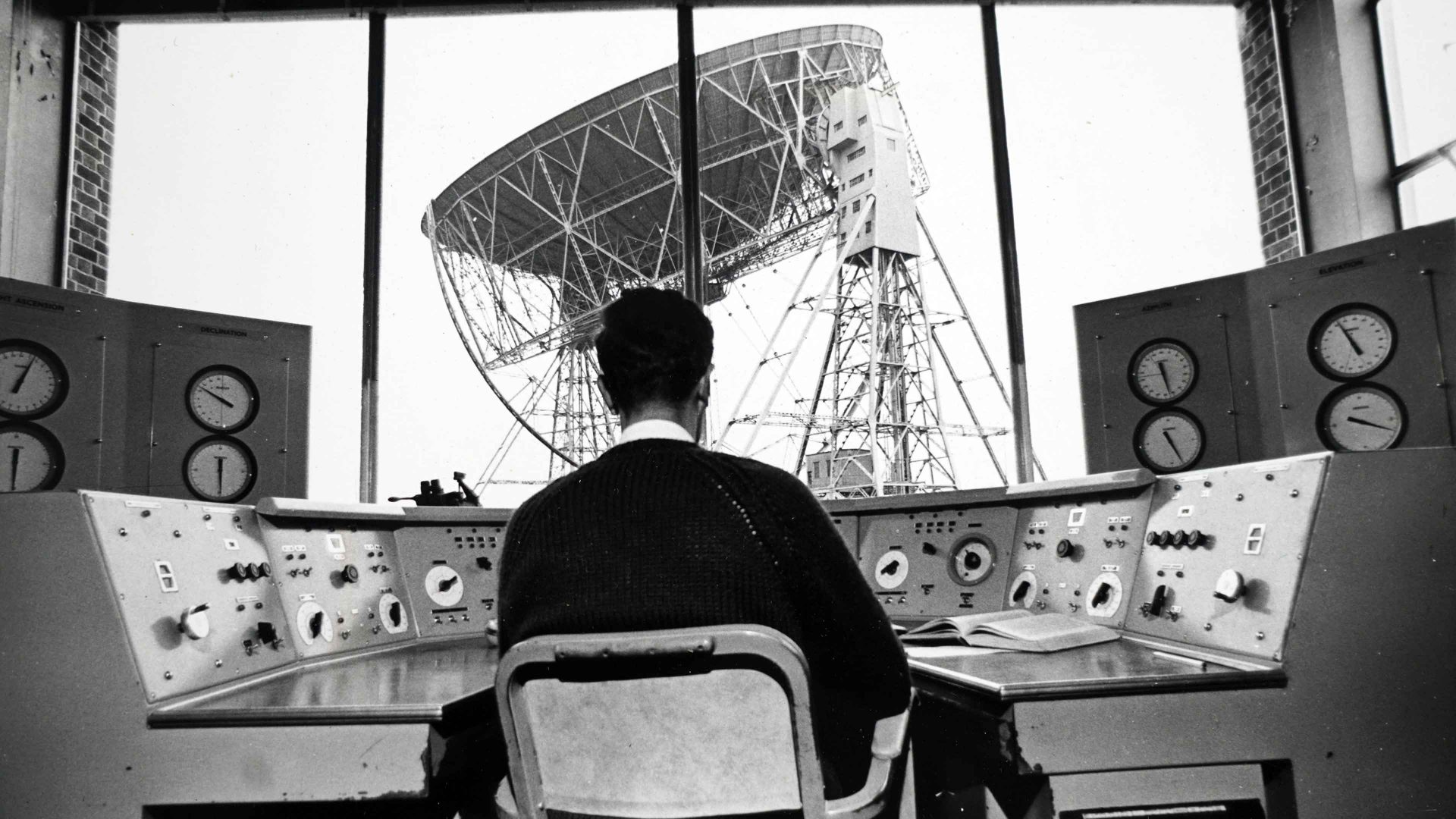
The Jodrell Bank Observatory in Cheshire, which houses the immense white dish that was once the largest radio telescope in the world, faces closure after funding cuts to the site by the UK Research and Innovation (UKRI) agency, the governmental body that directs funds for British science.
You’ll be hard pressed to find anyone, especially scientists, outside UKRI who thinks that losing this iconic instrument would be less than tragic.
It’s not just that the Jodrell Bank telescope is still active, forming the largest part of a network of English radio telescopes called e-Merlin that observe how stars and planets form and galaxies evolve. The instrument, completed in 1957, has become a part of British science culture – a symbol of “national prestige”, in the words of physicist Bernard Lovell who conceived the idea for the telescope after the war.
Lovell had worked on radar during wartime, and as a researcher at the University of Manchester he began in 1945 to set up a series of radio antennas at the university’s botanical station in rural Cheshire. His plans soon morphed into an ambitious design for a massive dish that would receive radio waves emitted from stars, galaxies and other astronomical objects. Raising funds was challenging in the period of postwar austerity, but Lovell persuaded the science and industry department that such an instrument would demonstrate British leadership in science.
Suggested Reading

The mystery woven into the Shroud of Turin
Despite a substantially overrun budget, the Jodrell Bank telescope soon began proving its worth once it was operational in the late 1950s. Quite aside from the astronomy, it could be used to track Soviet space activities at the height of the cold war, including the launch of ballistic missiles.
Lovell himself claimed in his memoirs that the Soviets tried to assassinate him, as head of Jodrell Bank, with lethal radiation when he visited the Soviet Deep-Space Communication Centre in the Crimea in 1963.
For Tony Blair in 2002, Jodrell Bank was the prime example of how Britain is an “innovative, forward-looking” player in global science. It faced off a threat of closure in 2008 to become a Unesco World Heritage site in 2019. It is also an icon of the cultural and technological heft of the north-west of England – which has to make you wonder if Andy Burnham will allow it to be axed. Perhaps the change of leadership will be its saviour.
The threat of closure is just a part of a bigger tranche of funding changes for UK science, which will also impact other areas of astronomy and high-energy physics, for example by withdrawing from some major international telescope facilities.
But the famous dish (now called the Lovell Telescope), where nearly 3,000 scientists work, may serve as a focal point for the opposition. Oxford astronomer Chris Lintott, a regular face on The Sky at Night, has called the UKRI cuts “short-sighted” and “stupid”. Many radio astronomers get their training there, and some researchers fear that, without it, the UK will fall behind internationally in a field the country once pioneered.
Astronomer Simon Garrington of the University of Manchester, Jodrell Bank’s associate director, told the BBC that the leadership team would seek other sources of funding if that from the UKRI is cut, but admitted that that would be a “huge hill to climb”. Historian of technology Jon Agar, author of a 1998 book on the history of Jodrell Bank, hopes the facility will survive but says: “I fear that this crisis might be too much.”