You could be forgiven for rolling your eyes at being told yet again that an AI model has solved a big problem in maths. But folks, this really is the Big One. An AI-assisted proof of the Riemann hypothesis has been announced by mathematician Levent Alpöge, working at Anthropic. On hearing the news, one mathematician told New Scientist that “I can only compare this achievement to the aliens with a vastly superior intelligence coming to the Earth and explaining to us all the sacred mysteries we ever dreamed of.”
The hyperbole is a little absurd but nonetheless conveys what this moment feels like to mathematicians. James Maynard of Oxford University, a leading expert on the subject, put it more soberly: “This is an absolute historic milestone for mathematics.”
Like many, I’d expected this would happen eventually – but not quite so soon. Only in October OpenAI reported a proof of a slightly weaker version called the quasi-Riemann hypothesis, so the full-strength proof was clearly in the offing. But what’s it all about?
Suggested Reading
The biggest mysteries of the universe just got a whole lot smaller
At the core of the problem is the question of how prime numbers are distributed along the number line: the integers from 1 to infinity. Prime numbers are not exactly divisible by smaller whole numbers (with the trivial exception of 1). At first they come thick and fast: 2 (the only even prime), 3, 5, 7, 11, 13…
But soon they start to thin out, as it becomes increasingly likely you can find a divisor. The number 91 looks like a good candidate, say, but is actually the product of 13 and 7. So how are primes distributed once we get to gigantic numbers?
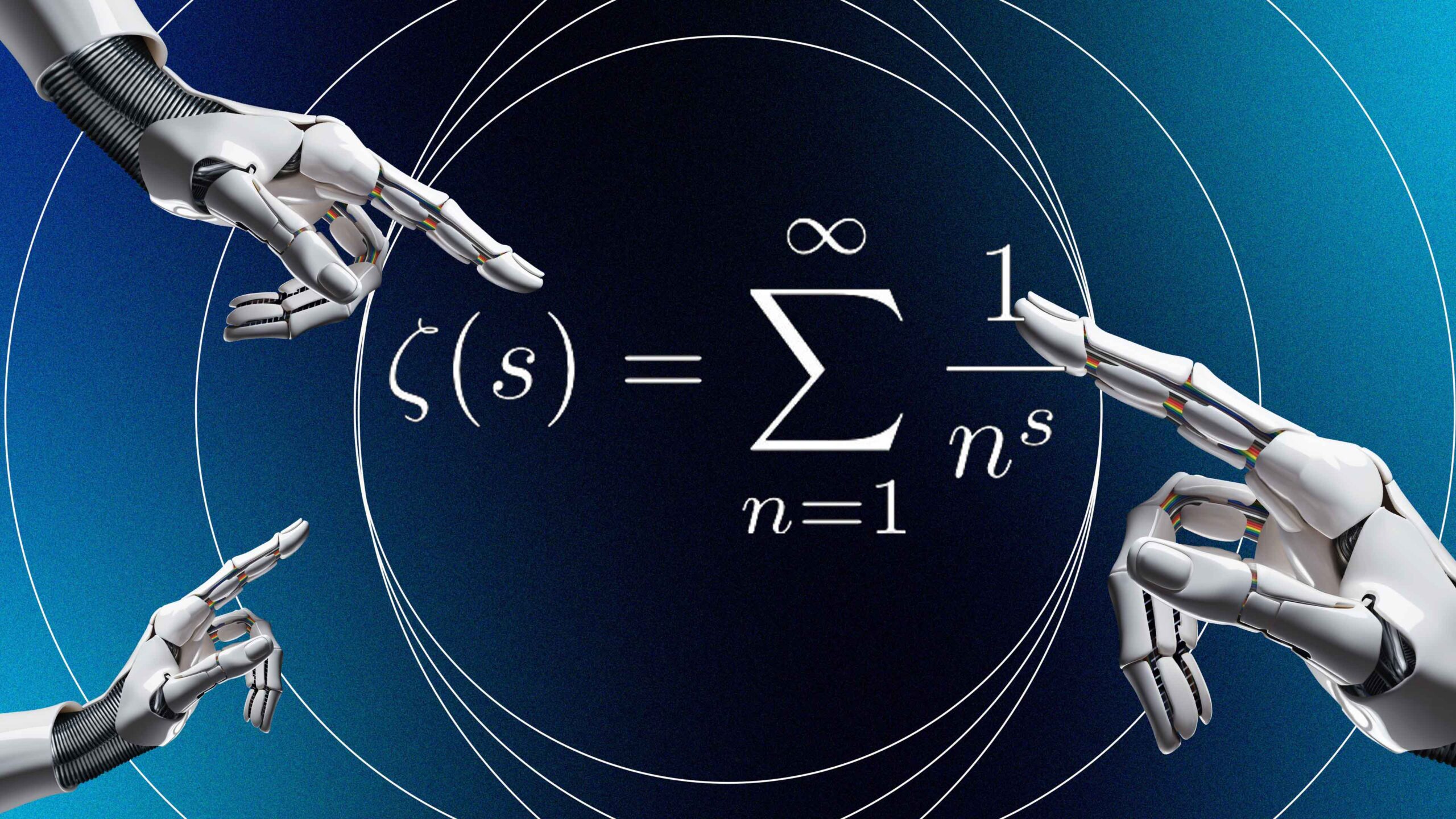
In 1859 the German mathematician Bernhard Riemann showed that the distribution of primes is related to a mathematical function called the zeta function. Riemann put forward a hypothesis about the numbers that, when fed into the zeta function, make the function equal to zero. Riemann conjectured that these “zeroes of the zeta function”, and thus the distribution of primes, follow a simple rule. But is it true?
The Riemann hypothesis was one of the most important unsolved problems in mathematics. Like many such problems, it’s not just a case of right or wrong; the idea connects to several other branches of maths, so a solution would offer deep insights into other questions too.
But there’s the rub. Those insights depend not just on knowing if the Riemann hypothesis is right or not, but on knowing why. Alpöge’s proof comes in the form of 250,000 pages of calculations developed with Anthropic’s Claude AI model, which no human could hope to check through.
Researchers use an automated algorithm called Lean to check proofs for any inconsistencies with the fundamentals of maths. Because the new proof seems to pass that test, it is widely believed to be correct. But without understanding why, the proof is of limited value.
That’s why mathematician Eugenia Cheng has dismissed the Riemann proof as not really maths at all. This is the problem with AI maths: it is not human-friendly, typically offering brute-force answers with no transparency about reasoning.
Suggested Reading
Will AI kill off the mathematician?
While others will be trying to mine the gargantuan AI proof, there may be hope at hand. The announcement prompted Alessandro Masullo, a Rome-
based mathematician, to release a wholly human-derived proof of the Riemann hypothesis that he had been working on for 12 years, and which runs to a mere 940 pages. It is, he admits, rough around the edges – he would have smoothed those edges if his hand hadn’t been forced – but he is confident he has the gist worked out.
Before we imagine this as a case of man versus machine, it’s important to remember that AI maths models don’t start from scratch. They seek out insights from the entire published maths literature, perhaps finding new connections no one had spotted. So they’re as dependent on past human effort as chatbots are on the plagiarised text of countless authors.
In many ways, by connecting the dots, AI maths models are finding the insights we never knew we had. They’re not clever aliens, just super-informed (but inarticulate) assistants.