
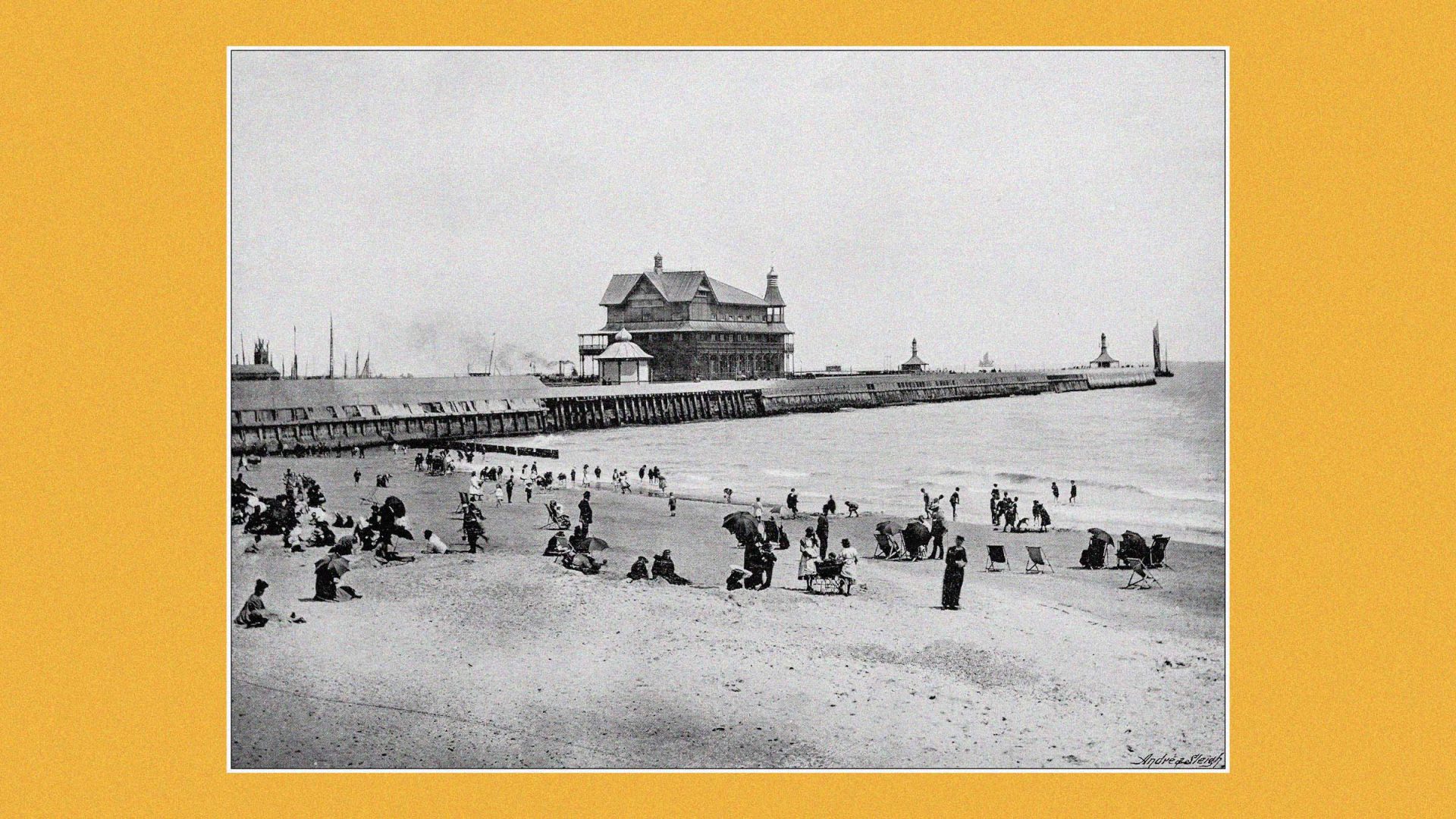
I was born during the second world war, when travel to and along the English coast was severely restricted for military security reasons. So in spite of living in Norfolk within only 15 miles of the North Sea, my parents were unable to enjoy the coastal area’s charms during that period.
My own first seaside holiday did not occur until the war was very nearly over, and even then permission to travel to the coast was not readily given because of troop movements being made in the build-up to D-Day. I was less than two years old at the time so do not remember it, but family photograph albums show that we spent our time on and by the beach in Lowestoft.
Lowestoft is the easternmost place in the whole of Britain. The town lies only about 100 miles across the North Sea from the coastline of the Netherlands. Everybody of my age who lived in and around the area knows that the name of this town is correctly pronounced as two syllables: Low-st’f, and not three, as younger people are now tending to pronounce it: Low-es-toft.
That two-syllable version makes perfectly good sense in terms of the name’s history and its earliest meaning, which originally referred to land belonging to a Viking settler whose name, Hlothver, via changes over time, came to be pronounced in English as “low”. The toft element has the same origin as the modern Norwegian word tomt “building plot”. So this man’s name was connected to the Old Norse word for a homestead by the possessive marker, originally –es-, eventually reduced to –s.
There are many other place-names in England where the originally genitive or possessive –s on the first element is no longer perceived as such by most people. Clear evidence that this is the case can be seen in what happens with place-names such as Hailsham, Faversham and Evesham, where the letters s and h are mistakenly (that is, unetymologically) combined together to produce the single “sh” sound as in shop.
My North Norfolk-born grandmother came from a village near the market town of Aylsham, which she pronounced “Els’m”. She understood that the correct way to analyse names such as these was Ayl’s-ham, Hail’s-ham, Faver’s-ham, and Eve’s-ham, where the first element was a person’s name, the –s was the grammatical marker of possession, and –ham indicated a homestead or settlement.
There are several other similar places-names in the Lowestoft area where the authentic pronunciation has the originally possessive syllable –es– being reduced to –s. Haddiscoe should be said “Hadd’scoe” (scoe was the Old Danish word for “wood”, Modern Danish skov); so this name means “wood belonging to a man called Hadd”.
Suggested Reading


Why do musicians still call violins and cellos ‘fiddles’?
D-Day
The first D in D-Day simply stands for the word day. This is a military convention signifying the actual day (unspecified for planning purposes) when something begins. Similarly, in military-speak, H-hour indicates the exact time a particular operation is scheduled to start, and H+1 would represent an hour later.