
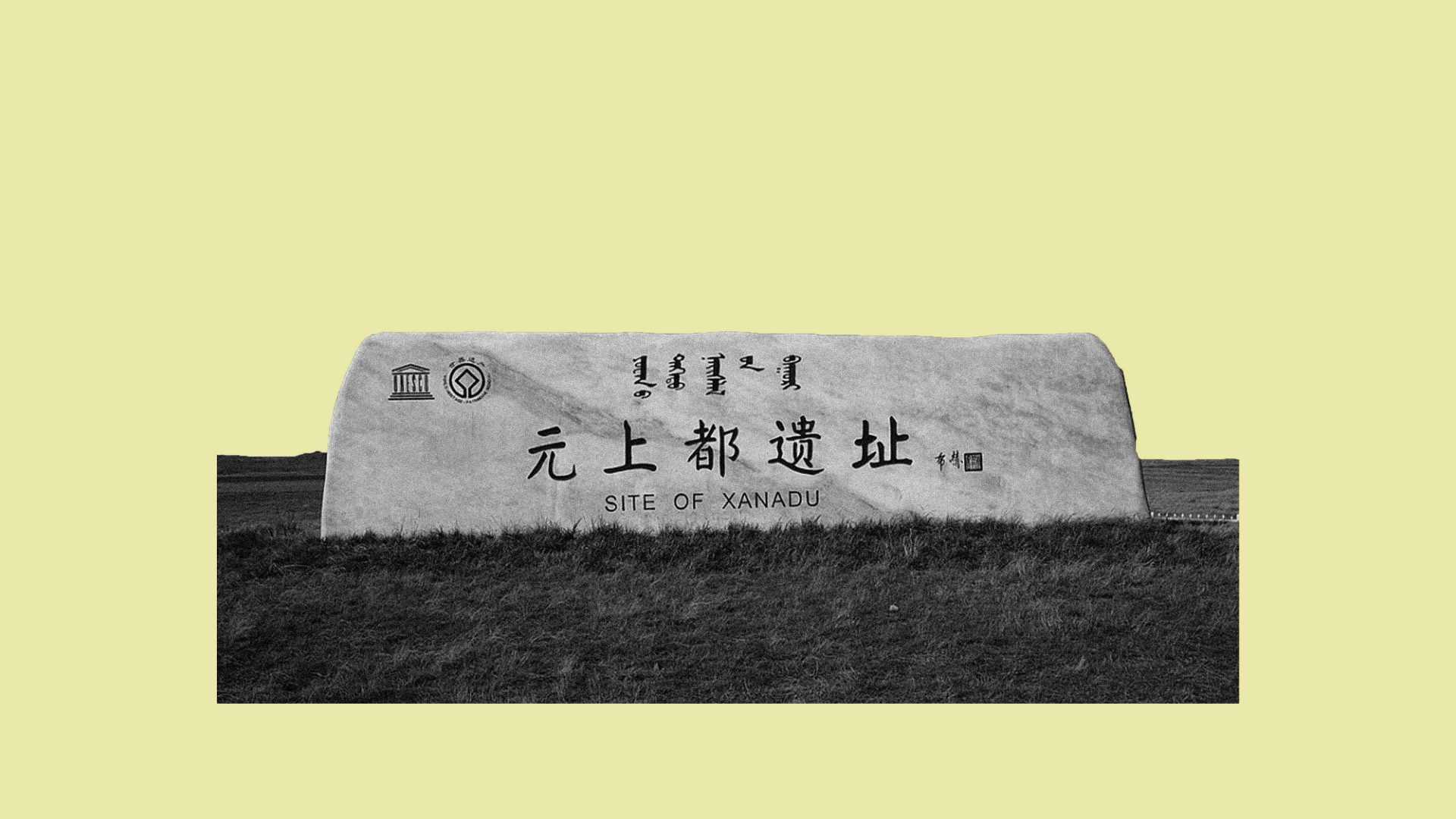
The famous poem Kubla Khan: A Vision in a Dream, which was written by the Devon-born “Lake Poet” Samuel Taylor Coleridge in 1797, begins “In Xanadu did Kubla Khan a Stately pleasure-dome decree: where Alph, the sacred river ran, Through caverns measureless to man, Down to a sunless sea.”
There is no evidence to suggest that in the territories ruled over by Kubla Khan there was ever any river, sacred or otherwise, called the Alph, although classical scholars surmise that Coleridge derived his fictional name for the river from the Greek Alpheiós, the name of the mythological river which supposedly flowed underground beneath the earth and the sea. There is today a real Greek river in the Peloponnese which goes by the same name, as well as a stream in Antarctica called the River Alph, having been given that name in 1911 by a member of Scott’s ill-fated Polar expedition because it could be seen to disappear underground for part of its length.
Nor was there ever, as far as we know, any kind of “pleasure dome”. This would appear to be the product of Coleridge’s opium-fuelled fantasy.
But Xanadu certainly was real. It was the summer capital of the Mongolian-dominated Chinese Yuan dynasty. It now goes by the name of Shàngdū, and is located in the Chinese Autonomous Region of Inner Mongolia.
“Outer Mongolia” is the independent sovereign nation now officially called Mongolia, which is bordered in the north by Russia and in the south by China.
The Emperor Kubla Khan, who was himself also a poet, was equally real. He is more usually known to English-speakers these days as Kublai Khan (1215-1294). The title Khan derives from the Turkic-Mongolian word Khagan “king, supreme ruler”.
Kublai was the grandson of the infamous Genghis Khan, also known as Chinggis Khan (1162-1227). Kublai Khan’s native tongue was Mongolian, but he knew Chinese well, and indeed wrote his poetry in a literary variety of Chinese.
His imperial court, too, was highly multilingual, also using Classical Persian, as well as the Turkic language Uighur, which in its modern version is still the language of at least 10 million Uighurs in north-western China, although the Chinese government are doing their best to repress and suppress it.
The ancient site of Xanadu was visited by Marco Polo in about 1275. Marco Polo’s mother tongue was Venetian, but he must have acquired some considerable knowledge of many languages to aid him on his travels: he journeyed not only to China but also to Turkey, Palestine, Iran, Iraq, Armenia, Georgia, Afghanistan, Uzbekistan, Tajikistan, Pakistan, Mongolia, China, Burma, India, Sri Lanka, Sumatra, and Vietnam.
The essential trade language that Marco Polo would have needed in his travels along the Silk Road would have been Persian, which he probably also used at the court of Kublai Khan. He most likely also used Mongolian and some variety of the Turkic languages. He never learnt Chinese, because foreign guests in Mongol-ruled China were routinely communicated with only in Persian or Mongolian.
After 24 years travelling, Marco Polo dictated the memoir of his journeys to the Italian writer Rustichello da Pisa, who wrote up his story in the then-contemporary variety of French that we now refer to as Old French.
Suggested Reading

Why Erling is really Haw-land, not Hah-land
Venetian
The Venetian language has a strong history of being spoken in Slovenia and Croatia as well as in the Veneto area of north-eastern Italy. The crime novels of the American author Donna Leon, such as Death at La Fenice, are set in and around Venice and contain frequent references to the Venetian language, which is the preferred tongue of her principal character, Commissario Guido Brunetti.