
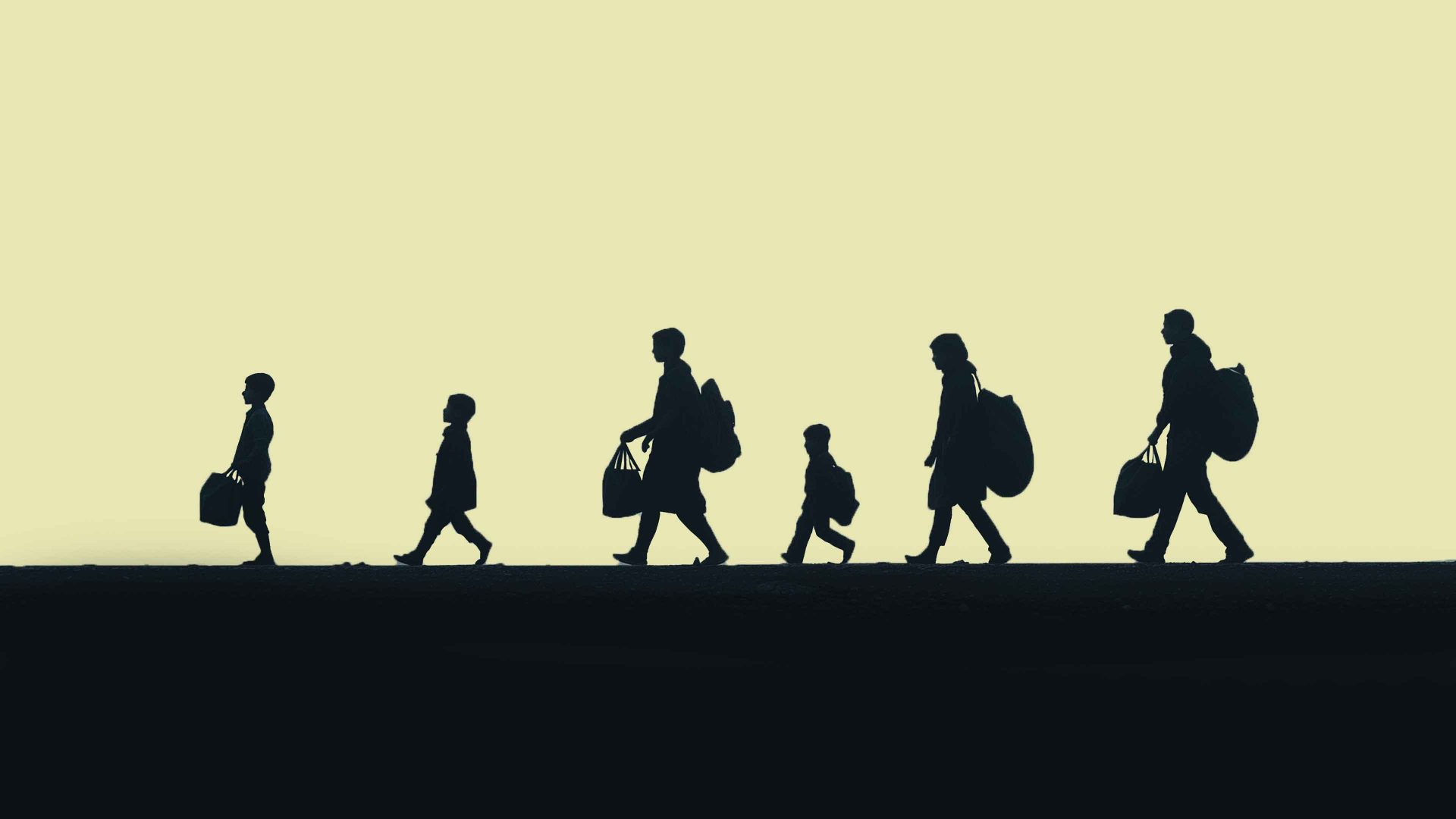
The English word refugee first appeared in print in 1628. From then until around 1916, it meant “one seeking asylum”, but the term then broadened out in meaning to include anyone fleeing from their home because of war, persecution or natural disaster.
According to the United Nations High Commissioner for Refugees, refugees are people who have been “forced to flee their own country and seek safety in another. They are unable to return to their own country because of feared persecution as a result of who they are, what they believe in or say, or because of armed conflict, violence or serious public disorder”.
Internally Displaced People displaced within their own country are often also called refugees, but they are technically speaking distinguished from those officially classed as refugees because they have not crossed any international border.
The term refugee was used initially in Britain with reference to the Protestants who fled France to escape religious persecution at the hands of the French monarchy and the Catholic establishment there. The largest exodus of these people occurred in 1685 following the Edict of Fontainebleau; this revoked the Edict of Nantes, which had previously permitted religious tolerance in France.
These Protestants were often referred to as Huguenots, a word that was perhaps derived from the German term Eidgenossen “oath brothers” or “confederates”; but there may also be a connection to the name of Besançon Hugues, who was a Protestant Genevan Calvinist leader. In France, the term came to be applied generally to Protestants because Geneva was thought of as a Calvinist centre.
The British riposte to the illiberal French revocation of the Edict of Nantes was the 1687 Declaration of Indulgence in England and Scotland (also called the Declaration for Liberty of Conscience). This was a proclamation by James II of England and Ireland and VII of Scotland which granted broad religious freedom in England by suspending penal laws enforcing conformity to the Church of England and allowing people to worship in their homes or chapels as they saw fit. But this early step towards establishing freedom of religion in Britain was cut short by the popular and basically democratic uprising known as the “Glorious Revolution” of 1688, which paradoxically and sadly also had the effect of putting an end to religious tolerance.
The noun refugee is connected linguistically with the past participle of the French verb refugier “to take refuge”, but it comes more directly from the root word refuge, from an Old French form meaning “hiding place”, referring to shelter or protection from danger or distress. Refuge is derived from Latin fugere “to flee” via refugium “a place of refuge, place to flee back to”.
The term refuge as a place of safety is used today in a variety of contexts. A women’s refuge refers to a safe, confidential, temporary type of accommodation for women and their children who are escaping from domestic abuse.
There are mountain refuges that provide basic shelter for hikers. A pedestrian refuge or traffic island is a safe waiting place in a carriageway for people crossing a road on foot. And a wildlife refuge is a managed conservation area which provides protection for endangered wildlife, plants and habitats.
Suggested Reading
Why did we call her the Queen – not Queen’s – Mother?
Refugium
During the last Ice Age, the only area of western Europe where human habitation remained possible was the Franco-Cantabrian Refugium, an area which was not covered by ice stretching from the Asturias region of northern Spain into Provence in southern France. As the Ice Age ended, there was a gradual repopulation of Europe out of that refuge as people followed the receding ice north.