
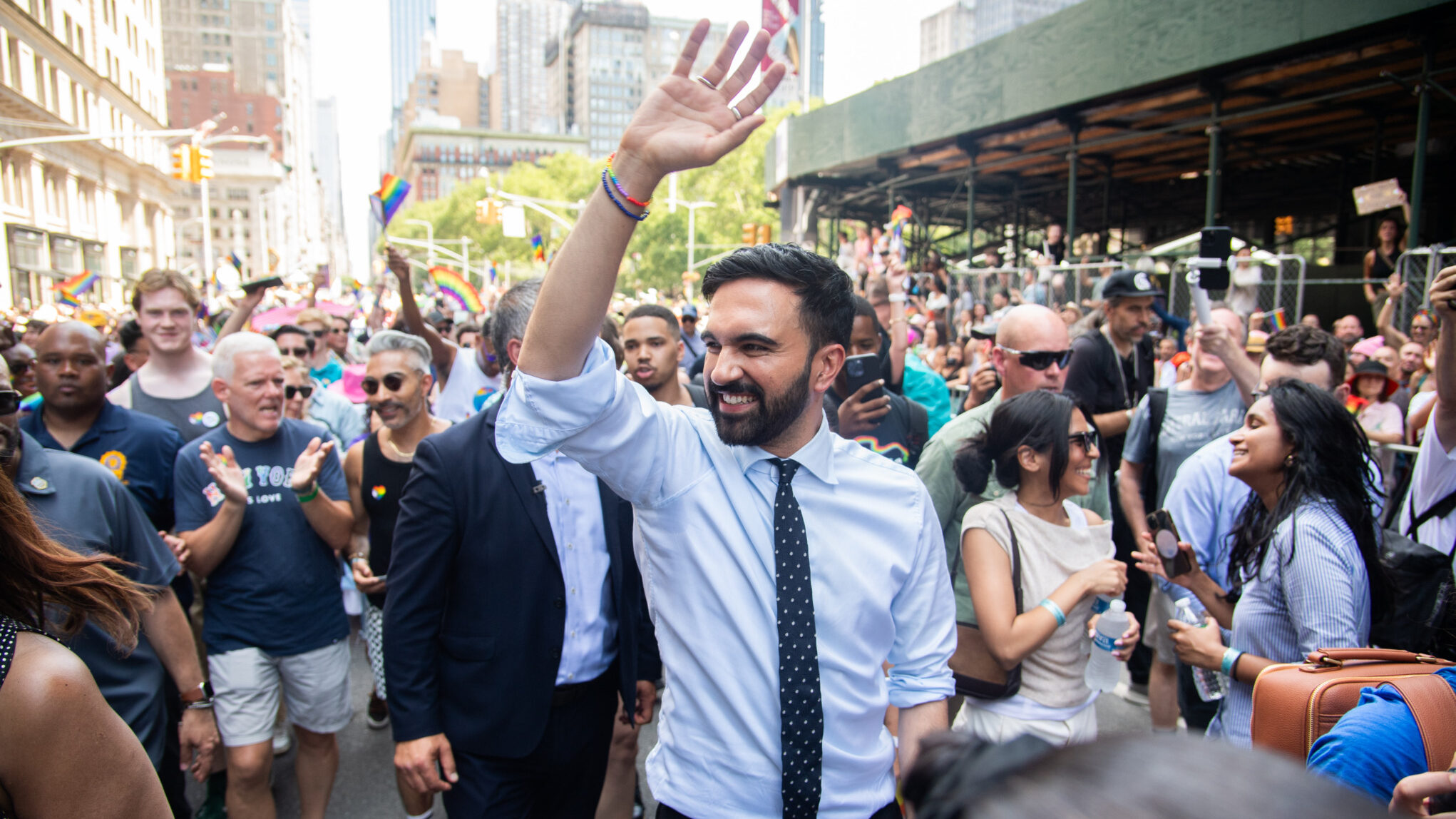
The US elections of November 3 were not only important for the collapse of the Republican vote: 59 of the lawmakers elected were backed by the Democratic Socialists of America, a pressure group within the Democratic Party whose politics stand well to the left of Labour here.
It’s a surge mirrored in the popular mood. A PRRI/Gallup poll in September found that 43% believe capitalism is no longer working for ordinary Americans. A YouGov poll right after the elections found that 32% of registered voters viewed socialism positively.
The demographic breakdowns of the November 3 result show that, though they make up just 11% of the electoral roll, 66% of voters under the age of 30 went Democrat, with iconic socialist radicals like Bernie Sanders, Alexandria Ocasio-Cortez and Zohran Mamdani cited as the inspiration.
The blue surge and its socialist component pose a question few Boomers thought they would ever seriously be required to consider: what would socialism look like in the USA?
For much of the post-1945 period, the possibility of socialism in America has been chimeric. The white working class were bound to capitalism through a mixture of upward mobility and racism. During the cold war, politics to the left of liberalism were anathema. And networked individualism – the Bowling Alone of Robert D Putnam’s book – did the rest.
But there was a lively tradition of American socialism in the 19th century, drawing on the radicalism imported by two waves of German refugees.
Suggested Reading

The three Cs that can keep Democrats winning
In 1886, the socialistic Labor Party of the USA backed the populist firebrand Henry George for New York mayor, sidelining Marxism in favour of a land tax to abolish rent. Probably the high point of this organic American socialist tradition – before its collision with Bolshevism and destruction through repression in the 1920s – was the foundation of the “Wobblies” – the anarchist-inspired grass roots union movement that flourished in the first two decades of the 20th century.
After that – for just short of 100 years – American capitalism was too strong for an authentic social democracy to become a rational choice for voters, let alone anything more radical. As the sociologist Werner Sombart argued, American wages gave access to “roast beef and apple pie”, the two-party system obliged them to play the game of patronage, and upward mobility was real.
As the apple pie runs out, as the two-party system fails to deliver even to its most loyal working class co-optees, and social mobility stalls, there’s a historical lawfulness to the resurgence of socialist ideas and projects in the USA.
It’s not just that, since 2008, the western economic model has been in trouble. It’s that liberalism has proved incapable either of finding a solution, or of combating the monsters the crisis is producing.
The abysmal Harris candidacy in 2024, following the increasingly dire presidency of Joe Biden, will stand as a monument to liberal centrism’s failures.
And even as liberalism is revived by avatars such as Senator Jon Ossoff of Georgia, who is looking and sounding like a reborn and radicalised Kennedy, the scale of the global crisis is going to demand alignment with the left wing aspirations of younger voters.
But as left wing US Democrats reach for a mixture of class rhetoric and redistributive policies, they face the same problems as those of us on the social democratic left in Europe. As chancellor John Healey said at Labour’s conference: “There’s no social democracy without growth. You can’t have the end without the means.”
Yet growth is stagnant across the globe, populations are ageing and getting sicker, and if artificial intelligence begins to massacre entry-level jobs – from the retail distribution centre to the law firm – socialism itself becomes a series of hard choices, as Labour MPs are about to find out.
The essential problem for American socialism is that there is no welfare state. For us, in Europe, welfare states provide a social safety net that no party, however right wing, could rip away, short of conditions of authoritarian rule.
The networked left may fantasise about the provision of a Universal Basic Income, with the figure of £12,000 – the equivalent of the state pension – achieved maybe within decades. But the entire package of benefits, pensions and free public services in the UK is worth around £40,000 for every citizen.
And it is that ineradicable platform that allows “politics” in the UK to be a civilised battle over relatively small adjustments to redistribution.
Suggested Reading


Who will deal the final death blow to the MAGA era?
In the USA, by contrast, any attempt to enact a mild social democratic solution to inequality, corruption and unfreedom is going to feel like a revolution; and the reaction to it is going to feel like a civil war. That does not mean I am against it, or think it impossible. It’s just a bigger deal.
For this reason, throughout my entire engagement with American socialism, I have found it prone to unrealism. There’s a brilliant illustration of this in the new book The Blueprint, by Mike Beggs, Ben Burgis and Bhaskar Sunkara – authors associated with Jacobin magazine.
They want, basically, a redistributive state capitalism, with the central bank as the planning mechanism, worker-owned firms, publicly owned housing with fair rents, a minimum wage and competition between firms ensuring Pareto efficiency.
What I like about The Blueprint is that it explicitly disavows the “USSR with democracy” fantasy nurtured by self-declared Marxist nostalgics. Even better, it rejects the “Modern Monetary Theory” peddled by those on the US left who believe you can print your way to social justice.
But despite its realism – the authors are immersed in mid-20th-century theories of market socialism – the system outlined in The Blueprint begs the same question as its more extreme counterparts: how do we get there?
Not until you get to that first base should you call yourself either a socialist or social democrat politician. British social democracy may be an intellectual mess, but it produces results because of its relentless realism.
The NHS, the Open University, the minimum wage, the Human Rights and Climate Change Acts are not just Labour “achievements”. They act like pitons in a rock face for the generations who climb behind those who created them. And they were designed as such: Nye Bevan, Barbara Castle, Gordon Brown and Tony Blair understood that one irrevocable thing achieved now is worth a thousand books about the future.


When I look at the achievements of Zohran Mamdani as mayor of New York City, it is their practicality that resonates: a rent freeze, free bus fares, a minimum wage of $30 an hour by 2030 and free childcare to the age of five. Even if the movement around Mamdani is full of people who think The Blueprint is reformist trash, his achievements are what matter to the working people of NYC.
Eduard Bernstein, the intellectual founder of modern social democracy, was excoriated for writing that the “end” of socialism means nothing but the “way” means everything. In self-defence, he explained, citing Marx, that all socialist blueprints run the risk of utopianism, getting in the way of the practical struggle for better outcomes in the here and now.
But at the same time, such utopias sustain people. That is the paradox of socialism throughout its 250-year history in the west. As they approach the presidential elections of 2028, I would advise American socialists to think less about blueprints that could only be achieved through civil war, and more about delivering what Mamdani – who even now has progressed only 24 out of 100 electoral pledges – is trying to do.